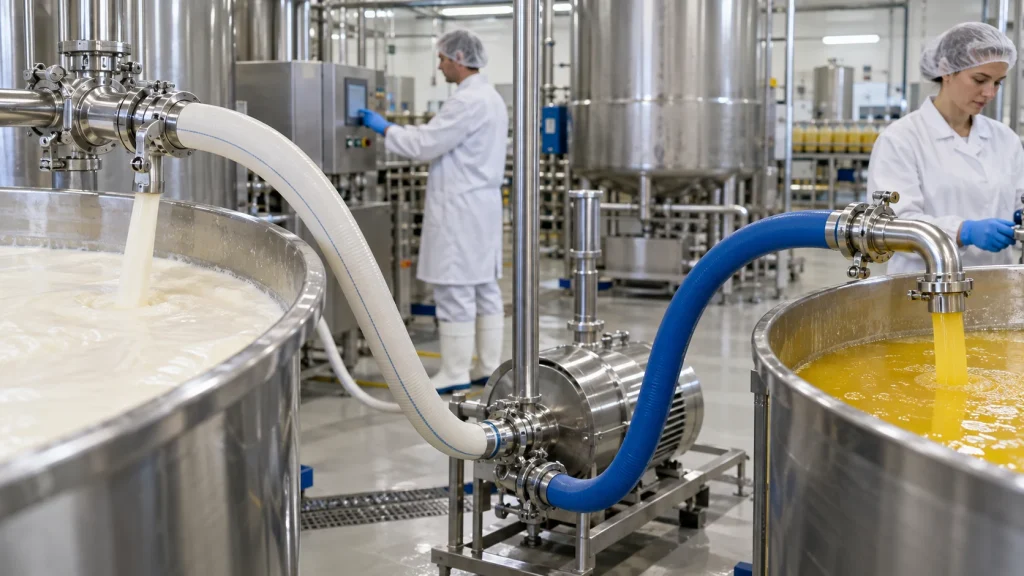
The right food hose depends on the product formulation, not only on the words “food grade.” Oils, butter, cream, dairy mixtures, juice, beer, water-based ingredients, and cleaning fluids can place different demands on the tube, hose construction, fittings, and cleaning method. A hose selected for a low-fat beverage may not be the correct choice for an oily product, while a hose suitable for fatty media can be unnecessary for a simple water-based transfer.
This guide explains how to compare food hoses for fatty and non-fatty products and how to turn that comparison into a usable specification for plants in the Middle East, Russia, Europe, and South America. Product compatibility must still be confirmed against the current technical document, the actual recipe, temperature, pressure, cleaning cycle, and local food-contact requirements.
What Makes Fatty and Non-Fatty Service Different?
“Fatty” describes a service in which animal fats, vegetable oils, dairy fat, butter, cream, or an oily formulation can contact the hose tube. “Non-fatty” is a useful working category for water-based beverages and ingredients with little or no oil content, but it is not a universal chemical classification. A product can change category when its recipe, concentration, temperature, or cleaning chemistry changes.
The first selection question is therefore: what will touch the tube, at what temperature, for how long, and under what flow or vacuum condition? Ask for the complete product list instead of relying on a single name such as “milk” or “juice.” Whole milk, skim milk, flavored dairy, edible oil, and a beverage line may require different confirmation even when they share the same nominal diameter.
Why Fatty Products Need Specific Compatibility Checks
Oily and fatty products can interact with hose materials differently from water-based products. The practical risk is not limited to visible leakage. A material that is not suitable for the actual fat or oil may soften, swell, lose mechanical stability, retain residue, or become difficult to clean. The result can be product contamination, odor carryover, shortened service life, or an unplanned shutdown.
For an edible-oil, dairy-fat, or mixed-food line, include the exact medium, concentration, temperature range, contact time, flow direction, and cleaning chemicals in the RFQ. State whether the hose will see suction, discharge pressure, or both. If the process uses hot oil, warm CIP fluid, or repeated thermal cycles, request the pressure and temperature limits for that complete duty rather than a general food-contact statement.
SOMAXFLEX lists a separate Food Suction Hose for Fatty Foods product with 10 bar working pressure and 30 bar burst pressure in the displayed table. It shows sizes from 1/2 to 6 inches, with maximum lengths that vary by size. Treat those values as the specification of that listed model, not as a rating for every food hose or every fatty product.
When a Non-Fatty Food Hose Is the Better Fit
Non-fatty service commonly includes water-based beverages, juice, beer, low-fat ingredients, and similar products, but the hose must still be selected for hygiene, pressure, temperature, cleaning, and flow. A non-fatty label does not remove the need to confirm the tube material, odor and taste requirements, internal surface, bend radius, and connection method.
A non-fatty transfer line may be easier to clean than an oily line, yet the actual cleaning cycle can be more severe. Hot water, alkaline detergents, sanitizers, or steam exposure can affect the hose differently from the product itself. Document both the product and the cleaning regime. If the hose alternates between fatty and non-fatty products, select for the most demanding confirmed exposure or use a documented changeover procedure.
SOMAXFLEX also lists a Food Suction Hose for Non-Fatty Foods model with 10 bar working pressure, 30 bar burst pressure, and the same displayed size family. Similar pressure figures do not make the two models interchangeable: product compatibility, cleaning, temperature, and the complete assembly remain decisive.
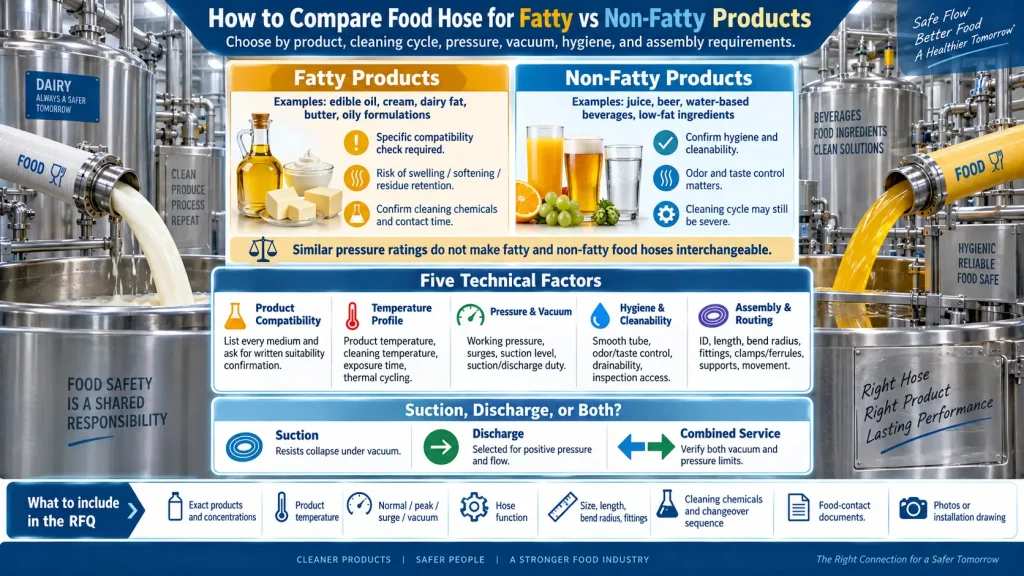
Compare the Hose on Five Technical Factors
Use the following comparison when reviewing a food hose quotation or replacement request:
– Product compatibility: list every fatty, non-fatty, acidic, alcoholic, or flavored medium and ask for written suitability confirmation.
– Temperature profile: record product temperature, ambient temperature, cleaning temperature, exposure time, and thermal cycling.
– Pressure and vacuum: state working pressure, pump or line surges, suction level, and whether the hose must handle both suction and discharge.
– Hygiene and cleanability: confirm the tube description, internal smoothness, odor and taste expectations, cleaning agents, drainability, and inspection access.
– Assembly and routing: specify inside diameter, length, bend radius, end connections, clamps or ferrules, supports, and any movement or lifting load.
These factors should be evaluated together. A food-contact tube that tolerates the product may still be unsuitable as an assembly if the fittings, gasket, support, pressure rating, or bend radius is wrong.
Suction, Discharge, or Both?
A suction hose normally needs construction that resists collapse under vacuum, while a discharge hose is selected around positive pressure and flow. A tanker unloading line, transfer pump, blending skid, and filling line may use different hose duties even when they handle the same food. Mark the direction of flow and the pressure source on the drawing or RFQ.
SOMAXFLEX’s general Food Delivery Hose specification describes food-grade tube options for products including milk, juice, beer, edible oil, and dairy products, and lists a temperature range of -32°C to 80°C on that page. It also describes a food-grade nitrile tube for oily transfer applications. Use these statements as product-page information, then confirm the exact model, recipe, cleaning method, and local documentation before purchase.
Do not select a hose solely because its nominal pressure matches the pump. Include vacuum, surge, temperature derating, fitting limits, and the weakest component in the complete assembly. If the product is viscous or contains solids, verify the required inside diameter and minimum bend radius so the hose does not become a restriction or a cleaning problem.
Cleaning and Changeover Controls
Fatty residues can be harder to remove than water-based residues, but cleaning intensity must be determined by the plant process. Define the cleaning sequence, chemical concentration, temperature, contact time, flushing direction, and drying method. Confirm that the hose should be drained between batches and that cleaning fluid cannot remain trapped behind a fitting or in a low point.
For a line that alternates between fatty and non-fatty products, use a controlled changeover record. Identify the previous product, cleaning verification, rinse condition, hose status, and release decision. Do not assume that a visual check alone proves the absence of residue. If odor, color, swelling, tackiness, or repeated cleaning failures appear, quarantine the assembly and request a technical review.
Regional Procurement and Documentation
Food plants across the target markets may use different customer specifications, language requirements, and food-contact documentation. Ask the supplier for the current data sheet, material description, pressure and temperature limits, size table, fitting details, cleaning guidance, and any food-contact declarations applicable to the destination and product. Do not copy a certification or approval from a different model, size, or market without verification.
SOMAXFLEX presents itself as an industrial rubber hose manufacturer with more than 30 years of experience and an export-oriented product range in its company information. That context can support supplier evaluation, but the decision between fatty and non-fatty service still rests on the confirmed medium, construction, assembly, and plant procedure. Send the completed application data to the SOMAXFLEX technical contact team when requesting a fit check or quotation.
A Practical Selection Checklist
Before releasing a purchase order, confirm that the record includes:
– the exact fatty and non-fatty products, concentrations, and product temperature;
– normal, peak, surge, and vacuum conditions;
– hose function: suction, discharge, or combined service;
– inside diameter, length, bend radius, fittings, clamps, supports, and movement;
– cleaning chemicals, temperature, contact time, and changeover sequence;
– food-contact documents required by the end user and destination market;
– inspection, replacement, storage, and traceability requirements; and
– photographs or drawings showing the installation and connection orientation.
For a replacement, add the failed hose model, service hours, failure location, photographs, and any evidence of swelling, odor, residue retention, abrasion, leakage, or coupling damage. This record helps determine whether a like-for-like model is appropriate or whether the fatty/non-fatty duty, cleaning cycle, or assembly needs to change.
Conclusione
Choosing a food hose for fatty versus non-fatty products is a compatibility decision, not a color or catalogue-label decision. Start with the actual recipe and cleaning cycle, then verify tube suitability, temperature, pressure, vacuum, hygiene, fittings, and routing. Use the listed SOMAXFLEX fatty and non-fatty models as product-specific references, and obtain a written fit check whenever the product, process, or destination requirements are uncertain.
FAQ
Can one food hose handle both fatty and non-fatty products?
Sometimes, but only when the exact hose construction and cleaning procedure are confirmed for both services. Similar pressure ratings do not prove material compatibility or cleanability.
Is a food-grade hose automatically suitable for edible oil?
No. Food-contact suitability and resistance to a particular oil or fat are separate checks. Confirm the actual product, temperature, exposure time, and tube material with the supplier.
Should fatty food transfer use a suction or discharge hose?
Choose according to the system duty. Tank unloading may require suction and discharge capability, while a pump outlet may need a discharge assembly. State vacuum and positive pressure separately.
What information should be sent for a food hose quotation?
Provide the product list, fatty or non-fatty classification, concentration, temperature, pressure, vacuum, flow, cleaning cycle, size, length, fittings, quantity, destination market, and an installation drawing or photograph.