
Before winter arrives, inspect every steam hose as a pressure-and-temperature assembly, not just as a length of rubber. Cold storage, freezing condensate, thermal cycling, outdoor exposure, and a long shutdown can reveal weaknesses that are easy to miss during a hot production shift. This steam hose inspection checklist gives maintenance and procurement teams a repeatable review for plants in Russia, Europe, South America, and seasonal or outdoor facilities in the Middle East.
The checklist is a field guide, not a substitute for the hose manufacturer’s current specification or the site’s safety procedure. Isolate, depressurize, cool, and drain the line before handling it. When a finding affects pressure containment, remove the hose from service until a qualified person decides whether it can be repaired, tested, or replaced.
Confirm the Hose Identity and Service History
Start with the information that prevents a wrong replacement. Record the hose tag, model or product code, inside diameter, length, end fittings, installation location, and date placed in service. Photograph the markings before cleaning them. Compare the marking with the approved purchase record and current data sheet; a similar-looking hose may be designed for hot water, air, or a different steam duty.
Write down the actual service conditions: steam or condensate, normal and peak pressure, temperature, operating hours, startup and shutdown frequency, cleaning chemicals, and any pressure surge. Include whether the hose is exposed to direct weather, radiant heat, salt air, dust, or vehicle traffic. A history of leakage, coupling movement, unusual vibration, or water hammer should trigger a more detailed engineering review.
Inspect the Tube, Cover, and Reinforcement
Clean enough of the outer cover to see its condition, then inspect the entire length under good lighting. Do not rely on a quick glance at the ends; damage often develops where the hose rubs against a frame or rests near a hot surface.
– Look for cuts, cracks, hardening, soft spots, blisters, swelling, exposed reinforcement, burns, flattening, and unusual discoloration.
– Trace abrasion patterns and check whether a clamp, bracket, floor edge, or neighboring pipe is wearing the cover.
– Flex only an isolated, cooled hose gently enough to reveal stiffness or surface cracking; do not bend a pressurized hose for inspection.
– Treat steam odor, visible leakage, steam marks, or a wet spot under insulation as a containment concern, not as a cosmetic defect.
If the cover is brittle after a cold soak, note the ambient temperature and allow the assembly to reach the manufacturer’s permitted handling condition before moving it. Never use heat, solvents, or makeshift patches to hide a defect. The tube and reinforcement can be damaged even when the outer cover looks acceptable.
Check Couplings, Clamps, and Restraints
Winter inspections should include every connection because a sound hose can still fail at an incorrectly assembled end. Check ferrules, clamps, flanges, threaded adapters, gaskets, bolts, and swivel components for corrosion, distortion, slippage, or steam staining. Confirm that the connection type and size match the hose record and the equipment nozzle.
– Verify that clamps or ferrules are not cutting into the cover and that no fitting has rotated relative to the hose.
– Check whip checks, safety cables, supports, and restraints for correct attachment, slack, corrosion, and load path.
– Look for sharp bends immediately behind the coupling; this area needs a supported transition, not a forced alignment.
– Replace damaged gaskets and hardware according to the site procedure rather than reusing components with unknown history.
Do not tighten a fitting on a live or hot line. If a coupling has moved, isolate the system and investigate the cause, which may be vibration, torsion, thermal movement, or an assembly error.
Verify Pressure, Temperature, and Phase
Compare the hose marking and data sheet with the highest confirmed winter operating condition. Record working pressure, not burst pressure, and include startup surges or trapped pressure. Record continuous and peak temperature, including the temperature of condensate during cooldown. If a process can alternate between saturated steam and hot water, verify that the selected model is approved for both conditions.
SOMAXFLEX lists a Steam Hose 7 BAR model with 7 bar working pressure, 70 bar burst pressure, four shown sizes from 1/2 to 1 inch, and a maximum length of 61 m (200 ft). These are model-level values, not a universal rating. Use the current Steam Hose 7 BAR specification to identify the exact product, then confirm temperature, assembly, and service limitations before approval.
Never infer a pressure or temperature limit from hose color, a catalogue category, or a nearby product. The site also lists a separate steam hose product category; use it to review the available family, but select by the documented model and operating envelope.
Review Routing, Bend Radius, and Cold-Weather Movement
Measure the installed route against the manufacturer’s minimum bend radius and check for kinks, twist, compression, or unsupported vertical weight. Cold rubber may become less flexible, while a heated hose expands and changes position. Those two conditions can load the fittings differently during a winter startup.
– Confirm that the hose is supported without being pinched and that supports do not create a new abrasion point.
– Allow the assembly to move in its intended direction; do not use it to compensate for misaligned fixed piping.
– Keep it clear of sharp edges, hot equipment, snow or ice accumulation, standing water, and traffic routes.
– Inspect low points and vertical rises where condensate can collect and freeze during a shutdown.
For Russian and northern European sites, document the minimum storage and handling temperature specified for the exact hose, and protect drains and low points from freezing. In South America, winter conditions vary widely, so use the site’s measured ambient exposure rather than a regional assumption. Middle Eastern plants may have mild winters but still face large day-night swings, outdoor storage, and thermal exposure near boilers.
Drain Condensate and Prepare for Shutdown
A winter checklist is incomplete until the fluid path is addressed. Follow the plant isolation procedure, close the correct valves, and drain condensate from designed low points. Confirm that drains discharge safely and that trapped water cannot remain between closed valves, fittings, or a sagging hose. Freezing water can expand and damage a hose or coupling before the next startup.
After draining, protect open ends from dirt and moisture without sealing in residual water. Store a removed hose straight enough to avoid permanent kinks, away from sunlight, ozone sources, heat, oils, and chemicals, and within the manufacturer’s stated storage conditions. Mark any hose with unknown service history so it cannot be returned to stock as a verified spare.
Decide: Return to Service, Test, or Replace
Classify every finding before the seasonal restart. A minor surface mark may be recorded for monitoring, but a crack, blister, exposed reinforcement, damaged coupling, missing restraint, severe hardening, leakage path, unreadable identification, or unknown pressure history should move the hose to a controlled hold area. Do not extend service simply because the hose passed a visual check last season.
If a pressure test is required, use the site’s approved method, trained personnel, controlled exclusion zone, and the manufacturer’s test instructions. A test is not permission to exceed the rated working pressure or to operate a hose with a known defect. Record the test date, medium, pressure, duration, result, tester, and any limitations in the maintenance file.
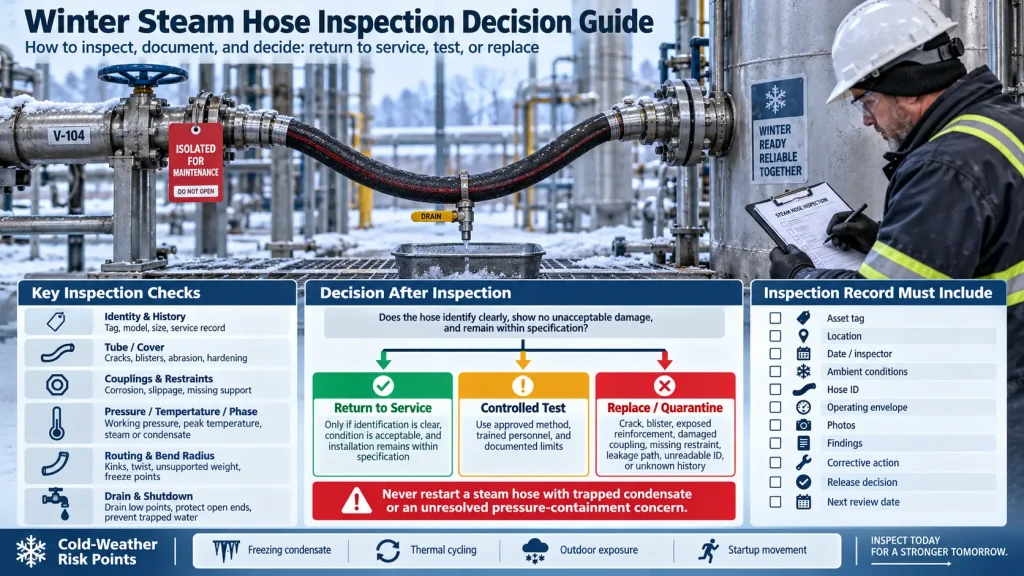
Record the Winter Inspection
Use one inspection record for each assembly. Include asset tag, location, date, inspector, ambient conditions, hose identification, operating envelope, photographs, findings, corrective action, and release decision. Add the next review date and the person responsible for closing an open action. A consistent record helps teams compare wear across Middle Eastern, Russian, European, and South American sites without assuming that climate alone predicts hose life.
For procurement, keep the inspection record with the replacement request. SOMAXFLEX describes more than 30 years of industrial rubber hose manufacturing experience and an export-oriented product range in its company information. That background can support a technical discussion, but the replacement still depends on the confirmed model, size, pressure, temperature, phase, fittings, routing, and winter exposure. Share those details with the SOMAXFLEX technical contact team when a fit check or quotation is needed.
Conclusione
The most useful steam hose inspection checklist before winter connects visible condition with the operating record. Confirm identity, inspect the tube and cover, check couplings and restraints, verify pressure and temperature, review routing and bend radius, drain condensate, control storage, and document the release decision. This sequence helps maintenance teams find cold-weather risks before heat and pressure return to the line.
FAQ
How often should a steam hose be inspected before winter?
At minimum, inspect before seasonal startup and after any shutdown, relocation, abnormal pressure event, leak, or visible damage. The site risk assessment and manufacturer instructions should determine the recurring interval.
Can a steam hose be stored outside during winter?
Only when the exact product documentation permits it and the hose is protected from moisture, sunlight, ozone, chemicals, traffic, and temperature extremes. Indoor, controlled storage is preferable when available.
What is the most important cold-weather check?
Check for trapped condensate and confirm the hose’s permitted storage and handling temperature. Also inspect for hardening, cracking, and movement that can load the couplings during startup.
When should a steam hose be replaced instead of tested?
Replace or quarantine it when the cover, tube, reinforcement, coupling, restraint, or identification is damaged or when service history is unknown. Testing cannot make a visibly compromised assembly safe.