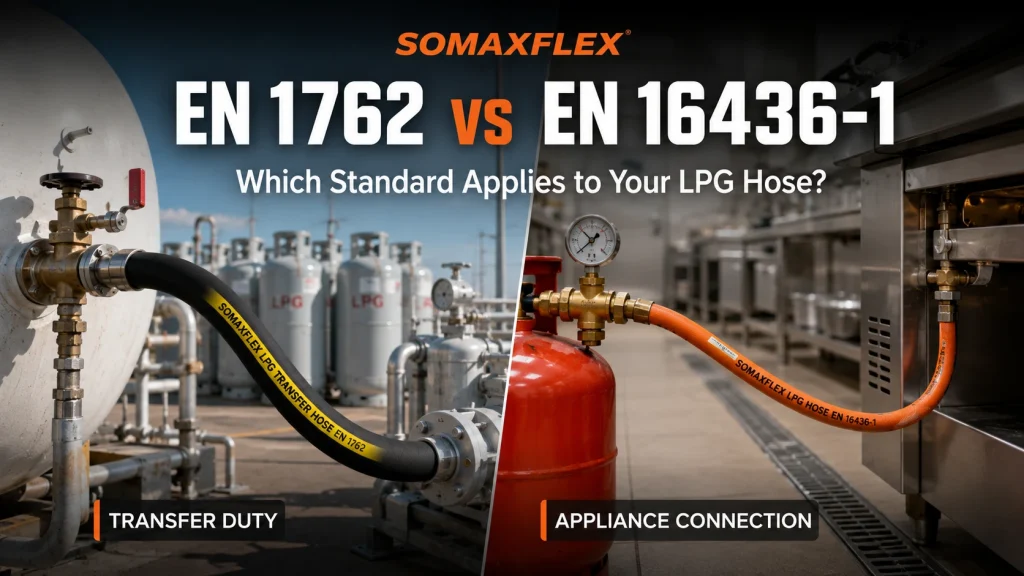
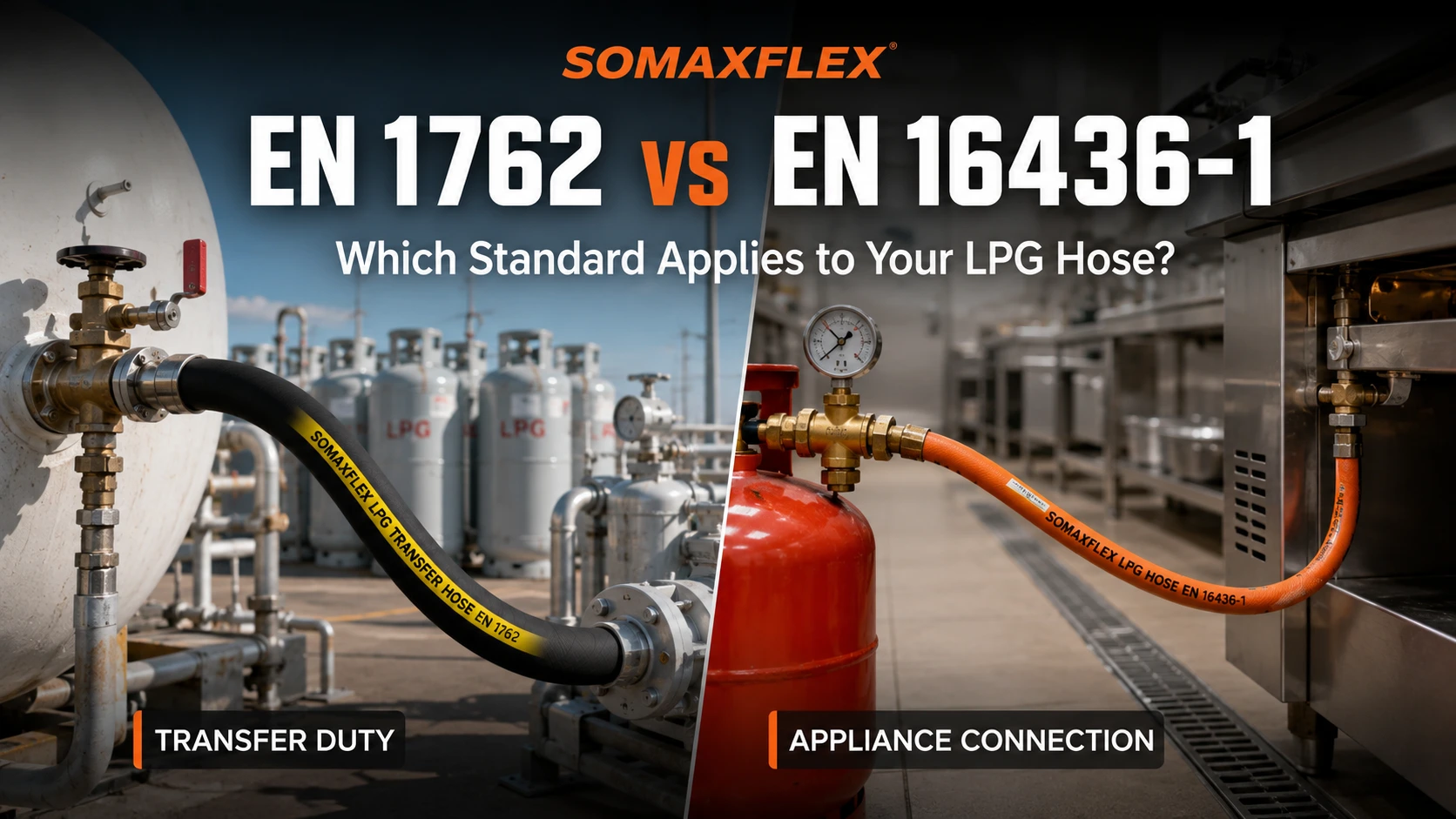
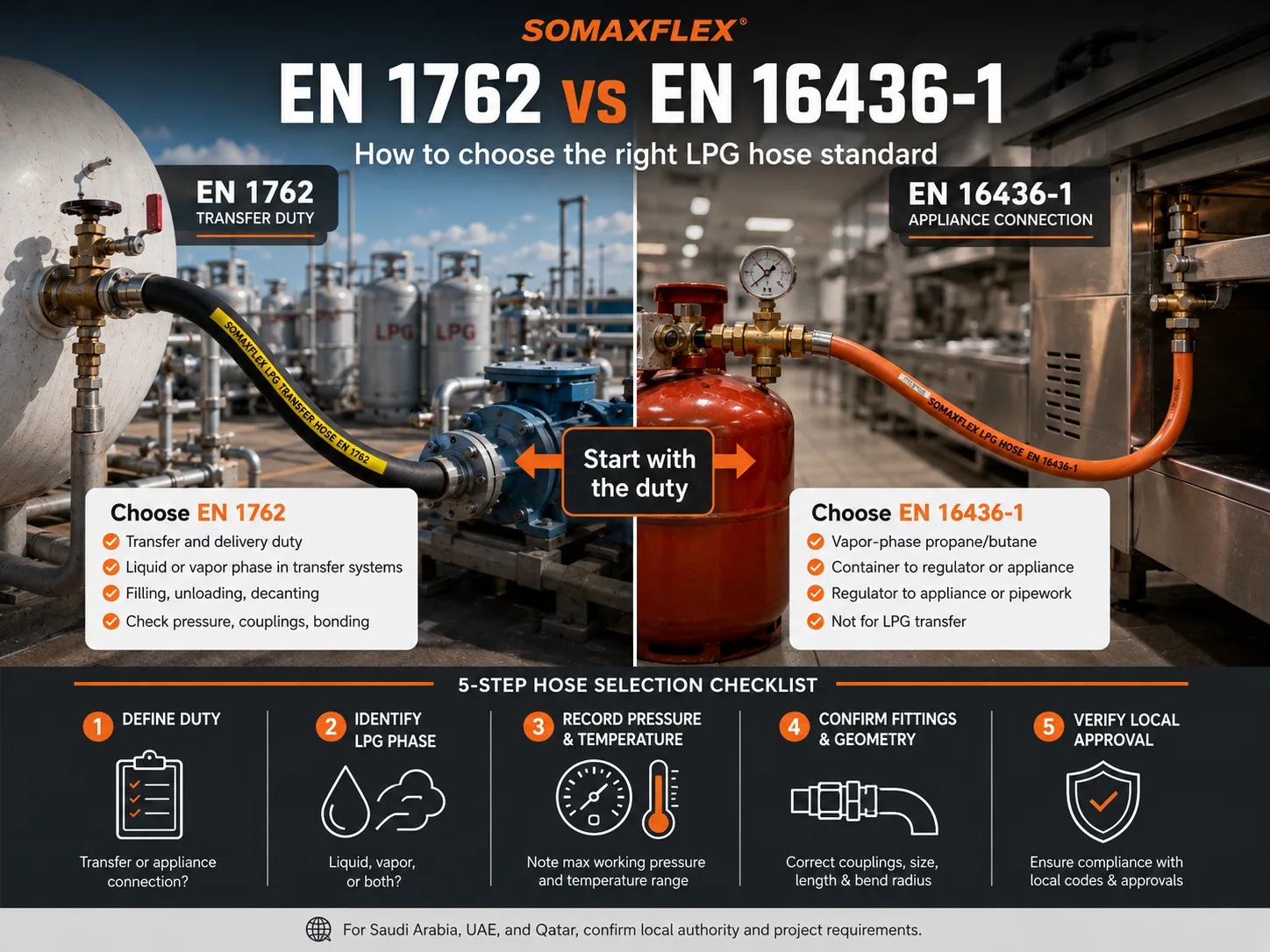
The correct LPG hose standard depends on what the hose is doing at the point of use. EN 1762 is associated with LPG transfer and delivery hose assemblies, including service in liquid or vapor phase where the hose forms part of a transfer system. EN 16436-1 addresses rubber and plastic hoses or tubing for commercial propane, commercial butane, and their mixtures in the vapor phase, typically between a container, regulator, appliance, or installation pipework. The standards are not interchangeable. For projects in Saudi Arabia, the UAE, and Qatar, use this functional distinction first, then check the authority, code, and project specification that govern the installation.
The Short Answer: Transfer or Appliance Connection?
Ask one question before comparing pressure ratings or colors: is the hose transferring LPG, or is it connecting a gas container to equipment? If the answer is transfer, EN 1762 is the relevant starting point. If the hose carries vapor-phase propane or butane from a cylinder or container to a regulating device, appliance, or installation pipework, EN 16436-1 is usually the more relevant starting point. A final selection still requires a product specification and local approval review.
- EN 1762: delivery, loading, unloading, or other LPG transfer duties; products may be designed for liquid or gaseous LPG service.
- EN 16436-1: flexible hose or tubing for vapor-phase commercial propane, butane, and mixtures in connections around containers, regulators, appliances, and pipework.
- Neither label alone confirms suitability for welding, vehicle propulsion, chemical service, or every pressure and temperature condition.
What EN 1762 Covers in Practical Terms
EN 1762 is used for rubber hoses and hose assemblies that move LPG between fixed or mobile equipment. Typical duties include filling, decanting, cylinder or tanker transfer, and industrial delivery. Because transfer can involve liquid LPG, flashing vapor, pump or compressor surge, and movement at the connection point, the hose assembly must be selected as a complete pressure component. Inside diameter, working pressure, bend radius, coupling retention, electrical continuity, and grounding arrangements should be checked together.
Somaxflex lists a dedicated delivery hose for LPG to EN 1762. The published construction uses a smooth conductive NBR tube, high-strength synthetic reinforcement, and a fire-proof, antistatic CR cover resistant to oil, abrasion, and weathering. The listed temperature range is -22°F to +158°F. These are product-specific facts; the buyer should still match the exact size, assembly, and duty to the transfer system.
What EN 16436-1 Covers in Practical Terms
EN 16436-1 is aimed at vapor-phase propane and butane connections rather than LPG transfer operations. Its use cases include container to regulator, container to appliance, regulator to appliance, and regulator to installation pipework. This makes it common in commercial kitchens, catering equipment, cylinder installations, temporary facilities, and other gas supply arrangements where the hose delivers vapor to a burner or appliance.
Somaxflex shows a 10 bar orange propane/butane hose to EN 16436-1:2014. The page identifies vapor-phase commercial propane, butane, and mixtures; a black smooth NBR tube; textile spiral reinforcement; an orange EPDM cover; a -30°C to +70°C temperature range; and a 3:1 safety factor. It also expressly excludes welding, propulsion, and LPG transfer purposes. That exclusion is the key boundary: a vapor appliance hose should not be repurposed as a transfer hose.
Why the Standards Must Not Be Swapped
A hose can look mechanically similar while facing a different hazard profile. Transfer service may expose the assembly to liquid LPG, rapid phase change, high flow, repeated coupling movement, and pumping forces. Appliance service normally focuses on controlled vapor delivery, routing near equipment, bend limits, and secure end connections. Choosing the wrong standard can create a mismatch in phase, connection design, pressure behavior, permeation control, or approval documentation.
The reverse mistake is also common: specifying a transfer hose for a small appliance connection can introduce unnecessary size, stiffness, or installation complications. Standard selection should follow the system boundary, not a preferred color, nominal pressure, or a familiar catalog name.
A Selection Checklist for Saudi Arabia, the UAE, and Qatar
The three markets share hot climates and extensive LPG use, but they do not automatically share one approval path. Local civil-defense requirements, gas authority rules, utility standards, client specifications, and conformity documentation may add requirements. Treat EN 1762 or EN 16436-1 as the technical starting point and confirm the governing documents for the project location.
- Define the phase and duty. Record liquid transfer, vapor supply, filling, unloading, cylinder changeover, appliance connection, or pipework connection.
- Record operating conditions. Include normal and peak pressure, pressure surges, ambient and gas temperature, sunlight, salt or dust exposure, and any pumping or movement.
- Confirm geometry. Specify inside diameter, length, bend radius, end fittings, thread or flange interface, swivel needs, support, and hose restraints.
- Check the assembly, not only the hose tube. Verify coupling compatibility, crimp or fitting method, electrical bonding, leak testing, marking, and traceability.
- Request project documents. Ask the supplier for the applicable standard edition, test evidence, declaration or certificate where required, product data sheet, and installation limits.
Climate and Installation Considerations in the Gulf
Saudi, Emirati, and Qatari sites can combine high ambient heat, intense solar loading, dust, and frequent outdoor handling. A published temperature range is not a blanket approval for every exposed installation. Check whether the hose is shaded, ventilated, dragged, kinked, or installed near hot equipment. Protect assemblies from sharp edges and vehicle traffic, maintain the specified bend radius, and prevent torsion at the coupling. For transfer systems, provide suitable restraint and bonding so a pressurized hose cannot whip or lose continuity.
Inspection should be scheduled around the real duty. Look for cuts, blistering, flattening, cover cracking, exposed reinforcement, chemical swelling, damaged threads, and loose fittings. Remove a hose from service when its history, marking, or assembly integrity is uncertain. A standards mark does not replace leak checks, pressure tests where required, or a documented hose-management plan.
How to Buy the Right LPG Hose
Start an RFQ with the service description rather than only “LPG hose.” State the standard under consideration, LPG phase, connection points, pressure, temperature, nominal bore, length, fittings, movement, quantity, and intended country of installation. Include drawings or photographs of the connection when interfaces are unusual. This lets a supplier separate an EN 1762 transfer assembly from an EN 16436-1 appliance hose before price becomes the main decision factor.
Somaxflex groups both options in its LPG gas hose range, while the individual product pages define their different applications. For a project-specific recommendation, contact the Somaxflex technical team with the duty profile and required documents.
Conclusione
EN 1762 is the logical starting point for LPG transfer and delivery. EN 16436-1 is the logical starting point for vapor-phase propane or butane connections between containers, regulators, appliances, and installation pipework. The decisive question is the system duty, not the hose color or a generic “LPG” description. In Saudi Arabia, the UAE, and Qatar, confirm the local authority and project requirements, then verify the complete hose assembly against phase, pressure, temperature, geometry, fittings, and inspection controls.
FAQ
Can an EN 16436-1 hose be used for LPG transfer?
No. The EN 16436-1 product boundary excludes LPG transfer purposes. Use a hose and assembly specified for the transfer duty, typically beginning with EN 1762, and verify the complete system.
Does EN 1762 mean the hose is suitable for every LPG application?
No. EN 1762 identifies a transfer-oriented standard. Phase, pressure, temperature, diameter, fittings, movement, bonding, and local requirements still determine suitability.
Is EN 16436-1 only for household appliances?
No. It can apply to commercial propane and butane vapor connections involving containers, regulators, appliances, and installation pipework. Confirm the exact class and installation rules for the project.
What should an RFQ include?
Include LPG phase, duty, pressure and temperature, bore and length, fittings, bend and movement, installation country, quantity, required standard edition, and any authority or client specification.