
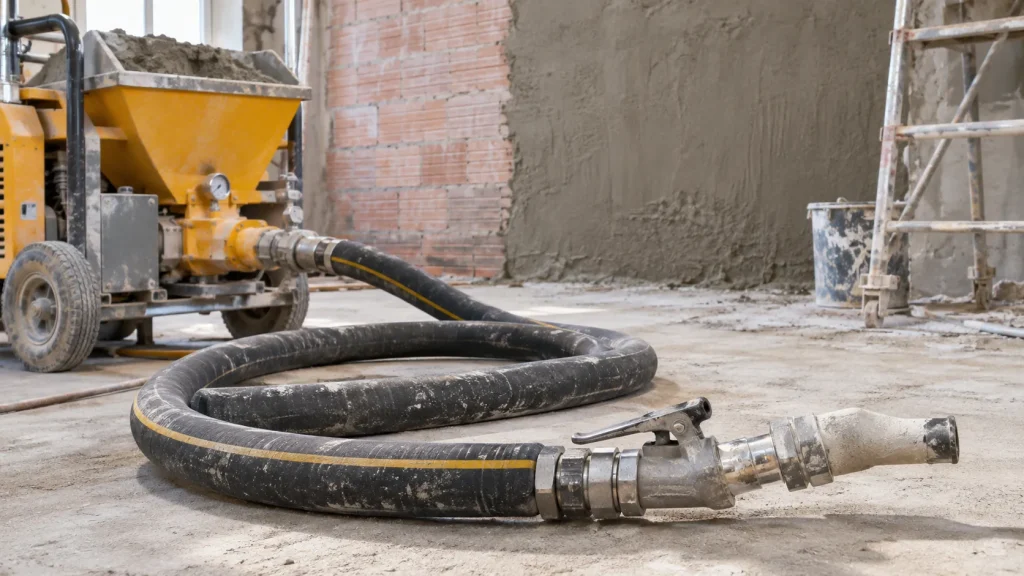
Specify a plaster pump hose by matching the equipment manufacturer’s approved bore, pressure limit, delivery route, and coupling system to the material being pumped. Record both internal and outside diameter, the finished assembly length, and the required working pressure. A hose that connects to the pump is not necessarily suitable for its material flow or pressure.
This guide covers the external material delivery hose used for plaster spraying and mortar injection. Air lines, water supply hoses, and the squeeze hose inside a peristaltic pump have different requirements. Identify the line before comparing replacement products.
Record the pump model, pumping mechanism, installed rotor and stator where applicable, pressure control arrangement, and delivery outlet details. Obtain the equipment manual’s approved hose configurations for the intended material. Motor power alone does not establish hose size, allowable delivery distance, or maximum material pressure.
Describe the plaster or mortar accurately: binder type, maximum aggregate size, additives, mixing instructions, and expected material temperature. Include the material supplier’s working time and cleaning requirements. A hose used successfully with one formulation may need reassessment when aggregate, consistency, or additives change.
For a replacement, photograph the existing marking and connections, then compare them with the manual and purchasing records. An old hose may have been substituted previously. Use its dimensions as evidence to check, rather than automatic approval for another identical order.
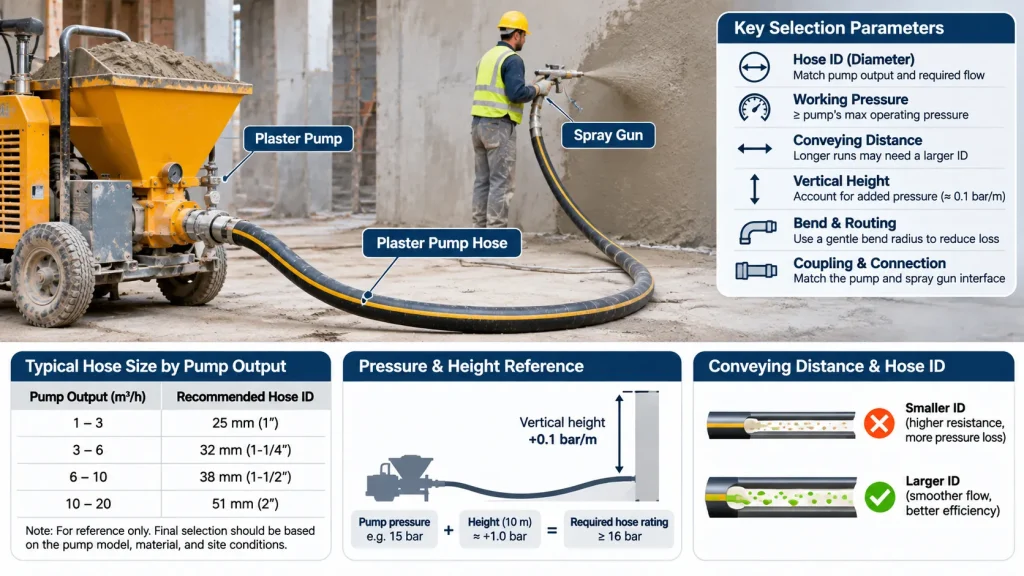
Plaster hose size usually refers to internal diameter, or ID. That bore must suit the approved pump configuration, material, output, and spray equipment. Selecting a smaller bore simply because an adapter is available can introduce a restriction. A larger bore also requires equipment approval and changes the weight and material volume in the line.
There is no universal diameter rule that makes every plaster or mortar mix pumpable. Confirm maximum grain size and the permitted hose configuration with the equipment and material suppliers. Keep the passage through reducers, couplings, and the spray gun in the review; hose ID alone does not describe the complete flow path.
Outside diameter, or OD, is essential for coupling retention. Two hoses with the same ID can have different wall dimensions and require different attachment hardware. Record ID, OD, dimensional tolerances, and the approved coupling installation method. A nominal thread size or an inch label is insufficient to specify a complete assembly.
Use the equipment manufacturer’s maximum possible material pressure for the installed configuration, including applicable pressure transients, when checking the required hose rating. Normal spraying pressure is only one operating condition. A pressure reading from an easy horizontal run does not establish the pressure limit for a harder application.
Check the working pressure of the hose, couplings, reducers, seals, and other pressure-containing components at the operating temperature. The assembly limit cannot exceed its lowest-rated component. Burst pressure is a destructive test value, not an operating allowance or permission to raise the pump setting.
Ask for confirmation of temperature-related pressure limits, material compatibility, and any required pressure protection. If delivery becomes restricted, stop and follow the equipment manufacturer’s blockage procedure. Increasing pressure to force through a blockage can exceed component limits and leaves the underlying cause unresolved.
Specify the actual horizontal distance, vertical rise, number of hose sections, and movement required at the work area. Include reducers and any short operator hose in the layout. Increasing length or elevation can change delivery resistance, so a previous setup may not remain suitable after the route changes.
Ask the equipment supplier to confirm achievable delivery for the actual mix, bore, and route. Clean-water calculations and a hose catalog’s roll length cannot establish plaster pumping reach. A stated manufacturing length describes the supplied hose, not the distance a particular machine can pump mortar.
Provide bend locations, support points, and exposure to edges, vehicle traffic, or dragging. Verify the minimum bend radius for the selected size and preserve room at connections. Do not use tight bends to absorb excess length. Define whether ordered length means cut hose length or overall assembled length, including fittings.
Specify the mating coupling profile, nominal size, clear passage, seal material, pressure rating, and attachment method at both ends. Include drawings or clear photographs with measurements. Visually similar plaster hose couplings may differ in geometry or retention requirements; approval should cover the hose and fitting combination.
Choose cleaning arrangements before the material sets in the line. Follow the equipment manufacturer’s procedure for priming, flushing, cleaning devices, isolation, and depressurization. Confirm that the hose and seals suit the cleaning medium and temperature. Compressed-air cleaning requires an expressly approved procedure; it should not be improvised.
Before startup, trained personnel should inspect the cover, bends, end attachments, and connections using the prescribed checks. A blockage can leave trapped pressure even after stopping the pump. Verify pressure release by the approved method before disconnecting. Record the accepted configuration so replacement orders retain the same essential requirements. During commissioning, document the material, route, output setting, and pressure readings under representative operation for future comparison.
For buyers comparing several hose categories, the SOMAXFLEX industrial rubber hose selection guide explains the broader relationship between medium, construction, and service conditions. Within the material handling hose range, shortlist products by their stated application before comparing dimensions or price. Abrasion resistance alone does not confirm suitability for a particular pumping machine.
The SOMAXFLEX BETON Concrete & Grout PLASTER HOSE 40BAR is intended for plaster spraying and mortar injection machines. Its construction includes an abrasion-resistant antistatic natural rubber tube, high-tensile synthetic textile reinforcement with antistatic copper wire, and an abrasion-, ozone-, and weather-resistant synthetic rubber cover.
The product table lists 40 bar working pressure and 120 bar burst pressure. Confirm the complete assembly rating for the proposed equipment; the burst figure does not expand the operating limit. The listed 25 mm ID options have either 37 mm or 38 mm OD, illustrating why both dimensions belong in a coupling specification.
Send a complete RFQ: equipment configuration, material and grain size, required pressure and temperature, ID and OD, route and finished length, end connections, cleaning method, and quantity. Request a drawing or written assembly specification before acceptance. SOMAXFLEX supports material batch traceability and laboratory hose testing; agree on the applicable order records and inspection requirements rather than assuming every test covers each supplied assembly.
A usable plaster pump hose specification connects the machine, material, delivery route, and complete assembly. Start with approved equipment requirements, verify both diameters and working pressure, then confirm coupling retention and cleaning. These checks give the buyer and supplier a common basis for evaluating a replacement or new installation.
No. Suitability depends on the machine’s maximum pressure, material, temperature, route, and complete assembly. Check the installed configuration before accepting the rating.
No. Verify OD, wall construction, coupling profile, pressure rating, and attachment method as well as ID. The hose and coupling must form an approved combination.
Only when its specification covers the actual formulation and operating conditions. A product name does not establish compatibility with every grout, additive, or aggregate size.
Provide the mix, output requirement, bore, horizontal distance, vertical rise, and fittings. Obtain equipment approval for the revised route before extending the line.
For a SOMAXFLEX quotation, request a plaster hose specification review with the machine details, material specification, required dimensions, operating conditions, route, coupling drawings or photographs, and quantity. Identify any unresolved equipment limits so the proposed hose can be reviewed against the intended installation.