
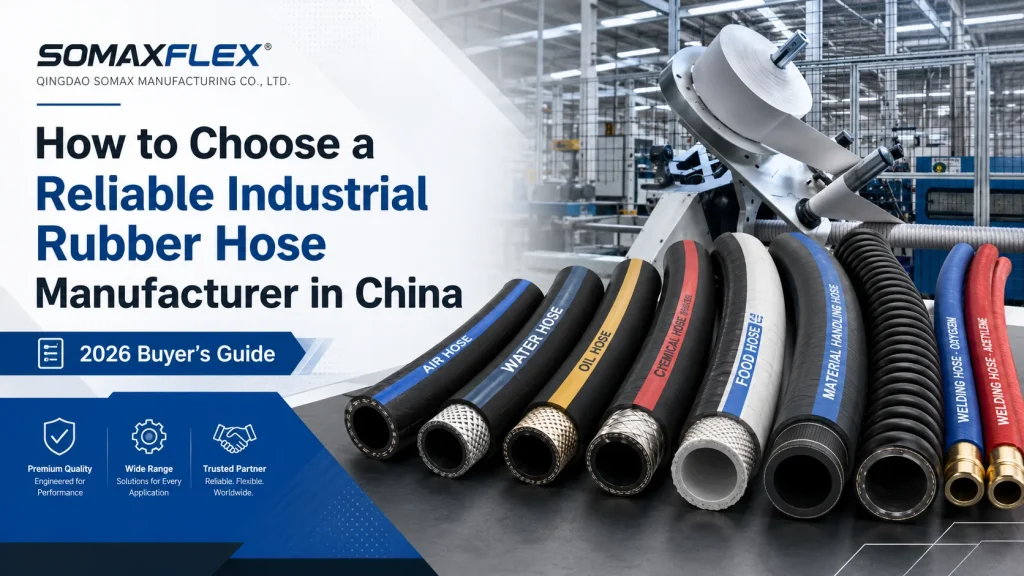
The selection process of a Chinese hose manufacturer is much more than comparing prices. The key issue for the importer, distributor, OEM customer, or maintenance crew is to determine whether the supplier will be able to select a hose suitable for the environment, to guarantee stability in terms of quality, and to establish communication on technical aspects for follow-up orders. A hose might seem to be right according to the catalog but perform poorly due to inappropriate rubber compounds, reinforcement carcass, or conveyed medium.
This guide explains how to evaluate a Chinese industrial rubber hose factory from a buyer’s perspective. It covers application matching, common hose categories, RFQ preparation, quality control, customization, MOQ, export support, and warning signs to check before placing a bulk order.
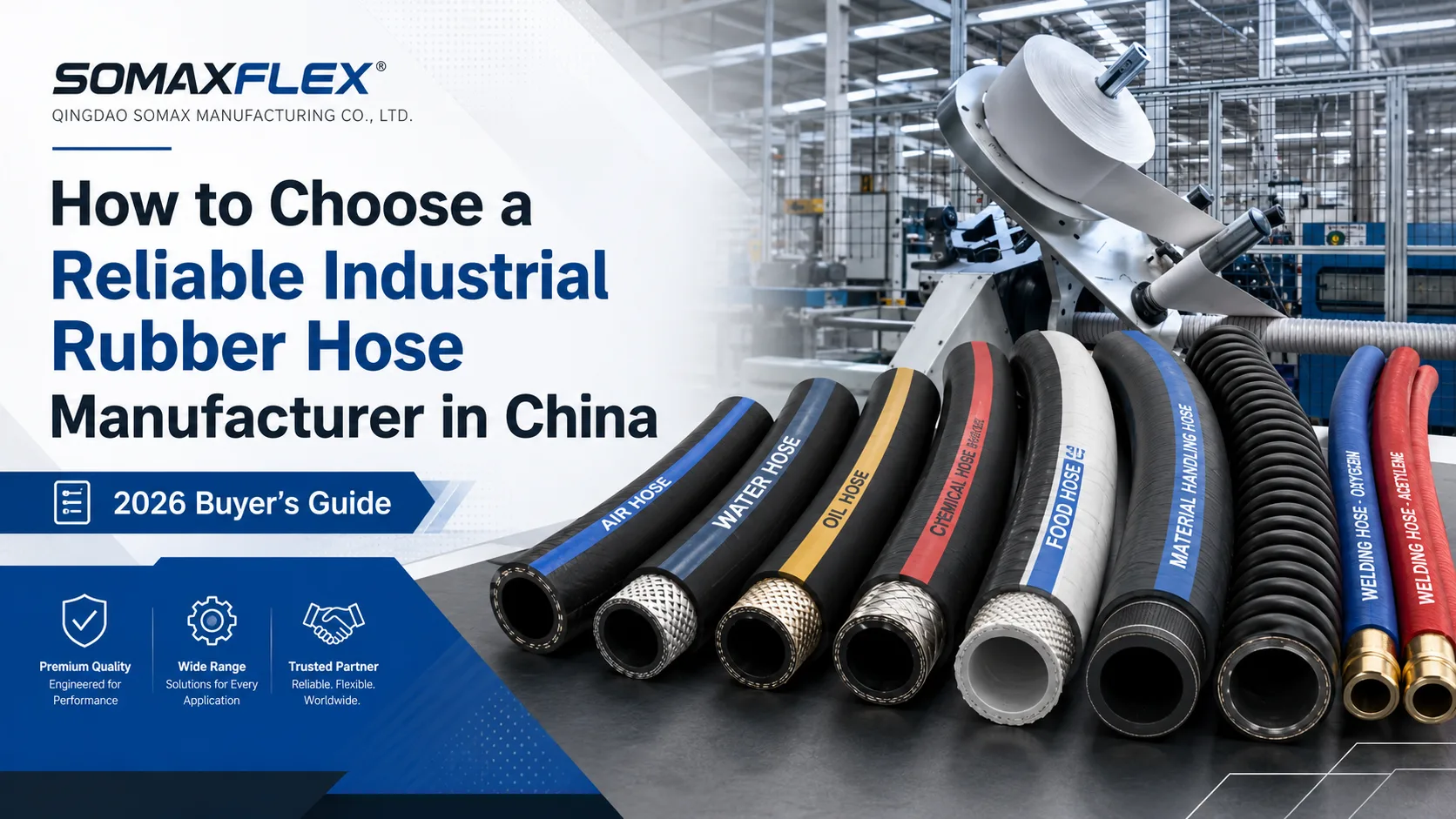
The quality of the quotation can never be derived through size alone. The purpose of the hose needs to be established by the buyer before quoting for the price. The types of fluid being pumped through the hose – air, water, oil, fuel, LPG gas, steam, food liquid, chemicals, slurry, cement, sand, and abrasive particles would all dictate the type of material for inner tube, reinforcement design, and outer cover.
For instance, a hose carrying air in a workshop is not going to experience the same hazards as a hose that is involved in sucking and discharging chemicals in conjunction with a transfer pump. An oil and fuel hose will need a hose that is resistant to oils such as NBR and FKM whereas a steam hose requires one which has the ability to withstand the heat. Food-grade rubber hoses will need materials which are not toxic, odourless and safe for food contact with a smooth inner tube for clean transfer. Material handling hoses require abrasion resistance for sand, cement, slurry and dry powder.
A competent supplier would request details regarding the medium, pressure, burst pressure required, temperature range, size of hose, length of hose, bend, exposure to weather and suction or discharge capability. These details help the manufacturer recommend the right hose instead of offering a general-purpose product that may not last in the field.
Many B2B buyers do not purchase only one hose type. A distributor may need water hoses for agriculture, oil hoses for fuel transfer, welding hoses for metalworking, LPG gas hoses for gas distribution, and material handling hoses for construction or mining customers. A supplier with a broad product portfolio can reduce sourcing time and make mixed-container purchasing easier.
Common categories include air and water hoses for workshops, irrigation, drainage, and general transfer; oil and fuel hoses for diesel, gasoline, lubricants, and hydrocarbon fuels; chemical hoses made with suitable rubber or lining materials such as EPDM, FKM, UPE, or PTFE; food-grade hoses for milk, juice, beverages, edible oil, syrup, and dairy products; steam and hot water hoses for high-temperature service; material handling hoses for cement, sand, slurry, powders, and granules; and hydraulic hoses for machinery and industrial power transmission.
This product matching stage is important because one hose cannot handle every job. A multipurpose hose may be convenient for general use, but it should not replace a dedicated steam hose, chemical hose, or food-grade hose in demanding applications.
A clear RFQ helps suppliers provide accurate quotations and reduces the risk of wrong product selection. Before contacting a rubber hose exporter from China, buyers should prepare the hose type or application, conveyed medium, inner diameter, required length, working pressure, burst pressure requirement, suction or discharge conditions, temperature range, expected rubber material, reinforcement carcass, standards or documents, order quantity, destination port, packaging method, branding, and target delivery date.
For chemicals, fuels, food liquids, or abrasive materials, the medium information should be specific. A fuel hose for diesel may still need confirmation for gasoline, high-aromatic hydrocarbon fuels, or special additives. A food transfer hose may require FDA food contact certifications or EU food contact compliance. Industrial buyers may also need ISO standards, EN industrial specifications, technical data sheets, or market-specific compliance documents.
Vague technical inquiries usually result in inaccurate quotations. If the buyer only asks for “rubber hose price,” the supplier may not have enough information to select the correct construction, pressure rating, or material formula.
Similar product photos can hide very different production levels. A serious rubber hose factory should explain hose construction, material selection, reinforcement carcass, cover compound, pressure rating, and application limits. Most industrial rubber hoses include three core components: the inner tube, which contacts the medium; the reinforcement carcass, which provides pressure-bearing and tensile strength; and the outer rubber cover, which protects against abrasion, ozone, weather, and handling damage.
For custom rubber hose projects, buyers should ask whether the factory can adjust inner diameter, outer diameter, length, color, rubber material, reinforcement type, branding, packaging, and product marking. OEM and ODM orders often require more than a logo. They may involve market-specific labels, private-label cartons, pallet dimensions, barcode labels, mixed product containers, and repeatable batch-to-batch consistency.
Quality control should also be discussed before price negotiation. Common checks include inner and outer diameter inspection, appearance inspection, pressure testing, reinforcement consistency, rubber surface condition, packaging inspection, and batch traceability when required. Low-cost hoses become expensive when they crack early, leak under pressure, swell after oil contact, fail during installation, or create end-user complaints.
The MOQ can change depending on hose type, material, dimension, reinforcement configuration, and customizing degree. Trial orders can be available for light-duty/standard hoses, but medium-duty and heavy-duty products can demand bigger manufacturing volumes because of material processing, molds setting, reinforcement design, or customized packing.
A good supplier has to inform a buyer about sample shipping time, lead time for production, payment conditions, packing technique, shipping terms, and after-sales management. Exporting customers can need invoices, packing list, certificate of origin, inspection report, technical data sheet, and specific documents for particular markets like SASO or GOST documents.
It is important to think about logistics as well. Packing of rubber hoses has to be organized in a way which can avoid excessive moisture, compression, abrasion, and deformation during transportation. Bulk shipments can be shipped by sea or road transportation. Customer service department can inform you about shipment status and production progress and can handle claims in case if there is a problem with quality.
Hoses are at risk of various factors depending on the industry they belong to. Buyers in the agriculture industry usually require flexibility, UV resistance, irrigation capability, and transfer of fertilizers or pesticides. On the other hand, food and beverages processors will require sanitary hoses with smooth interior tubes for clean transfers of products. Chemical industries require hoses that are capable of being used for certain types of media with leak prevention as well as resistance to acids, alkalis, solvents, or cleaning solutions.
For oil and gas, there is the need for hoses that are oil resistant, pressure resistant, anti-static, and heat resistant for purposes of transfer, refining, loading, and unloading processes. In cases where hoses are to be used in ship building and for marine purposes, resistance to seawater, fuel, vibrations, and harsh environmental conditions outdoors become paramount. Geographical requirements include heat and UV resistance in Middle Eastern markets and abrasion-resistant hoses for mining and agricultural industries in Latin America, among others.
Several warning signs appear often in industrial hose sourcing. Be cautious if a supplier quotes immediately without asking about the medium, pressure, temperature, or working environment. A very low price without technical explanation may indicate unsuitable rubber materials, thin reinforcement, weak cover quality, or unstable batch control.
Other risks include unclear data sheets, no sample support, vague production lead time, poor packaging details, slow response, and unwillingness to explain service limits. A trustworthy industrial hose supplier does not claim that every hose can handle every job. Instead, it should clarify where a product is suitable, where it is not suitable, and what information is needed before production begins.
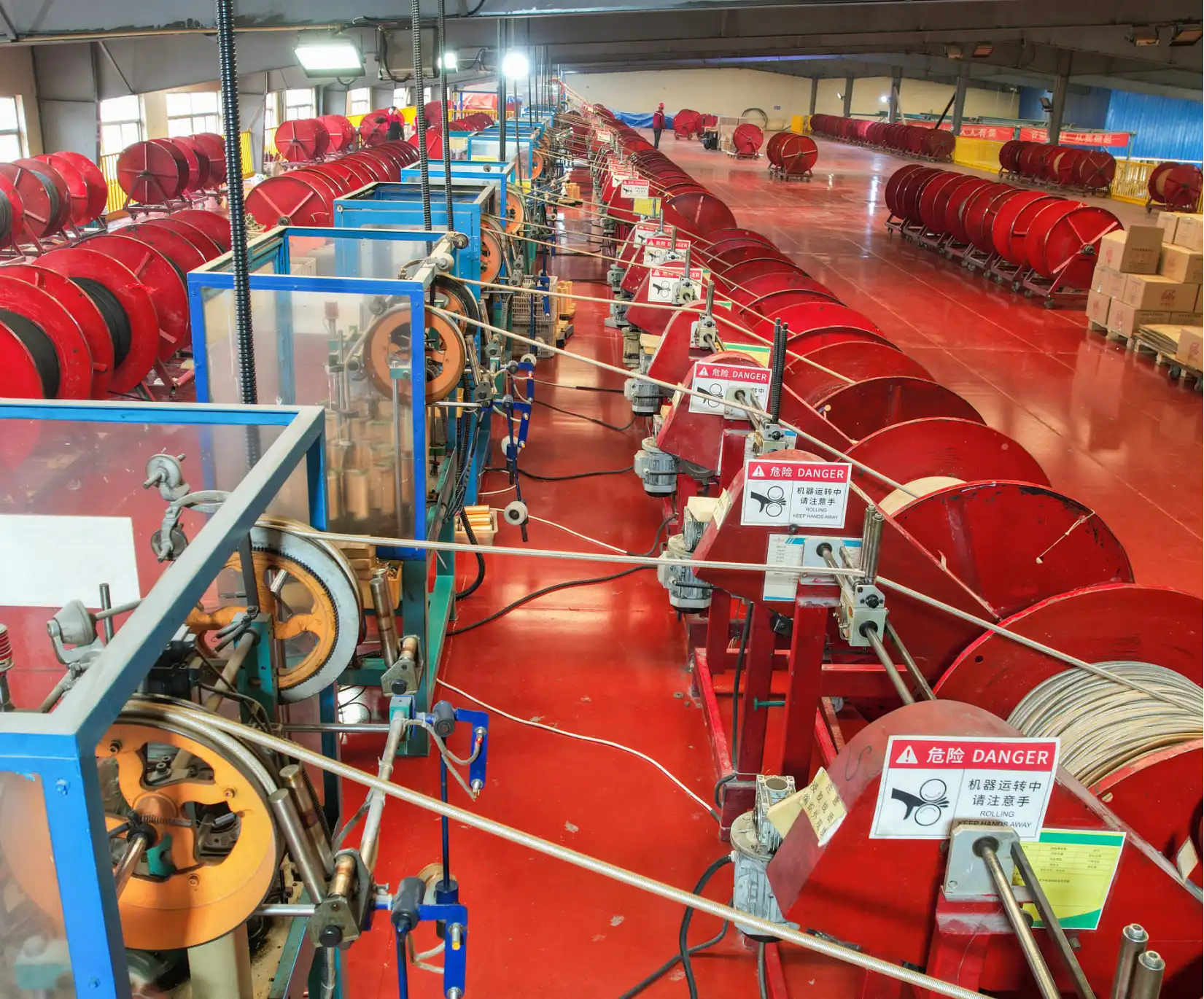
After understanding the key selection factors, buyers can evaluate whether a manufacturer fits their sourcing needs. SOMAXFLEX, operated by QINGDAO SOMAX MANUFACTURING Co., Ltd., focuses on industrial rubber hose supply for global B2B buyers that need practical products, export communication, and a broad category base.
Its product range covers common purchasing needs, including air hose, water hose, oil and fuel hose, chemical hose, food hose, steam hose, hot water hose, LPG gas hose, welding hose, multipurpose hose, material handling hose, and related industrial hose solutions. This makes it suitable for distributors, OEM buyers, maintenance contractors, agricultural suppliers, construction users, food processing buyers, and general industrial transfer applications.
For buyers testing a new market, SOMAXFLEX can support inquiry communication around hose type, size, medium, pressure, temperature, quantity, packaging, and destination. For bulk orders or private-label projects, buyers can discuss customization options such as hose dimensions, rubber materials, reinforcement structure, color, branding, packaging, and product marking.
The company’s export-oriented service is also relevant for buyers comparing Chinese hose suppliers. Clear inquiry records, formal quotations, production tracking, packing confirmation, shipment coordination, and after-sales response all help reduce communication delays. For long-term cooperation, this type of support is often as important as the unit price.
Selecting an effective manufacturer of industrial rubber hoses in China entails more than simply comparing images and prices of different products. One must look into the applications, the medium to be transferred, the pressure class, temperature range, the structure of the hose, rubber material, reinforcement carcass, quality assurance, customization options, MOQ, delivery time, exporting documentation, and after-sales services.
An efficient supplier will first ask all necessary technical questions and then offer appropriate solutions depending on the specificities of your working environment. If one needs B2B procurement of a wide variety of industrial hoses along with OEM support and English-speaking personnel, SOMAXFLEX can be considered a good start. The next logical move would be providing detailed information about the application of a product in question.
Q1: What information is needed before making an inquiry about rubber hose quote?
A: It is necessary to offer the type of the hose, medium conveyed, inside diameter, hose length, working pressure, temperature range, quantity, delivery port, packing request, branding request, and standard requirement. If the medium conveyed is the chemical, fuel, food liquid, or abrasive material, the medium details should be offered as detailed as possible.
Q2: Which rubber hose is fit for oil, steam, chemicals, or food transfer?
A: Oil hoses need oil-resistant rubber material like NBR and FKM. Steam hoses need heat-resistant rubber hose. Chemical hoses should be chosen depending on the media compatibility and can use such materials as EPDM, FKM, UPE, and PTFE lining in certain conditions. Food hoses need food contact approved materials and smooth inner tube for clean transferring.
Q3: Is it possible to customize the industrial rubber hoses for OEM order?
A: Yes. Usually, the customization choices include the inner diameter, outside diameter, length, color, rubber material, carcass reinforcement, product marking, packaging, labeling and box/pallet design. Buyers should be sure of samples, minimum order quantity, lead time and batch stability before mass production.
Q4: What influences the minimum order quantity of industrial rubber hose bulk purchase?
A: Minimum order quantity will depend on the type of the hose, its size, material, pressure rating, reinforcement carcass, color, branding, and packing choice. Light-duty hose usually allows small trial quantity order but heavy-duty hose, customized hose, or hose with special material does not.
Q5: Why is it important not to choose industrial rubber hose by the lowest price only?
A: The most expensive hose could become the source of additional expenses due to crack, leak, swelling, failed pressure testing or unsuitable working condition. For the importer and distributor, stable quality, proper material choice, reliable delivery, correct document, and after-sales service are more important than low price.