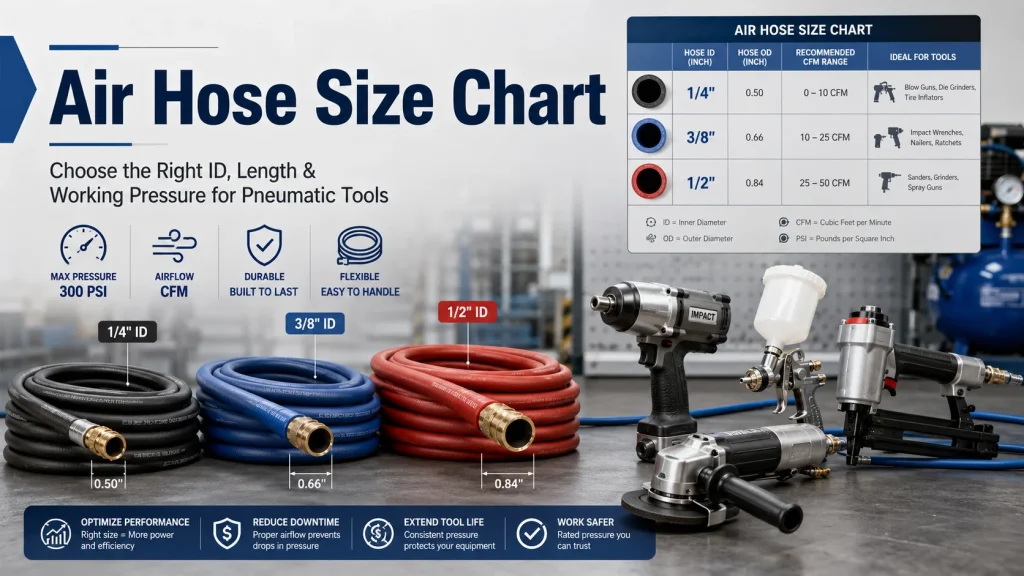
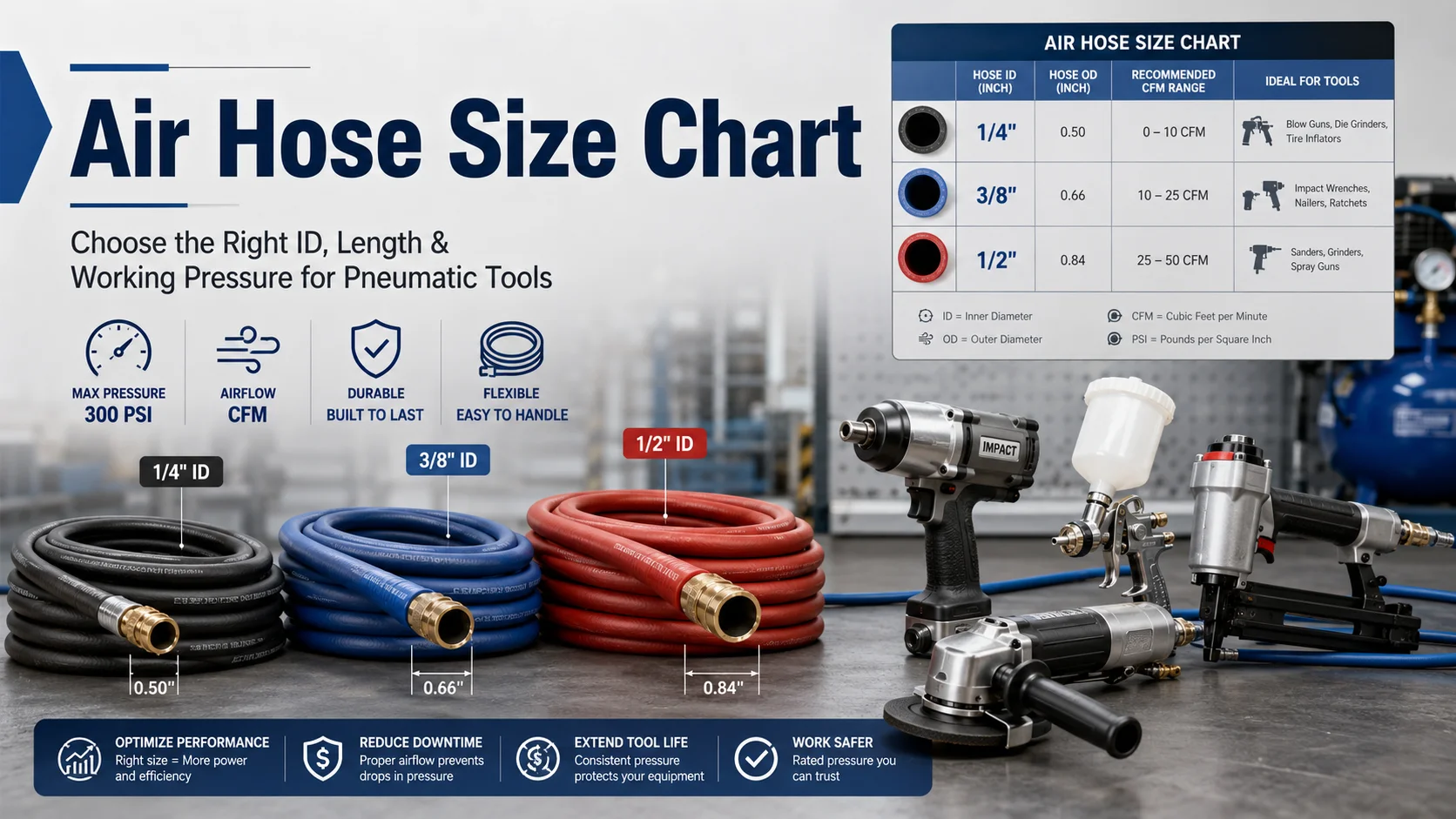
Non si tratta solo di trovare un tubo dell'aria adatto che si integri con l'uscita del compressore. Con gli utensili pneumatici, un diametro interno del tubo non corretto, tubi troppo lunghi e una pressione di esercizio insufficiente possono trasformare anche un compressore potente in uno poco performante. La guida alle dimensioni dei tubi dell'aria fornisce informazioni sull'influenza dei fattori sopra menzionati sull'utilizzo pratico del tubo.
Cosa significa realmente la dimensione del tubo dell'aria
La dimensione del tubo dell'aria si riferisce in genere al diametro interno, spesso indicato con la sigla ID. Questo è lo spazio aperto all'interno del tubo attraverso il quale passa l'aria compressa. Un diametro interno maggiore consente il passaggio di un volume d'aria maggiore, mentre un diametro interno minore è più leggero e maneggevole, ma può limitare il flusso d'aria se utilizzato con utensili ad alto flusso d'aria (CFM).
La lunghezza è importante quanto il diametro. Un tubo flessibile di 7,6 metri (25 piedi) può mantenere una pressione abbastanza stabile per una piccola pistola sparachiodi, mentre un tubo di 30 metri (100 piedi) su una smerigliatrice o un avvitatore a impulsi può causare una notevole perdita di pressione. Anche la pressione di esercizio è un dato fondamentale. Indica agli acquirenti l'intervallo di pressione sicuro del tubo durante il funzionamento. Per gli acquisti industriali, il diametro interno del tubo, la lunghezza, la pressione di esercizio, la pressione di scoppio, il rinforzo, il materiale di rivestimento e i raccordi dovrebbero essere valutati congiuntamente, piuttosto che separatamente.
La seguente tabella fornisce un punto di partenza pratico per la scelta della dimensione del tubo flessibile per l'aria compressa degli utensili pneumatici. La scelta finale deve essere sempre verificata consultando il manuale dell'utensile, la portata del compressore, gli standard di raccordo e l'ambiente di lavoro.
| Utensile pneumatico |
tipica richiesta di aria |
ID tubo flessibile comune |
Intervallo di lunghezza pratico |
Nota di selezione |
| Pistola sparachiodi o graffettatrice |
Basso flusso d'aria (CFM), utilizzo intermittente |
1/4 di pollice o 5/16 di pollice |
25–50 piedi |
Per brevi tratti, di solito è sufficiente un tubo flessibile leggero. |
| pistola a spruzzo |
Flusso d'aria medio e stabile. |
3/8 di pollice |
25–50 piedi |
Una pressione stabile contribuisce a mantenere la consistenza dello spruzzo. |
| Trapano pneumatico |
Portata d'aria media |
3/8 di pollice |
25–75 piedi |
Un buon equilibrio tra flusso d'aria e maneggevolezza. |
| Chiave a impulsi |
Flusso d'aria medio-alto |
3/8 di pollice o 1/2 pollice |
25–75 piedi |
Per ottenere una coppia maggiore potrebbe essere necessario un diametro interno più grande. |
| Smerigliatrice o levigatrice |
Elevato flusso d'aria (CFM), utilizzo continuo |
1/2 pollice |
25–100 piedi |
Gli utensili a funzionamento continuo spesso necessitano di una maggiore riserva di flusso d'aria. |
| Utensili pneumatici per l'edilizia |
Da medio ad alto carico |
3/8 di pollice o 1/2 pollice |
In base alla disposizione del sito |
Selezionare in base a CFM, caduta di pressione, rischio di abrasione e raggio di movimento. |
Tubo dell'aria da 1/4 di pollice, 3/8 di pollice o 1/2 pollice
Un tubo dell'aria da 1/4 di pollice è adatto per utensili leggeri e percorsi brevi, soprattutto quando flessibilità e peso ridotto sono importanti. Un tubo dell'aria da 3/8 di pollice è la soluzione intermedia più comune per molte officine, centri di riparazione, linee di assemblaggio e utensili pneumatici in generale. Un tubo dell'aria da 1/2 pollice è più indicato per utensili ad alta portata d'aria (CFM), percorsi più lunghi e uso industriale continuo, dove la perdita di flusso d'aria può rallentare la produzione o aumentare il carico di lavoro del compressore.
La regola fondamentale è semplice: maggiore è il fabbisogno di CFM e più lungo è il tubo flessibile, più importante diventa il diametro interno del tubo.
Come la lunghezza del tubo flessibile influisce sulla caduta di pressione
La perdita di pressione è una delle cause più comuni di perdita di potenza negli utensili pneumatici. L'aria compressa non scorre attraverso un tubo flessibile senza incontrare resistenza. I fattori che causano la riduzione della pressione includono la lunghezza eccessiva del tubo flessibile, il piccolo diametro interno del tubo, le curve strette, i raccordi sottodimensionati e i raccordi danneggiati.
Ad esempio, il personale addetto alla manutenzione può installare una lunga linea d'aria in un cantiere, consentendo agli operai di lavorare senza essere vincolati a un unico punto. Quando il diametro interno del tubo è troppo piccolo, un avvitatore a impulsi potrebbe emettere un suono normale ma avere una potenza insufficiente. Gli schemi di spruzzatura potrebbero essere irregolari in caso di perdita di pressione durante il lavoro continuo in un'officina di verniciatura. Le levigatrici potrebbero rallentare dopo alcuni secondi di lavoro a causa della maggiore richiesta di aria da parte dell'utensile rispetto a quella che il tubo è in grado di fornire.
La soluzione più semplice al problema consiste nell'utilizzare un tubo flessibile il più corto possibile, aumentando il diametro interno per tratti di tubo lunghi, evitando curve eccessive e assicurandosi che raccordi, utensili e tubo siano ben accoppiati. I consumatori devono inoltre accertarsi che la guaina del tubo flessibile sia in grado di resistere a trascinamenti, usura, nebbie oleose, utilizzo all'aperto e maltrattamenti.
Come scegliere la pressione di esercizio
La pressione di esercizio non dovrebbe essere scelta solo in base al valore PSI dell'utensile. Gli acquirenti industriali devono considerare anche il ciclo di lavoro, il margine di sicurezza, la temperatura, il rinforzo e se il tubo flessibile verrà utilizzato in ambienti interni, esterni, in miniere, nei cantieri edili o in prossimità di macchinari.
Per l'alimentazione pneumatica generale, un tubo flessibile in gomma da 20 bar è adatto a numerose applicazioni industriali di distribuzione di aria e acqua. Il tubo flessibile per aria compressa SOMAXFLEX Black a superficie liscia da 20 bar è progettato con un tubo interno in gomma sintetica nera liscia e resistente alla nebbia oleosa, un rinforzo intrecciato in filato sintetico ad alta resistenza e una copertura esterna in gomma sintetica liscia, resistente agli agenti atmosferici e all'abrasione. È destinato ad usi generici in industrie, cantieri edili e miniere, con un intervallo di temperatura da -35℃ a 80℃.
Per applicazioni con aria compressa più gravose, potrebbe essere necessario un rinforzo in filo d'acciaio. Il tubo flessibile per aria compressa SOMAXFLEX Steel Wire Air Hose 40BAR è progettato per alte pressioni ed è rinforzato con filo d'acciaio. È composto da un tubo interno in gomma NBR liscia nera, un rinforzo in filo d'acciaio ad alta resistenza e una guaina esterna in gomma EPDM gialla resistente agli agenti atmosferici e all'ozono. Il suo intervallo di temperatura di esercizio va da -30℃ a +70℃. Questo tipo di costruzione è più adatto quando la pressione richiesta, l'usura esterna o le condizioni del sito richiedono una struttura del tubo più robusta.
Errori comuni da evitare nella scelta della misura del tubo dell'aria compressa.
Un errore comune è quello di scegliere in base al diametro esterno anziché a quello interno. Il diametro esterno influisce sullo spessore della parete e sulla maneggevolezza, mentre il diametro interno controlla il flusso d'aria. Un altro errore è quello di utilizzare un tubo flessibile di piccole dimensioni per un utensile ad alto flusso d'aria (CFM) solo perché la filettatura o il raccordo sembrano adatti. Un raccordo può essere fisicamente compatibile, ma limitare comunque il flusso d'aria.
Un terzo errore consiste nel trascurare la lunghezza del tubo flessibile. Un tubo che funziona bene a 7,5 metri potrebbe non funzionare allo stesso modo a 30 metri. Gli acquirenti spesso sottovalutano anche raccordi, fascette e giunti. Un connettore rapido stretto può diventare il passaggio più piccolo dell'intero sistema pneumatico, anche se il tubo flessibile ha le dimensioni corrette.
L'ultimo errore è concentrarsi solo sul prezzo. Negli acquisti all'ingrosso, un tubo flessibile economico che si crepa, si piega, perde o non supera il test di pressione può aumentare i costi di sostituzione e i tempi di inattività. Una richiesta di offerta migliore dovrebbe includere diametro interno (ID), diametro esterno (OD), lunghezza, pressione di esercizio, pressione di scoppio, materiale, rinforzo, tipo di rivestimento, colore, standard di raccordo, imballaggio, quantità e ambiente di applicazione.
La capacità del fornitore è fondamentale per l'acquisto di tubi flessibili per aria compressa in grandi quantità.
Dopo aver compreso i fattori chiave per la selezione, diventa più facile valutare se un produttore è in grado di soddisfare le esigenze di acquisto a lungo termine. Un produttore di tubi per aria compressa qualificato dovrebbe fornire non solo prodotti adeguati, ma anche una produzione stabile, supporto per la personalizzazione, controllo qualità e una comunicazione chiara prima della spedizione.
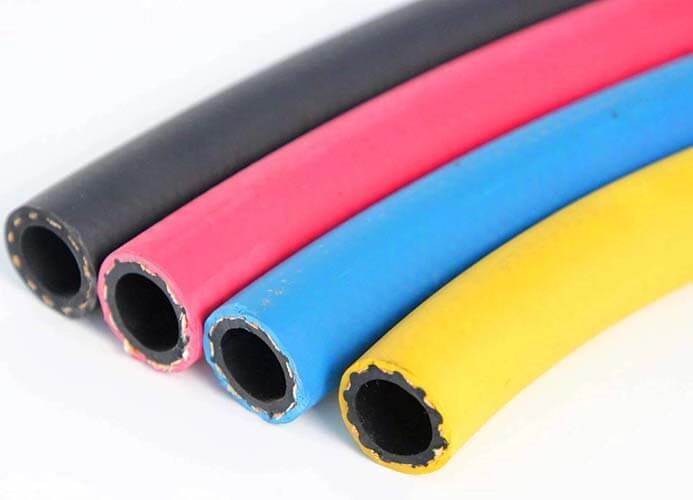
È qui che SOMAXFLEX, produttore di tubi flessibili industriali in gomma. può supportare gli acquirenti alla ricerca di tubi dell'aria per utensili pneumatici, linee di compressori, cantieri edili, miniere e forniture industriali generali. La gamma di tubi dell'aria dell'azienda comprende opzioni con superficie liscia e superficie avvolta da 20 BAR, tubi multiuso da 20 BAR e Tubo flessibile per aria compressa in gomma da 20 bar Per uso industriale generale. Per applicazioni con aria compressa più impegnative, la gamma di prodotti comprende anche tubi flessibili in filo d'acciaio con capacità di pressione superiore.
Per gli acquirenti che confrontano i fornitori, le domande importanti sono di natura pratica. La fabbrica può discutere il diametro interno richiesto e la pressione di esercizio prima della produzione? Può supportare lunghezza, materiale, colore, rinforzo e pressione nominale personalizzati quando necessario? Può fornire tracciabilità dell'ordine, imballaggio sicuro, supporto logistico e assistenza post-vendita? Le informazioni Informazioni su SOMAXFLEX L'azienda offre una gamma di prodotti che comprende tubi per aria compressa, tubi per acqua, tubi per olio, tubi per prodotti chimici, tubi per alimenti, tubi per vapore, tubi multiuso, tubi per saldatura e altre categorie di tubi in gomma industriali, con flessibilità produttiva e servizio di esportazione come parte integrante del suo modello operativo.
Conclusione
Una tabella affidabile per la scelta del diametro dei tubi per aria compressa non dovrebbe limitarsi al solo diametro. La scelta giusta dipende da diametro interno, lunghezza, portata d'aria (CFM), caduta di pressione, pressione di esercizio, rinforzo, durata del rivestimento, raccordi e dall'ambiente in cui il tubo verrà utilizzato. Per utensili leggeri e brevi tratti, un tubo di diametro inferiore può essere sufficiente. Per avvitatori a impulsi, smerigliatrici, levigatrici, utensili pneumatici da costruzione e per il trasporto di aria compressa su lunghe distanze, un diametro interno maggiore e una maggiore capacità di pressione spesso fanno una netta differenza.
Gli acquirenti che cercano tubi flessibili per aria compressa industriale all'ingrosso possono condividere con SOMAXFLEX il tipo di strumento, il CFM richiesto, la pressione (PSI), la lunghezza del tubo, lo standard di raccordo, l'ambiente di lavoro e la quantità. Il team può esaminare l'applicazione e fornire suggerimenti sui prodotti, campioni, preventivi o specifiche personalizzate tramite Contatta SOMAXFLEX per la selezione del tubo dell'aria.
FAQ
D1: Qual è la dimensione ideale del tubo dell'aria per gli utensili pneumatici?
R: La dimensione ideale del tubo dell'aria compressa dipende dalla portata d'aria (CFM) richiesta dall'utensile, dalla lunghezza del tubo e dalla pressione di esercizio necessaria. Gli utensili leggeri spesso funzionano con tubi da 1/4 di pollice, mentre molti utensili pneumatici generici utilizzano tubi da 3/8 di pollice. Gli utensili ad alta portata d'aria, i tratti lunghi e l'uso industriale continuo possono richiedere tubi da 1/2 pollice.
D2: Perché i miei utensili pneumatici perdono potenza con un tubo dell'aria lungo?
A: Gli utensili pneumatici perdono potenza quando il tubo flessibile crea una caduta di pressione prima che l'aria raggiunga l'utensile. Tubi flessibili lunghi, diametri interni ridotti, curve strette, perdite e raccordi sottodimensionati possono limitare il flusso d'aria. Aumentare il diametro interno del tubo flessibile, accorciarne la lunghezza e utilizzare raccordi adeguati può contribuire a ridurre la caduta di pressione nel tubo dell'aria.
D3: Il tubo dell'aria da 3/8 di pollice è migliore di quello da 1/4 di pollice?
A: Un tubo dell'aria da 3/8 di pollice è migliore quando l'utensile necessita di un flusso d'aria maggiore o il tubo è più lungo. Un tubo da 1/4 di pollice è più leggero e maneggevole, ma potrebbe limitare il flusso d'aria (CFM) per avvitatori a impulsi, pistole a spruzzo, smerigliatrici o levigatrici. La scelta migliore dipende dalle esigenze dell'utensile e dalla disposizione del cantiere.
D4: Come si sceglie la pressione di esercizio per un tubo flessibile per aria compressa industriale?
A: Scegliere la pressione di esercizio del tubo dell'aria compressa verificando la pressione in PSI dell'utensile, la portata del compressore, il ciclo di lavoro, la temperatura, il rinforzo e il rischio di applicazione. Per un utilizzo pneumatico generico è sufficiente un tubo dell'aria compressa da 20 bar, mentre per applicazioni con aria compressa più gravose potrebbero essere necessari rinforzi in filo d'acciaio e una maggiore capacità di pressione.
D5: Quali informazioni devo inviare quando richiedo un preventivo per un tubo dell'aria compressa?
A: Una richiesta di offerta (RFQ) utile dovrebbe includere il diametro interno (ID), il diametro esterno (OD), la lunghezza, la pressione di esercizio, la pressione di scoppio, il tipo di utensile, i requisiti di CFM e PSI, lo standard di raccordo, il tipo di superficie, il colore, la quantità e l'ambiente di lavoro. Questo aiuta il fornitore a consigliare un tubo flessibile per aria compressa industriale adatto, anziché un prodotto generico.