
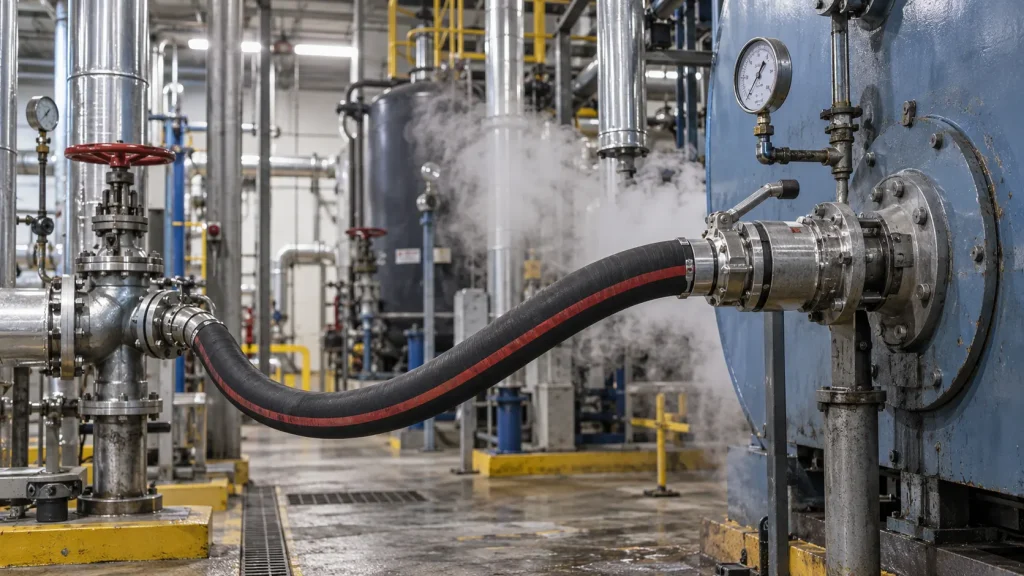
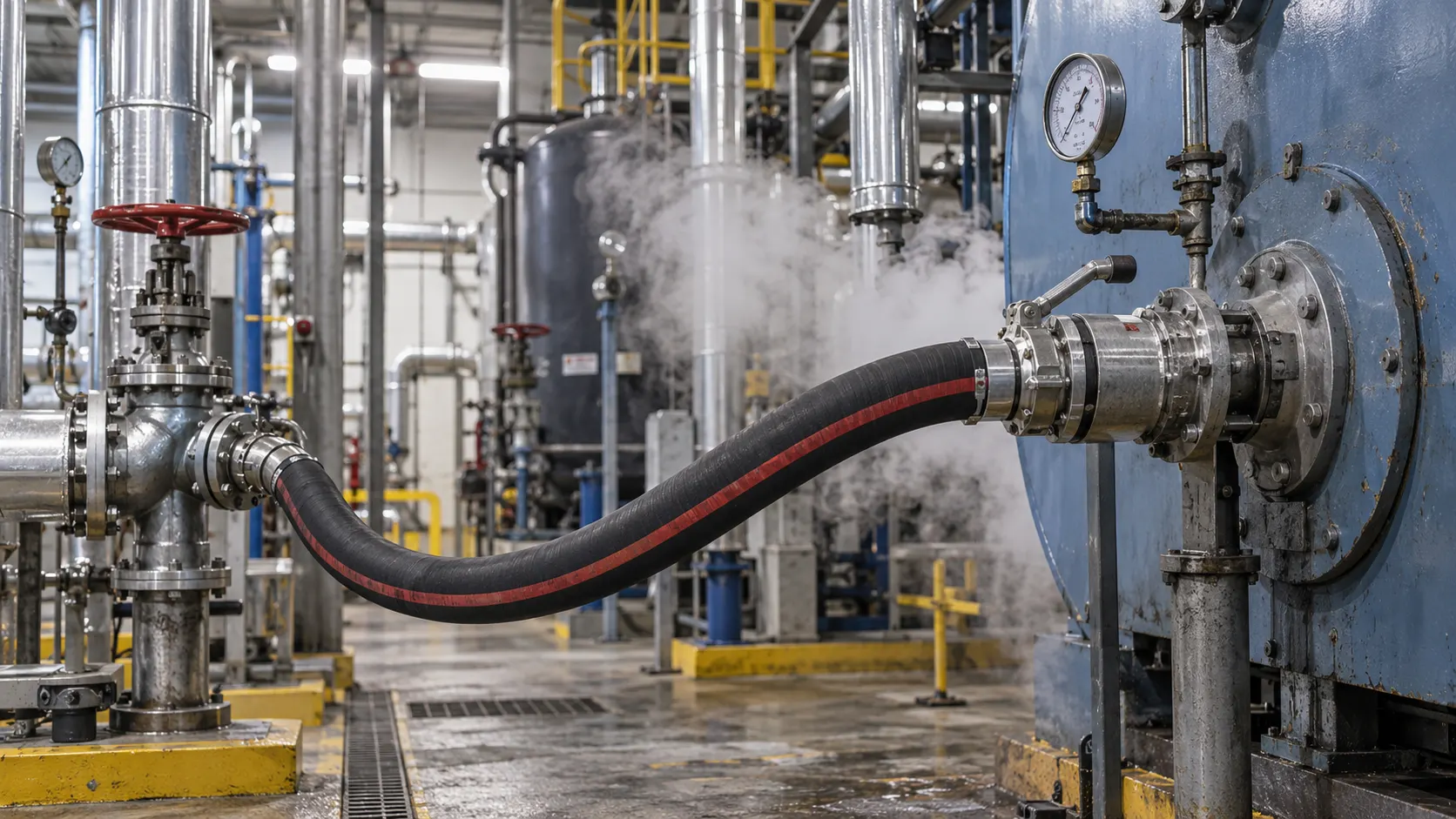
A steam hose specification should state the medium, pressure, temperature, duty cycle, hose size, movement, and connection details together. A single number such as “high pressure” or “high temperature” is not enough because steam conditions change with pressure, heat-up, condensate, and the assembly at each end. The goal is a traceable operating envelope that a supplier can match to a documented hose and complete assembly.
Begin the RFQ by identifying what the hose carries at the point of use: saturated steam, superheated steam, steam condensate, or a process that can alternate between steam and hot water. State whether the hose is used for a fixed connection, intermittent cleaning, a steam lance, boiler-room service, or another duty. Include startup, shutdown, draining, and cleaning steps because a hose that sees steam only during sanitation still needs a rating for that exposure.
Record the source pressure and the pressure where the hose will operate. A regulator or valve can reduce normal pressure, but it does not remove the need to consider upstream isolation, trapped pressure, surges, or a failed control component. If the line can be blocked in, state the resulting pressure condition and how the system relieves it. The hose specification should reflect the most severe confirmed condition, with assumptions clearly marked for engineering review.
| Term | What it means in an RFQ | How to use it |
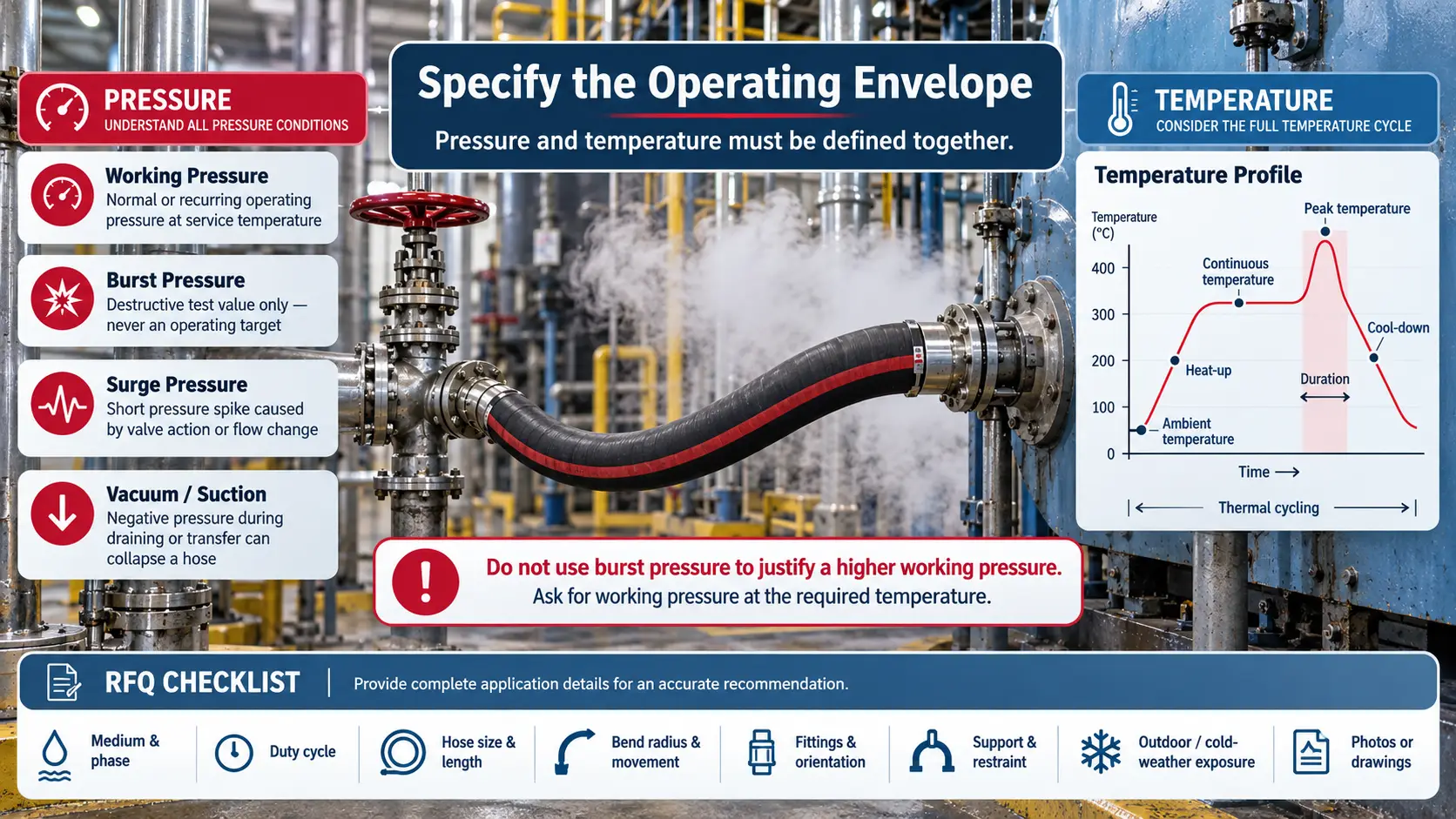
| Working pressure | The maximum continuous or recurring pressure the hose assembly is intended to carry under stated conditions | Specify normal, peak, and any cyclic pressure at the service temperature |
| Burst pressure | A destructive test value, not an operating target | Use it to understand the stated safety margin; never operate at burst pressure |
| Surge pressure | A short pressure rise caused by valve action, pump behavior, or flow change | State the magnitude, duration, frequency, and cause when known |
| Vacuum or suction | Negative pressure that can collapse a hose even when discharge pressure is low | State vacuum level and whether suction occurs during draining or transfer |
Do not use burst pressure to justify a higher working pressure. The assembly rating can be limited by the tube, reinforcement, cover, coupling, clamp, gasket, or installation method. Ask the supplier to state the working pressure at the required temperature and to identify any derating, cycle, or fitting limitations.
List the continuous steam temperature, the highest short-duration temperature, the time at each condition, and the ambient temperature around the hose. Also state heat-up and cool-down rates when the hose experiences repeated thermal cycling. A steam line may be exposed to hot vapor, cooler condensate, and ambient air in the same operating cycle. Those transitions can be more demanding than a steady temperature held for a short test.
Pressure and temperature must be read together. The allowable working pressure of a hose can change with temperature, size, reinforcement, and service type. If a supplier provides separate ratings for steam and hot water, use the steam rating whenever vapor can occur. If the process includes superheated steam, specify the degree of superheat or the measured temperature at the hose inlet and the far end of the assembly.
For cold-weather installations in Russia and other northern markets, add the minimum storage and operating temperature and explain how the hose is protected from freezing condensate. For Middle Eastern outdoor plants, record ambient heat, solar exposure, and routing near hot equipment. European and South American sites should document local plant requirements, cleaning cycles, and any country-specific procurement or inspection records required by the end user.
SOMAXFLEX lists a Steam Hose 7 BAR model with a 7 bar working pressure and 70 bar burst pressure for the shown 1/2 to 1 inch sizes. These values are useful examples of how a product table separates working pressure from burst pressure, but they are not a universal rating for every steam hose or assembly. Confirm the exact product, temperature range, length, connection, and service conditions in the current datasheet before approving the selection. Review the Steam Hose 7 BAR product specification as the model-level reference.
The site also presents a separate steam-hose category and identifies a red steam hose product in its product navigation. Review the steam hose category for the available product family, but do not infer pressure or temperature from a product name, color, or category label. The purchase record should preserve the selected model number, size, working pressure at temperature, burst pressure, construction, end fittings, test or inspection information, and revision date of the technical document.
When the data sheet does not show the exact combination of pressure, temperature, size, and duty cycle, pause the order and request a written fit check. Conditional wording such as “subject to confirmation” is safer than treating an adjacent size or a lower-temperature rating as interchangeable.
Pressure and temperature do not determine hose size by themselves. State the required flow, allowable pressure drop, hose length, routing, minimum bend radius, and movement. A small inside diameter can increase velocity and pressure loss, while an oversized hose can become heavy, difficult to support, and slow to drain. Steam quality and condensate management can also affect the practical size and layout.
Describe both ends of the assembly: flange or thread type, nominal connection size, orientation, swivel requirement, gasket material, clamp or ferrule method, and any restraint or whip-check arrangement. The hose should not be bent to force an incorrect fitting into alignment. If the assembly moves, state the travel, cycle frequency, torsion, and whether the motion is axial, lateral, or angular.
A complete request should state the support method, vertical load, nearby heat sources, abrasion points, outdoor exposure, chemical cleaners, and access for inspection. Ask how the assembly should be stored, drained, routed, and isolated. Steam hoses should not be treated as permanent piping unless the system design and product documentation allow that use. Provide the responsible engineer with the operating envelope, not only a catalogue name.
Before commissioning, verify that the hose, fittings, clamps, gaskets, and restraints match the approved specification. Check that valves open in a controlled manner, low points drain as intended, and personnel are protected from hot surfaces and a possible hose release. Establish an inspection interval based on temperature, pressure, movement, abrasion, and site risk. Replace a hose when the cover, tube, reinforcement, coupling, or markings show damage or when its service history is unknown.
For a project spanning multiple countries, keep one controlled specification and document any site-specific deviation. SOMAXFLEX describes industrial rubber hose manufacturing experience, a broad industrial hose portfolio, and support for export customers. Its company information provides context for the product range, but the final selection still depends on the confirmed application. Send the completed operating data to the SOMAXFLEX technical team for a model and assembly fit check.
Include these fields in the request: medium and phase; normal, peak, surge, and vacuum conditions; continuous and peak temperature; ambient temperature; heat-up and cool-down cycle; flow and allowable pressure drop; inside diameter and length; bend radius and movement; fittings and orientation; support and restraint; cleaning chemicals; outdoor or cold-weather exposure; quantity; delivery market; required documents; and photographs or drawings of the installation.
For a replacement, add the failed hose model, service hours, failure location, date, photographs, and any evidence of blistering, hardening, abrasion, leakage, or coupling damage. This information lets the supplier decide whether a like-for-like replacement is appropriate or whether the pressure, temperature, reinforcement, cover, or assembly needs to change.
To specify steam hose pressure and temperature correctly, describe the full operating profile and keep working pressure, burst pressure, surge pressure, vacuum, and temperature limits separate. Then match those conditions to a model-level datasheet, hose size, fittings, supports, and inspection plan. A clear RFQ protects the supplier from guesswork and gives the end user a defensible basis for approval across Middle Eastern, Russian, European, and South American projects.
Use the unit required by the plant and show the converted value when the project crosses markets. Keep the working-pressure unit consistent with the datasheet and the assembly documentation.
No. Burst pressure describes a destructive test threshold. The operating specification must use the stated working pressure at the required temperature and service cycle.
Give the continuous temperature, peak temperature, duration, cycle frequency, and the temperature at the hose inlet and outlet when they differ. Ask for any pressure-temperature derating.
No. Flow, temperature, phase, movement, bend radius, fittings, support, chemicals, ambient conditions, and surge or vacuum can change the suitable construction and assembly.