
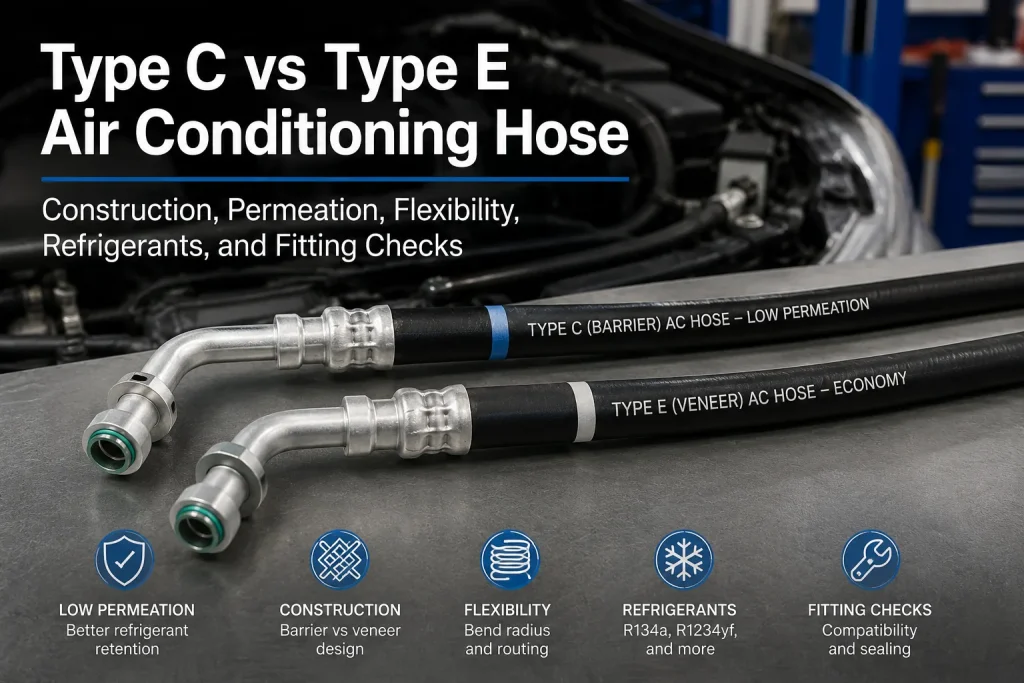
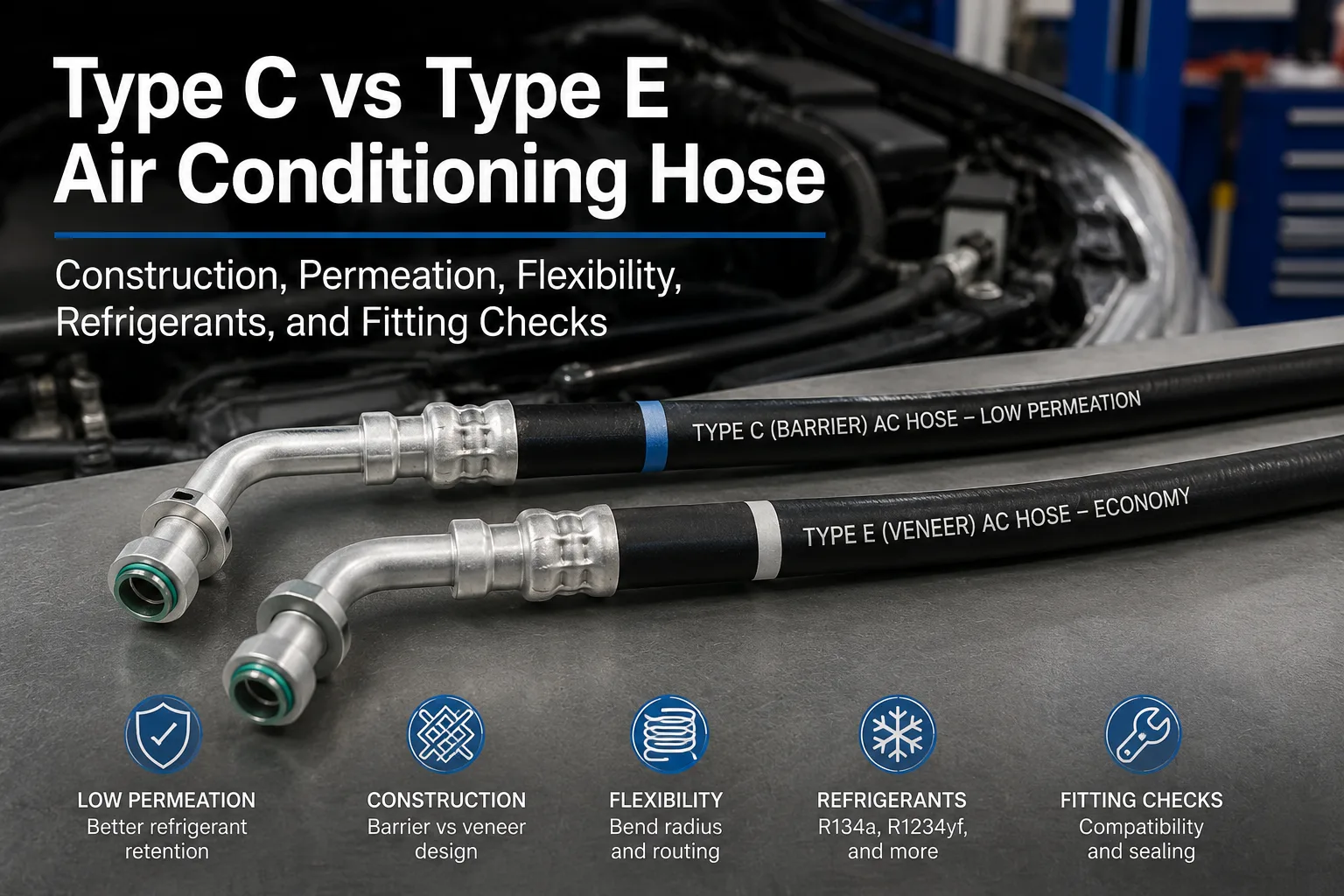
Type C vs Type E air conditioning hose selection is not a choice between a universally “better” and “basic” product. The terms describe different barrier arrangements used in automotive refrigerant hose, but they do not independently confirm flexibility, refrigerant compatibility, permeation, outside diameter, or fitting interchangeability. Engineers, assembly businesses, distributors, and technical buyers should compare the actual construction and completed connection system before approval.
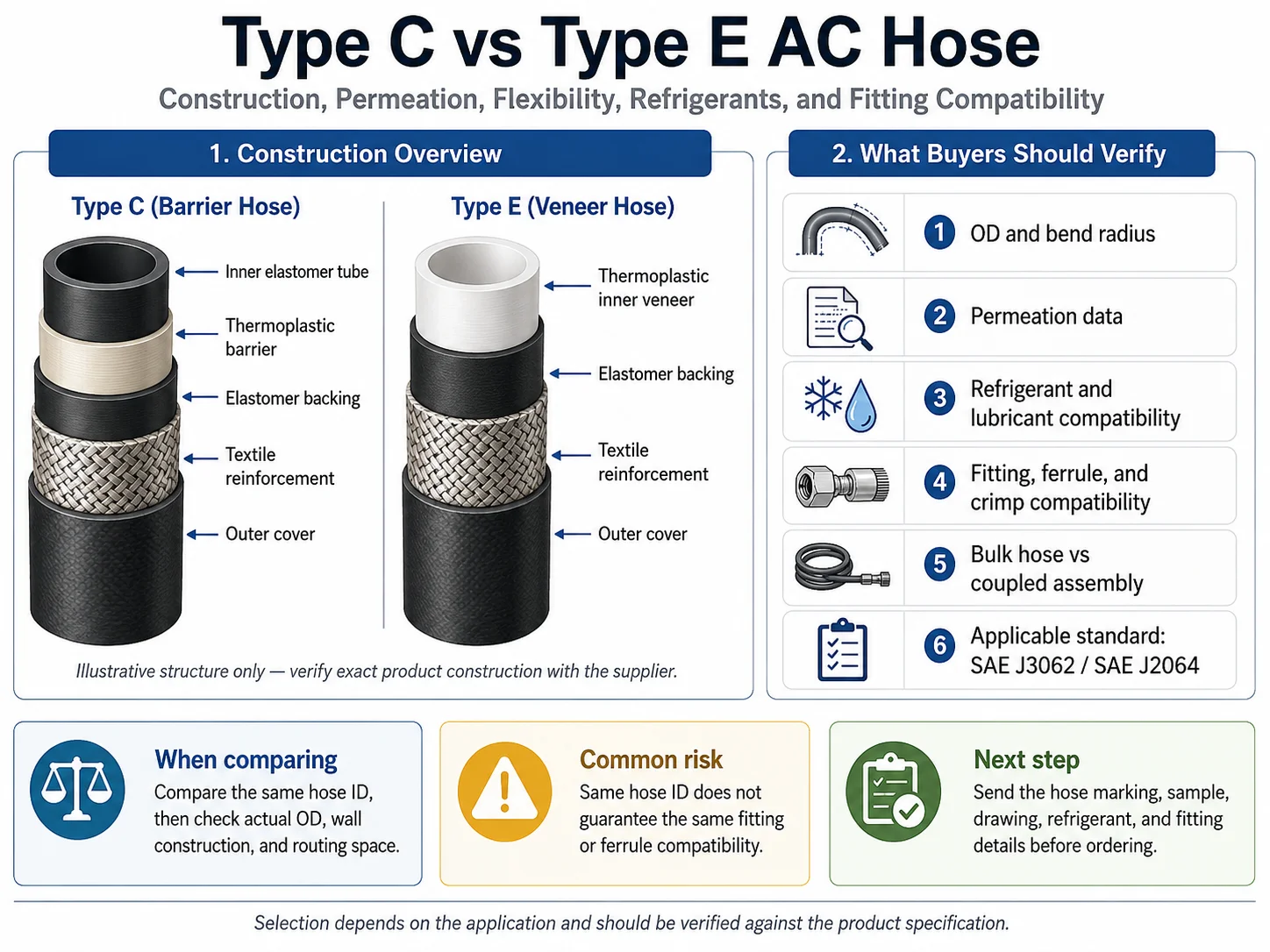
The central distinction is the position of the thermoplastic refrigerant-control layer. In commonly referenced industry definitions, Type C is a textile-reinforced barrier hose with a thermoplastic barrier between elastomeric layers. Type E is a textile-reinforced veneer hose with a thermoplastic veneer lining the inside diameter and an elastomeric layer outside it.
| Comparison point | Type C | Type E | Buyer should verify |
|---|---|---|---|
| Basic structure | Barrier between elastomeric layers | Veneer at the inner bore | Actual layer sequence |
| Flexibilité | Product-dependent | Product-dependent | OD and bend radius |
| Permeation | Product-dependent | Product-dependent | Tested value and refrigerant |
| Fittings | Must match the exact hose | Must match the exact hose | Stem, ferrule, and crimp data |
| Replacement | Not automatically interchangeable | Not automatically interchangeable | Full application validation |
A typical Type C arrangement can include an inner elastomeric tube, thermoplastic barrier, elastomeric backing, textile reinforcement, and outer cover. A Type E veneer design places the thermoplastic layer at the inner bore, followed by elastomeric backing, reinforcement, and a protective cover.
Layer position can affect material exposure, bonding, bending behavior, and fitting selection. It does not prove that every Type C is more flexible or every Type E has lower permeation; comparable product data is still required.
For a new project, request a cross-section drawing or written layer sequence. For a replacement, compare the old hose marking, ID, OD, construction, and fitting system rather than choosing from the type letter alone.
Automotive AC hose often passes through crowded engine compartments. Useful checks are actual OD, minimum bend radius, installed length, and the straight section required beside a fitting.
A smaller OD can help where clearance is limited, but it may require a different ferrule and fitting stem even when ID is unchanged. A larger OD may use a different wall or reinforcement arrangement and require more routing space.
The SOMAXFLEX Type E automotive air conditioning hose page shows why exact data matters. Its table includes multiple IDs and, for one 13 mm ID, different listed ODs and bend-radius values. The same nominal bore therefore does not define the complete installation envelope or coupling requirement.
Compare both types at the same ID, record OD and wall thickness, check bend radius and fitting orientation, and use a sample or routing mock-up before bulk approval.
Permeation concerns refrigerant passing through the hose wall. Extractables are substances that may migrate from hose materials into the refrigerant and lubricant.
SAE J3062 states that automotive refrigerant hose should minimize refrigerant permeation and system contamination, while specific construction details are agreed between user and supplier. It covers hose intended for R-134a, R-152a, and R-1234yf systems, but that scope does not prove that every individual hose is qualified for every listed refrigerant.
A useful permeation report should identify the refrigerant and lubricant, test conditions, result units, hose size, and whether the sample was bulk hose or a coupled assembly. “Low permeability” is not a substitute for product-specific evidence.
Type C and Type E identify architecture, not a universal fluid-compatibility class. The inner material, thermoplastic layer, elastomers, refrigerant, lubricant, temperature, and exposure time all affect suitability.
SOMAXFLEX publicly lists R134a, R12, and R404a on its Type C and Type E information. The pages also identify EPDM, CSM, or IIR materials, PA or nylon barrier material, textile reinforcement, and an operating range of -40°C to +135°C.
These facts do not establish compatibility with R1234yf, R152a, R744, every compressor lubricant, or every vehicle specification. A buyer requiring a refrigerant not explicitly listed should obtain product-specific written confirmation and required test documentation.
Provide the refrigerant, lubricant, temperature, pressure, customer standard, and required permeation level. Correct dimensions cannot compensate for incompatible materials.
Two hoses with the same nominal ID may differ in OD, wall thickness, layer stiffness, and compression response.
They should not be assumed interchangeable. The fitting stem must suit the hose bore and internal construction, while the ferrule must suit the actual OD and wall response. The approved crimp dimension belongs to a defined hose-and-fitting combination, not simply to a nominal size.
Before reusing a connection or changing hose type, confirm ID and OD, product series, stem dimensions, ferrule, crimp procedure, and assembly testing. Reject corroded, scratched, deformed, or unidentified fittings; otherwise submit a sample or drawing.
SAE J3062 addresses automotive refrigerant hose. SAE J2064 addresses factory- and field-coupled automotive refrigerant hose assemblies.
SAE states that hose meeting J3062 may not meet J2064 after it is coupled. J2064 contains assembly requirements, while J3062 separates bulk-hose requirements into their own standard.
A purchase order should state whether it covers bulk hose, coupling components, or a completed assembly, and who selects, crimps, and validates the finished connection.
The correct selection is the product that meets documented requirements, not the type that sounds more advanced.
| Project requirement | Required comparison |
|---|---|
| Tight routing | OD, bend radius, and fitting orientation |
| Low refrigerant loss | Product-specific permeation data |
| Existing fittings | ID, OD, stem, ferrule, and crimp compatibility |
| New refrigerant | Written compatibility evidence |
| OEM program | Customer specification and validation documents |
| Field coupling | Approved coupling and assembly-test requirements |
A buyer can compare the published Type C automotive air conditioning hose and Type E information, but missing equivalent data should be requested before a product-level conclusion is made.
Begin with the reason for change. For tighter routing, compare OD and bend radius; for lower refrigerant loss, compare permeation under the same conditions. After failure, identify chemical, abrasion, heat, routing, or coupling causes.
Do not approve substitution until refrigerant, lubricant, ID, OD, pressure, temperature, bend radius, fittings, crimp specification, and assembly-validation requirements have been rechecked. A sample fit or prototype assembly may be appropriate where drawings or comparable data are incomplete.
A useful RFQ gives the supplier enough information to identify a suitable hose and unresolved validation steps.
Include requested type or construction, hose ID, maximum OD, refrigerant, lubricant, pressure, temperature, bend-radius limit, fitting details, SAE or customer standard, roll length, quantity, marking, and packaging. State whether the request is for bulk hose or a finished assembly.
For replacements, attach the old layline, dimensions, fitting photographs, failure location, and application details. “Type E #8 hose” alone is insufficient.
A supplier should identify actual layer sequence, dimensions and tolerances, bend radius, refrigerant scope, permeation information, compatible fitting system, applicable standard, documentation, and exact delivery scope.
SOMAXFLEX presents Type C and Type E products within its automotive range, while its industrial rubber hose manufacturer website provides product and company inquiry routes. Requirements involving fittings, ferrules, completed assemblies, R1234yf compatibility, or assembly testing should be confirmed in writing.
Type C uses a thermoplastic barrier between elastomeric layers, while Type E places a thermoplastic veneer at the inner bore. That structural difference matters, but it does not independently determine flexibility, permeation, refrigerant compatibility, or fitting suitability.
To review a project, contact SOMAXFLEX with the refrigerant, lubricant, hose ID and OD, pressure, temperature, bend space, fitting drawing, old sample or photographs, quantity, and whether the request concerns bulk hose or a completed assembly.
Type C generally places a thermoplastic barrier between elastomeric layers. Type E uses a thermoplastic veneer at the inside diameter. Confirm the exact product construction with the supplier.
Not in every case. Compare products of the same ID using actual OD, wall thickness, minimum bend radius, and test data.
They may require different stems, ferrules, and crimp settings because OD and wall construction can differ. Use a documented compatible combination.
Replacement may be evaluated, but dimensions, refrigerant, lubricant, pressure, temperature, routing, fittings, and assembly requirements must be rechecked.
No. J3062 addresses automotive refrigerant hose, while J2064 addresses coupled assemblies. A compliant bulk hose does not automatically make the assembly compliant.