


A data center liquid cooling hose should not be selected by diameter or pressure alone. Engineers and buyers must match it to the coolant, required flow, allowable pressure drop, operating temperature, routing space, and connection method. A hose that looks suitable on a datasheet may still restrict flow, kink near a rack manifold, react with the coolant, or overload a fitting. This guide turns system requirements into a practical specification for new installations, retrofits, replacements, and supplier RFQs.
First define the hose’s function inside the cooling loop. A short server rack cooling hose, a flexible CDU-to-manifold connection, and a larger distribution line do not face the same flow, routing, or maintenance conditions.
Flexible hose is useful where movement, vibration isolation, installation tolerance, or service access makes rigid piping impractical. Before selecting a CDU cooling hose, identify the connection points, flow direction, routed length, available bend space, and maintenance requirements.
Rack-level jumpers usually prioritize compact routing and service access. Longer CDU-to-rack connections place more emphasis on flow capacity, pressure drop, stability, and support. A hose suitable for a short rack connection may not be appropriate as a main supply line, even when the nominal ID is the same.
The Open Compute Project’s cold-plate work includes evaluation of EPDM hose length, routing, hose guides, quick-disconnect interfaces, and higher-flow connections. This supports treating installation layout as part of the specification.
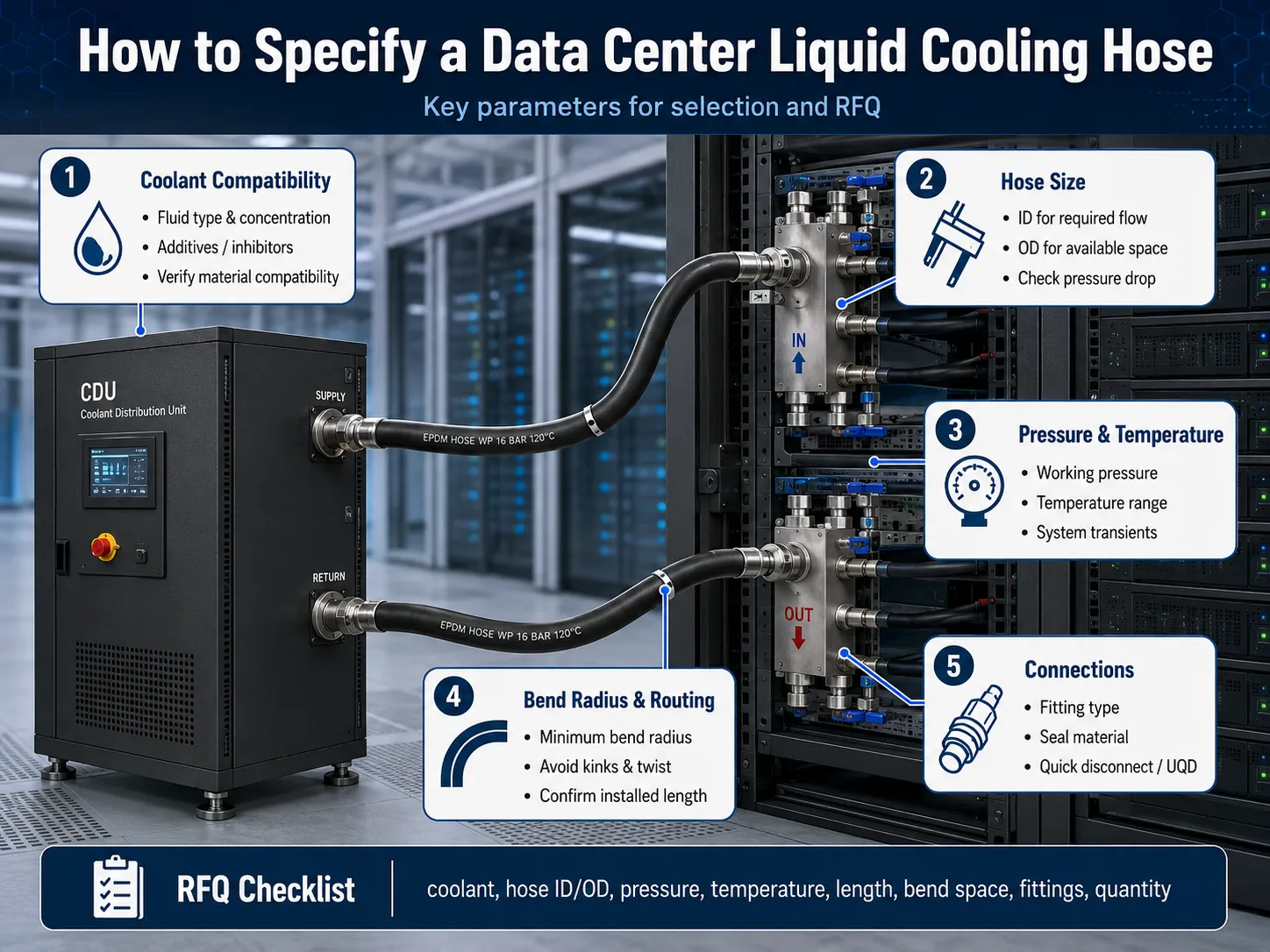
Material selection begins with the coolant, not the hose color or the term “water cooling.” Provide the coolant’s commercial name, base fluid, concentration, inhibitor package, expected temperature range, and cleaning chemicals.
Peroxide-cured EPDM may be considered for some water-based systems, but not every EPDM compound is compatible with every glycol concentration, inhibitor, biocide, or proprietary coolant.
The SOMAXFLEX EPDM data center liquid cooling hose uses a black peroxide-cured EPDM tube described as calcium- and zinc-free, high-tensile textile reinforcement, and an EPDM cover. Its published application is data center liquid cooling. The page also states push-on fitting compatibility and a temperature range of -40°F to 248°F. Compatibility with a specific coolant formulation should still be confirmed against the project specification.
For dielectric fluids, unusual additives, concentrated glycol mixtures, or an unidentified coolant, request a written compatibility review or application-specific testing before production.
Liquid-cooling loops may contain narrow cold-plate passages, filters, valves, and manifolds. Material degradation, particles, extractables, or incompatible additives may affect coolant condition or restrict components.
Ask what the “calcium- and zinc-free” statement covers, whether extractables or ion-release data are available, and whether testing used the actual project coolant. If evidence is unavailable, do not turn a general material description into claims such as “zero contamination.” Where cleanliness is critical, require prototype validation.
The correct data center cooling hose size depends on flow, routed length, fluid properties, fittings, valves, quick disconnects, and allowable pressure loss. Rack power alone does not determine hose ID.
Start with the design flow for each line. Document installed length, including bends and service loops. Include fittings, valves, and quick disconnects because their passages may be smaller than the hose bore.
| Selection factor | What the buyer should confirm | Risk if ignored |
|---|---|---|
| Required flow | Design flow per line or rack | Inadequate cooling flow |
| Routed length | Installed length including service allowance | Unexpected pressure drop |
| Hose ID | Usable internal flow diameter | Restriction or oversizing |
| Fitting bore | Smallest connection passage | Hidden bottleneck |
| Coolant properties | Exact fluid and concentration | Incorrect flow assumptions |
| Allowable pressure drop | System design limit | Pump or flow imbalance |
The SOMAXFLEX product page lists IDs from 3/16 inch to 2 inches, with corresponding ODs and bend-radius values. These dimensions support size comparison but do not replace flow calculations.
An undersized hose can increase velocity and pressure loss, leaving insufficient flow at the rack or cold plate. Narrow adapters or quick disconnects may worsen the restriction.
Oversizing can require more rack space, a wider bend, larger fittings, stronger support, and greater clearance. It may add weight without improving performance when another component remains the bottleneck.
When ID is uncertain, compare the complete flow path, identify the smallest internal passage, calculate expected pressure loss, and validate the configuration with the system designer.
Check ratings for the complete assembly, including hose, fittings, seals, valves, and quick disconnects. The lowest-rated component sets the practical limit.
Working pressure is the intended normal service pressure; burst pressure is not an operating target. Consider pump startup, rapid valve movement, blocked flow, thermal expansion, and other transient conditions.
The published SOMAXFLEX specification lists 16 bar working pressure and 64 bar burst pressure across its stated size range. Final suitability still depends on system design, temperature, fluid, fittings, and safety margin.
An RFQ should include normal pressure, maximum expected pressure, and any test or transient requirement.
Confirm coolant temperature and local ambient conditions. Outdoor climate alone is not the hose operating temperature; projects in the Middle East, Europe, Russia, or South America may have different equipment-room designs and fluid temperatures.
The product page describes the EPDM cover as abrasion-, ozone-, and UL94 V0 flame-resistant. Verify what was tested, which report applies, and whether the requirement covers the cover compound or the finished hose. A material rating does not prove that the complete installation meets every facility or local fire requirement.
A hose can meet pressure and material requirements yet fail because the route is too tight. Kinking reduces flow area and concentrates stress near bends or fittings.
Compare minimum bend radius with actual space, including the straight section needed near a fitting. Published SOMAXFLEX values rise with hose size, from 20 mm for the smallest listed ID to 204 mm for the 2-inch size.
A short hose may be stretched or pulled sideways. An excessively long hose may form unsupported loops, contact edges, or block service access. Twisting can also deform the hose.
Use drawings, rack models, or a physical sample before bulk purchasing. Record length, tolerance, fitting orientation, support points, and service-loop needs. OCP’s EPDM routing work reinforces the importance of installation geometry.
Nominal connection size does not define a complete interface. Hose ID, fitting stem dimensions, seal material, retention method, pressure rating, and quick-disconnect standard must be reviewed together.
A hose described as compatible with push-on fittings still requires a fitting designed for its ID, OD, construction, pressure, and installation method. The mating port and seal must also match the coolant and temperature.
Where a project specifies Universal Quick Disconnects, verify the exact interface and revision rather than using “UQD” generically. The Open Compute Project describes UQD as an open, spill-free interface for data center liquid cooling, with standardized plug-and-socket dimensions and sealing under pressure.
The SOMAXFLEX page confirms push-on fitting compatibility, but not public UQD compliance or finished assembly availability. Confirm those points in writing.
Leaks, kinks, hardening, swelling, abrasion, and connection stress can have different causes. Replacing the hose without finding the cause may repeat the failure.
A leak near a fitting may result from an incorrect stem, damaged seal, poor retention, side loading, or incompatible materials. A kink may indicate insufficient bend space, excessive length, twisting, or a hose that is too large. Hardening, softening, or swelling can indicate temperature exposure, aging, or chemical incompatibility.
Inspect a line when there is leakage, blistering, exposed reinforcement, severe flattening, cracking, or connection movement. Record coolant, pressure, temperature, installation date, failure location, fitting details, and photographs. Avoid assigning a universal replacement interval; inspection criteria vary with material, coolant, duty cycle, temperature, and movement.
A useful RFQ reduces assumptions before price and production are discussed. It should allow the supplier to assess whether a standard hose is appropriate and identify unresolved technical points.
Include:
A sample fitting, dimensional drawing, schematic, or measured photograph is more useful than an unsupported assumption.
A supplier should identify tube, reinforcement, cover, available dimensions, pressure and temperature limits, fitting compatibility, and application restrictions. It should also distinguish hose-only supply from matching accessories or finished assemblies.
As an industrial rubber hose manufacturer, SOMAXFLEX publishes a detailed size table and construction for this liquid-cooling product. Its industrial hose manufacturing capabilities cover a broader hose range, while the product page gives the data-center application details. Buyers should still request written confirmation of coolant compatibility, connection scope, reports, and order-specific availability.
A reliable specification starts with coolant and flow, then checks ID, pressure loss, working pressure, temperature, bend radius, routing, and connections. No single diameter, material, or rating fits every CDU, manifold, or server-rack connection.
For a compatibility and availability review, contact SOMAXFLEX with the coolant specification, flow, hose dimensions, operating conditions, routing drawing, connection details, quantity, and any sample or failure photographs.
It depends on coolant, concentration, additives, temperature, cleanliness, pressure, and connection method. Peroxide-cured EPDM may suit some water-based systems, but compatibility should be verified.
Not in every formulation or concentration. Confirm the glycol type, inhibitor package, concentration, and temperature with the hose supplier.
Calculate size from flow, line length, coolant properties, fitting bore, quick disconnects, and allowable pressure drop. Rack power alone is insufficient.
It depends on the project, installation location, and facility requirements. Confirm what material or component was tested and whether the report applies to the proposed hose.
They can be used when the specification permits them and the stem dimensions, hose ID and OD, pressure, coolant, retention method, and installation procedure all match.