
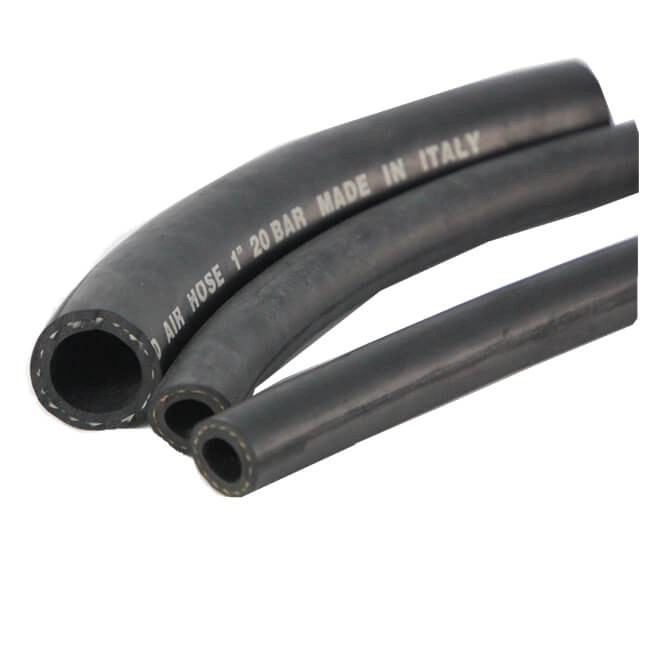
Le tuyau d'air comprimé de 20 bars est largement utilisé pour les outils pneumatiques, les ateliers, les chantiers et les applications industrielles. Lors de nombreux achats, il est désigné par l'appellation « 300 PSI », ce qui explique pourquoi les acheteurs comparent ce type de tuyau en caoutchouc de 300 PSI avec celui en acier de 40 bars avant de passer commande en gros. Cependant, le choix du tuyau adapté ne doit pas se baser uniquement sur la pression nominale. Il dépend également du débit du compresseur, du besoin en air, de la longueur du tuyau, de son renforcement, de la température, des raccords et du lieu d'utilisation.
Un tuyau d'air comprimé de 20 bars est conçu pour une pression de service de 20 bars dans des conditions normales d'utilisation. La pression de service est différente de la pression d'éclatement. La pression de service correspond à la pression d'utilisation courante, tandis que la pression d'éclatement est la pression maximale à laquelle le tuyau peut se rompre lors des tests. Les acheteurs industriels doivent toujours vérifier ces deux valeurs avant de passer commande.
Dans les documents d'achat, la pression de 20 bars est souvent arrondie à 300 PSI pour faciliter les comparaisons sur les marchés nord-américains et d'exportation. Cela ne signifie pas pour autant que tous les tuyaux d'air de 300 PSI ont la même structure. Un tuyau d'air en caoutchouc renforcé de textile, un tuyau d'air renforcé de fil d'acier et un tuyau polyvalent air/eau peuvent tous afficher des pressions nominales, mais leurs performances réelles dépendent du matériau du tube, de la couche de renforcement, du composé de revêtement, de leur comportement en flexion, de leur résistance à l'abrasion et de leur plage de températures.
Un tuyau utilisé sur une ligne d'air comprimé propre en usine est soumis à des contraintes différentes de celles d'un tuyau traîné sur du béton, de la roche, des arêtes d'acier ou un terrain minier. Un tuyau court raccordé à une perceuse pneumatique ne subit pas la même perte de pression qu'un long tuyau de compresseur alimentant des outils pneumatiques à fonctionnement continu. C'est pourquoi la pression nominale d'un tuyau d'air doit être lue en tenant compte de son utilisation complète.
Un tuyau d'air comprimé en caoutchouc de 20 bars est généralement suffisant pour les applications courantes lorsque la pression du compresseur, la demande des outils et les conditions du chantier restent dans une plage modérée. Il est typiquement utilisé pour l'alimentation en air des ateliers, les chaînes de montage, les stations de réparation, la distribution d'air sur les chantiers, les outils pneumatiques courants et certaines tâches de soutien dans le secteur minier, à condition que le tuyau ne serve pas de conduite de refoulement haute pression.
Pour les outils pneumatiques tels que les perceuses, les cloueuses, les agrafeuses, les outils à percussion légers, les pistolets à peinture et les outils de nettoyage courants, un tuyau d'air en caoutchouc de 300 PSI offre un bon compromis entre pression de service, flexibilité, maniabilité et coût. Il est également plus facile à enrouler, à déplacer, à stocker et à installer que les tuyaux en fil d'acier plus lourds. Cet avantage est important pour les distributeurs et les entrepreneurs qui ont besoin d'un tuyau polyvalent et facile à manipuler sur les chantiers.
Le Tuyau d'air en caoutchouc 20 bars Le tuyau d'air SOMAXFLEX de 20 bars, à surface lisse, répond à ce besoin général. Conçu comme un tuyau air/eau en caoutchouc, il supporte une pression de service de 20 bars. Son tube est en caoutchouc synthétique noir, lisse et résistant aux brouillards d'huile, renforcé par une tresse de fil synthétique haute résistance. Le revêtement extérieur est en caoutchouc synthétique lisse, noir ou coloré, résistant aux intempéries et à l'abrasion. Il est conçu pour résister à des températures allant de -35 °C à 80 °C et convient à une utilisation générale dans l'industrie, sur les chantiers de construction et dans les mines.
Un tuyau d'air comprimé en acier de 40 bars est plus adapté aux applications nécessitant une pression d'air comprimé plus élevée, un cycle de service plus intensif, une manipulation agressive ou une marge de sécurité accrue. Il n'est pas systématiquement nécessaire, mais son utilisation devient plus judicieuse lorsque le tuyau est installé à proximité de compresseurs, de points de refoulement haute pression, d'outils industriels fonctionnant en continu, sur des chantiers difficiles ou dans des environnements miniers où les chocs et l'abrasion sont fréquents.
La principale différence réside dans le renforcement. Les tuyaux d'air renforcés en textile sont souvent privilégiés pour leur flexibilité et leur polyvalence. Les tuyaux d'air renforcés en fil d'acier sont quant à eux choisis lorsque la pression et les risques liés au chantier sont plus élevés. Pour les tuyaux d'air comprimé haute pression destinés à la construction, à la distribution d'air comprimé sur de longues distances ou aux outils pneumatiques haute pression, une structure interne plus robuste peut faire toute la différence en termes de fiabilité.
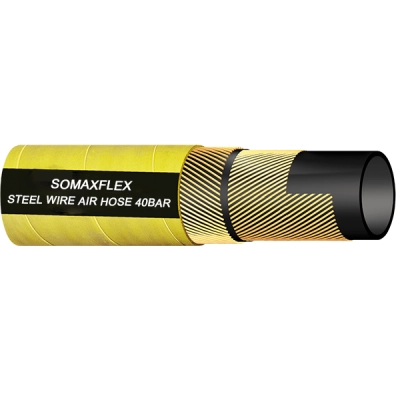
Tuyau d'air en fil d'acier SOMAXFLEX 40 BAR Ce tuyau est conçu pour les applications d'air comprimé haute pression renforcées par un fil d'acier. Il est composé d'un tube en caoutchouc NBR noir lisse, d'un renforcement par fil d'acier haute résistance et d'un revêtement en caoutchouc EPDM jaune résistant aux intempéries et à l'ozone. La plage de température d'utilisation est de -30 °C à +70 °C. Les données techniques standard indiquent une pression de service de 40 bars et une pression d'éclatement de 120 bars pour plusieurs diamètres intérieurs (13 mm, 19 mm, 25 mm, 32 mm, 38 mm et 51 mm), avec une longueur maximale de 61 mètres. Les diamètres intérieurs de plus grande taille (63,5 mm et 76 mm) sont conçus pour une pression de service de 30 bars et une pression d'éclatement de 90 bars.
| Facteur de sélection | Tuyau d'air en caoutchouc 20 bars / 300 PSI | Tuyau d'air en fil d'acier de 40 bars |
|---|---|---|
| Utilisation principale | Air comprimé général, outils pneumatiques, distribution d'air/eau | Air comprimé haute pression et services industriels plus lourds |
| Renforcement | Fil synthétique à haute résistance ou renfort textile | Renforcement par fil d'acier à haute résistance |
| Manutention | Plus flexible et plus facile à déplacer | Structure plus robuste, généralement pour des charges plus lourdes. |
| marge de pression | Adapté à de nombreuses applications courantes | Capacité de pression plus élevée pour les applications exigeantes |
| Site typique | Atelier, usine, construction générale, soutien minier | Construction difficile, exploitation minière, refoulement de compresseur, service intensif |
| Priorité à l'acheteur | Flexibilité, maîtrise des coûts, usage général | Résistance, réserve de pression, construction renforcée |
Le choix d'un tuyau pneumatique de 20 bars ne doit pas se baser uniquement sur sa pression nominale. La comparaison entre un tuyau de 20 bars et un tuyau de 40 bars doit prendre en compte l'utilisation prévue. Pour une alimentation pneumatique classique dans un environnement contrôlé, une pression de 20 bars peut suffire. En revanche, si le tuyau est utilisé à proximité d'équipements haute pression, exposé à des terrains accidentés ou soumis à des conditions exigeantes, une construction en acier renforcé de 40 bars mérite d'être sérieusement envisagée.
La pression maximale du compresseur n'est pas le seul critère à prendre en compte. Il est important de vérifier la pression de service normale, les fluctuations de pression, le débit d'air, le débit d'air requis par l'outil et le cycle de service. Une meuleuse ou une ponceuse utilisée en continu consomme plus d'air qu'un outil utilisé par brèves impulsions.
Les longs tuyaux augmentent la perte de charge. Si le tuyau est long, le système peut nécessiter un diamètre intérieur plus important, des raccords plus robustes ou une marge de pression plus élevée. Un tuyau performant à 10 mètres peut ne pas l'être à 50 mètres, notamment avec des outils pneumatiques à alimentation continue.
Un tuyau d'air industriel de qualité doit être analysé en fonction de sa structure. Le tube intérieur est en contact avec l'air comprimé et les brouillards d'huile. La couche de renforcement supporte la pression. Le revêtement extérieur protège le tuyau contre l'abrasion, les intempéries, l'ozone et les dommages liés à la manipulation. Cette structure à trois couches est particulièrement importante pour les chantiers de construction, les mines et les interventions en extérieur.
Pour les acheteurs qui s'approvisionnent en tuyaux d'air comprimé en gros, la capacité du fournisseur est tout aussi importante que les spécifications du produit. Un fabricant qualifié doit garantir une production stable, la vérification des spécifications, des contrôles qualité, une assistance en matière d'emballage, la coordination des exportations et des conseils pratiques lorsque l'application n'est pas clairement définie.
C'est ici que SOMAXFLEX fabricant de tuyaux en caoutchouc industriels Nous pouvons accompagner les acheteurs recherchant des tuyaux d'air de 20 bars, des tuyaux d'air en caoutchouc de 300 PSI et des tuyaux d'air renforcés par un fil d'acier de 40 bars pour une utilisation industrielle. Notre gamme de tuyaux d'air comprend des produits 20 bars à surface lisse et à surface enveloppée, des tuyaux 20 bars polyvalents et des tuyaux 40 bars renforcés par un fil d'acier. Au-delà du catalogue, à propos de SOMAXFLEX reflète l'expérience de fabrication dans le domaine des tuyaux en caoutchouc industriels, des installations certifiées ISO, des lignes de production automatisées, des équipements de test de précision, une flexibilité pour les petites quantités, un soutien en R&D et un service d'exportation.
Pour les distributeurs, les entrepreneurs et les acheteurs OEM/ODM, l'intérêt pratique ne se limite pas à un simple devis. Il réside dans la possibilité de discuter, avant la production, des dimensions suivantes : diamètre intérieur et extérieur, longueur, pression de service, pression d'éclatement, matériau du caoutchouc, renforcement, couleur, emballage et conditions de livraison.
Un tuyau d'air comprimé de 20 bars convient à de nombreuses applications d'air comprimé et d'outils pneumatiques, notamment lorsque la flexibilité, la maniabilité et la maîtrise des coûts sont des critères importants. Un tuyau d'air comprimé en caoutchouc de 300 PSI peut suffire pour les ateliers, les usines, les chantiers de construction et la distribution d'air comprimé industriel en général, à condition que la pression, la longueur, les raccords et l'environnement soient adaptés. Un tuyau d'air comprimé en acier de 40 bars est préférable lorsque l'application requiert une pression plus élevée, un renforcement plus important et une meilleure résistance aux conditions de travail difficiles.
Les acheteurs peuvent envoyer le type d'outil, la pression du compresseur, le débit d'air requis (CFM), le diamètre intérieur du tuyau, sa longueur, la norme de raccordement, l'environnement de travail et la quantité commandée via Contactez SOMAXFLEX pour le choix des tuyaux d'air pour recevoir des suggestions de produits, des échantillons, des devis ou des conseils en matière de spécifications personnalisées.
Q1 : Que peut-on faire avec un tuyau d'air de 20 bars ?
A: Un tuyau d'air comprimé de 20 bars sert à alimenter en air comprimé les outils pneumatiques, les circuits d'air comprimé des ateliers, les chantiers de construction et certains services de soutien minier. Ce type de produit est souvent privilégié lorsqu'il est nécessaire d'équilibrer pression de service, flexibilité et facilité d'utilisation.
Q2 : Un tuyau d'air en caoutchouc de 300 PSI est-il suffisant pour les outils pneumatiques ?
A: Dans la plupart des cas, un tuyau d'air en caoutchouc de 300 PSI est suffisant pour les outils pneumatiques s'il répond aux exigences de l'outil pneumatique (pression et CFM), s'il a une longueur de tuyau optimale et un raccord correct.
Q3 : Pourquoi dois-je envisager de choisir un tuyau d'air en fil d'acier de 40 bars ?
A: Si vous avez besoin d'un tuyau d'air comprimé à haute pression, pour des applications industrielles intensives, une utilisation sur des chantiers de construction difficiles, des applications minières ou une ligne de refoulement de compresseur d'air comprimé, il est recommandé d'opter pour un tuyau d'air en fil d'acier de 40 bars.
Q4 : Quelle est la différence entre un tuyau d'air renforcé par du textile et un tuyau d'air renforcé par un fil d'acier ?
A : Un tuyau d'air renforcé de textile est généralement plus flexible et convient aux applications d'air comprimé courantes. Un tuyau d'air renforcé de fil d'acier possède une couche de renforcement plus épaisse et est mieux adapté aux pressions plus élevées, aux cycles de service plus intensifs et aux environnements de travail plus difficiles.
Q5 : Comment choisir la pression nominale appropriée pour mon tuyau d'air ?
A : Choisissez la pression nominale du tuyau d'air en tenant compte de la pression de service, de la pression d'éclatement, du réglage du compresseur, de la demande de l'outil, du facteur de marche, de la longueur du tuyau, de la température, du renforcement, de la résistance du revêtement et des raccords. La pression nominale appropriée doit correspondre à l'environnement de travail complet, et pas seulement à la pression de sortie du compresseur.