
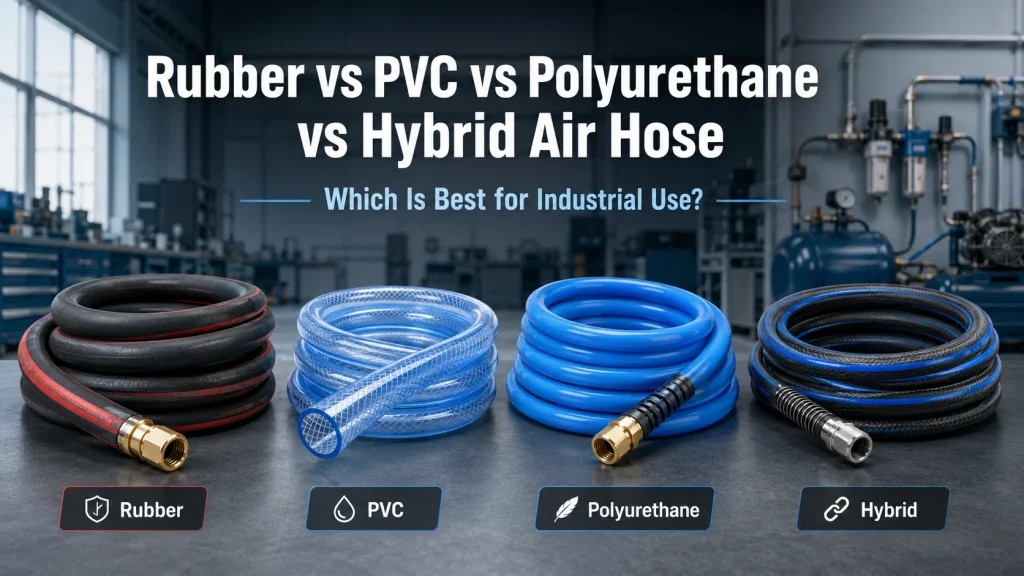
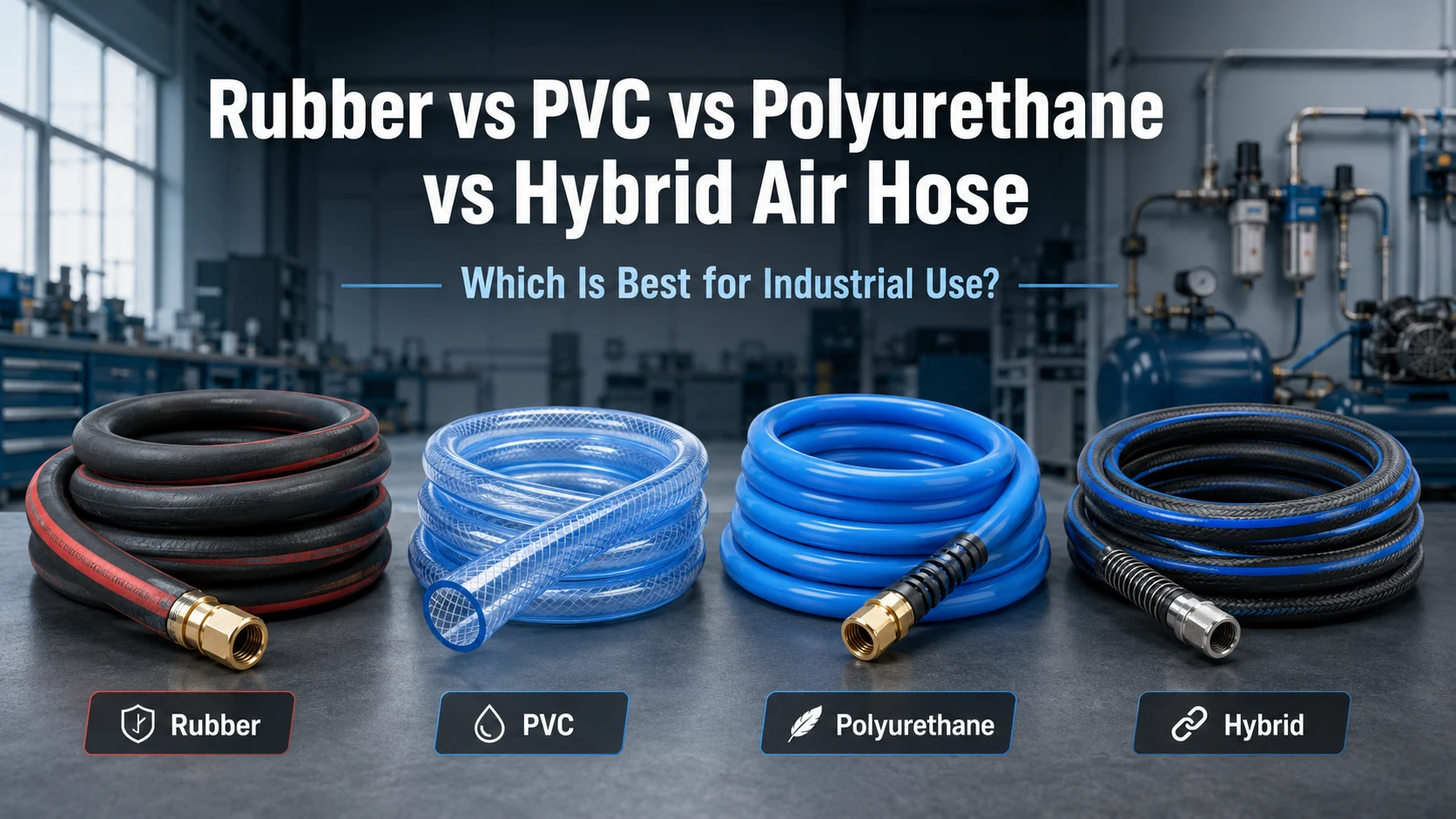
A rubber vs PVC vs polyurethane vs hybrid air hose comparison should begin with the operating environment, not the material name. A hose used on a construction site faces different risks from one installed on an assembly line or retractable reel. Temperature, dragging, oil mist, movement frequency, working pressure, bend radius, and downtime cost can all change the purchasing decision.
Rubber is often considered for demanding outdoor and industrial service. Polyurethane can reduce hose weight in frequently moving applications. Hybrid hose may provide a practical balance between flexibility and handling, while PVC can suit controlled, light-duty use where initial cost is a major consideration. The correct choice still depends on the complete hose construction and verified product specification.
Industrial hose performance is not determined by the cover material alone. A typical rubber hose includes an inner tube that contacts the medium, a reinforcement layer that supports pressure, and an outer cover that protects against weathering, abrasion, and mechanical damage. Changes to any of these layers can affect flexibility, pressure capability, and service conditions.
| Decision factor | Rubber | PVC | Polyurethane | Hybrid |
| Typical purchasing priority | Industrial durability | Lower initial cost | Low weight and mobility | Balanced flexibility and handling |
| Cold-weather handling | Often favorable, depending on compound | May become stiff | Depends on grade and construction | Often selected for flexibility |
| Frequent tool movement | Suitable, but can be heavier | May have more memory | Often suitable | Often suitable |
| Rough-ground dragging | Common with a suitable cover | Usually limited to lighter service | Must be verified | Must be verified |
| Hose-reel use | Suitable if bend radius and weight are acceptable | Application-dependent | Often considered | Often considered |
| Main purchasing risk | Assuming all rubber compounds perform alike | Selecting by price alone | Confusing air hose with pneumatic tubing | Treating “hybrid” as a standardized specification |
Use the table to identify a likely material family, then confirm the actual working pressure, temperature rating, inner diameter, reinforcement, bend radius, media compatibility, and fitting requirements.
Rubber air hose is a practical starting point for road construction, quarries, mines, industrial maintenance, and other locations where the hose may be dragged across rough ground or exposed to changing weather. It may also suit compressor lines and pneumatic tools when the selected inner tube is compatible with light oil mist.
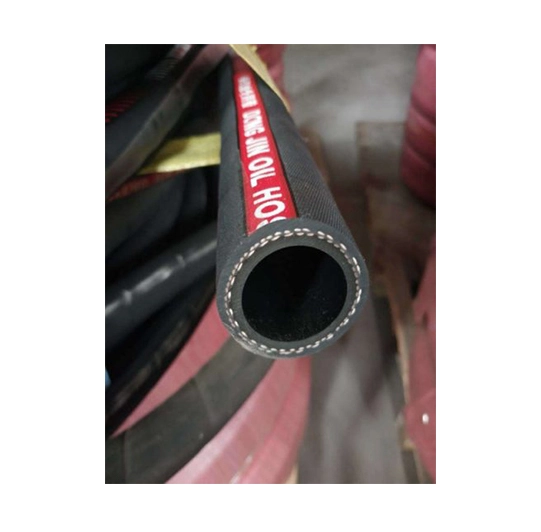
The main disadvantage is weight. A heavy rubber assembly may create unnecessary operator fatigue in a repetitive assembly station or on a long overhead reel. Buyers should therefore compare the value of durability against the frequency with which the hose must be lifted, pulled, or repositioned.
For demanding site applications, the SOMAXFLEX 20 bar wrapped rubber air hose uses an SBR inner tube, high-strength synthetic-cord reinforcement, and an EPDM wrapped cover. Its listed applications include air drills and pneumatic tools in mines, quarries, road construction, and the building industry. The product specification lists a temperature range from −30°C to +70°C.
Polyurethane and hybrid air hoses are commonly considered when low weight, easy handling, and repeated movement matter more than the rugged feel of a heavier rubber hose. Possible applications include automotive workshops, production assembly areas, mobile pneumatic tools, and retractable hose reels.
However, a lightweight hose should not automatically be selected for sharp debris, hot surfaces, welding areas, or continuous dragging. The buyer should verify abrasion performance, bend radius, temperature limits, coupling compatibility, and whether the product is intended for outdoor compressor service.
It is also important to distinguish reinforced polyurethane air hose from small-bore pneumatic tubing. Pneumatic tubing is frequently installed within machinery and control systems, but its pressure range, fittings, wall construction, and environmental exposure may be different from those required for a portable industrial compressor hose. Product selection should be based on the intended application rather than the word “polyurethane” alone.
PVC air hose may be suitable for controlled indoor conditions, intermittent operation, and purchasing situations where low initial cost is important. It can be a reasonable option when the hose is not frequently dragged, tightly coiled, or exposed to low temperatures.
Problems occur when a light-duty hose is placed in a more demanding application than its specification allows. Cold stiffness can make handling difficult, while high material memory may contribute to coiling and kinking. Repeated dragging can damage the cover, and a kinked hose may restrict airflow to the tool.
Before replacing PVC with rubber, polyurethane, or hybrid hose, check whether the original problem was caused by material, excessive hose length, insufficient inner diameter, poor routing, or a reel with an unsuitable bend radius. Changing material will not correct an undersized air line or restrictive coupling.
Cracking, hardening, swelling, soft spots, surface cuts, and exposed reinforcement are warning signs, but they do not all indicate the same cause. Cracking after cold exposure may point to an unsuitable temperature range. Swelling or softening may indicate that oil, solvent, or another contaminant is incompatible with the inner tube. Rapid external wear may mean that the cover is not suitable for the floor surface or dragging frequency.
Chemical resistance should be checked against the specific compound and medium. General material guides provide an initial reference, but final suitability can vary with concentration, temperature, exposure time, pressure, and product formulation.
Record where the damage appears, how quickly it develops, and which environmental conditions are present. This information helps determine whether the next hose needs a different tube compound, cover, reinforcement, or installation method.
Why does an air hose keep kinking even after the material is changed? The problem may be excessive length, tight routing, a small reel drum, or a hose that is too soft for the installation. Weak pneumatic-tool performance may result from insufficient inner diameter, long hose runs, restrictive quick couplings, or pressure loss rather than the hose polymer.
Leaks and cracks near the coupling can also indicate incorrect fitting selection, poor assembly, repeated bending at the hose end, or insufficient strain relief. A stronger cover will not correct an incompatible fitting.
Before ordering a replacement, document the hose ID, length, working pressure, connection type, tool airflow demand, reel dimensions, and failure location. This turns a general complaint such as “the hose is not durable” into a specification that a supplier can evaluate.
An industrial air hose should not be twisted during installation or forced below its specified minimum bend radius. Sharp bends create concentrated stress, particularly near couplings. Guide points, supports, or protective sleeves may be appropriate where the hose repeatedly contacts edges or moving equipment.
Pneumatic-tool connections should also be secured against accidental separation where required by the workplace and application. OSHA guidance addresses positive means of preventing pneumatic tools and hoses from unintentionally disconnecting because a released pressurized hose can create a whipping hazard.
For permanent and reel-mounted installations, confirm that the selected hose can accommodate the expected movement without being stretched, crushed, or pulled sideways at the fitting.
Routine inspection should look for cuts, cracks, hard areas, soft spots, bulges, loose covers, exposed reinforcement, leaking couplings, and permanent kinks. OSHA states that compressed-air hose should be examined before use and that visibly damaged or unsafe hose should not be used.
Storage conditions also matter. Avoid unnecessary UV exposure, heat, sharp objects, chemical contamination, and coils that force the hose into a tight radius. The SOMAXFLEX industrial air hose range includes different surface finishes, reinforcement types, and pressure categories, allowing the construction to be selected around the actual operating condition rather than appearance alone.
An effective industrial air hose RFQ should identify:
Der SOMAXFLEX industrial hose website separates air hose from chemical, oil, steam, material-handling, automotive, and other hose categories. This distinction matters because a hose designed for compressed air should not be selected only because another product has a similar diameter, color, or pressure marking.
Does air hose material determine working pressure? Not by itself. Pressure capability depends on the complete structure, including reinforcement, wall dimensions, temperature, coupling system, and assembly quality. A textile-reinforced rubber air hose and a steel-wire-reinforced rubber air hose may use related elastomer families while serving different pressure requirements.
Buyers should compare working pressure rather than relying only on burst pressure. They should also check whether the published rating applies across the full temperature range and whether the hose assembly, fittings, and clamps have compatible ratings.
For larger orders, product documentation may also need to define dimensional tolerance, marking, color, cut length, packaging, and any required protective sleeves or accessories. SOMAXFLEX product information indicates that material, dimensions, length, color, and reinforcement can be discussed according to the application.
A supplier should be able to identify the inner tube, reinforcement, cover, dimensions, pressure data, temperature range, and intended application. General claims such as “heavy duty,” “oil resistant,” or “cold resistant” are not enough without product-level specifications.
Ask whether the supplier can:
Der SOMAXFLEX company profile describes a product scope focused on light- and medium-duty industrial rubber hoses, while SOMAXFLEX service documentation outlines specification-based quotations and OEM/ODM cooperation based on hose type, length, pressure level, and operating environment.
Industry conditions also affect the questions a supplier should ask. Construction and mining applications may involve dragging, impact, dust, outdoor exposure, and repeated movement, while factory installations may prioritize routing, reel behavior, and operator handling. A credible recommendation should reflect these differences rather than assigning one material to every industrial application.
Rubber, PVC, polyurethane, and hybrid air hoses each serve different operating priorities. Rubber is often considered for demanding outdoor and high-wear service. Polyurethane or hybrid constructions may be more practical where weight and repeated movement are major concerns. PVC may fit controlled, light-duty applications where its temperature and handling limits are acceptable.
The final decision should be based on the medium, pressure, temperature, airflow, movement, abrasion risk, reinforcement, fittings, and consequences of failure. To review a requirement, submit the hose ID, length, working pressure, temperature range, operating environment, fittings, target quantity, and any failure photographs through request an air hose specification review.
Q1: Is rubber air hose better than hybrid air hose?
A: Rubber may be more appropriate for rough outdoor service and repeated dragging, while hybrid hose may be easier to handle on reels and mobile tools. Compare the actual cover, reinforcement, weight, temperature range, and working pressure rather than choosing by material name alone.
Q2: Which air hose stays flexible in cold weather?
A: Cold-weather performance depends on the specific compound and construction. Rubber and some polyurethane or hybrid hoses may remain flexible at low temperatures, while some PVC products may become stiffer. Verify the manufacturer’s minimum operating temperature.
Q3: What is the most durable air compressor hose material?
A: There is no single most durable material for every environment. A hose that resists abrasion may still be unsuitable for heat, oil, chemicals, tight bending, or frequent reel use. Durability should be judged against the main failure risk.
Q4: When should a PVC air hose be replaced with rubber?
A: Consider a change when cold stiffness, cracking, dragging damage, or repeated kinking continues after correcting hose size, routing, and coupling issues. Confirm that the replacement rubber hose has the required pressure, temperature, and media compatibility.
Q5: What specifications are needed when ordering an industrial air hose?
A: Provide the medium, working pressure, temperature, ID, length, airflow requirement, reinforcement, movement pattern, environmental exposure, fittings, quantity, and any marking or packaging requirements. These details allow the supplier to recommend a product construction rather than quote from material name alone.