

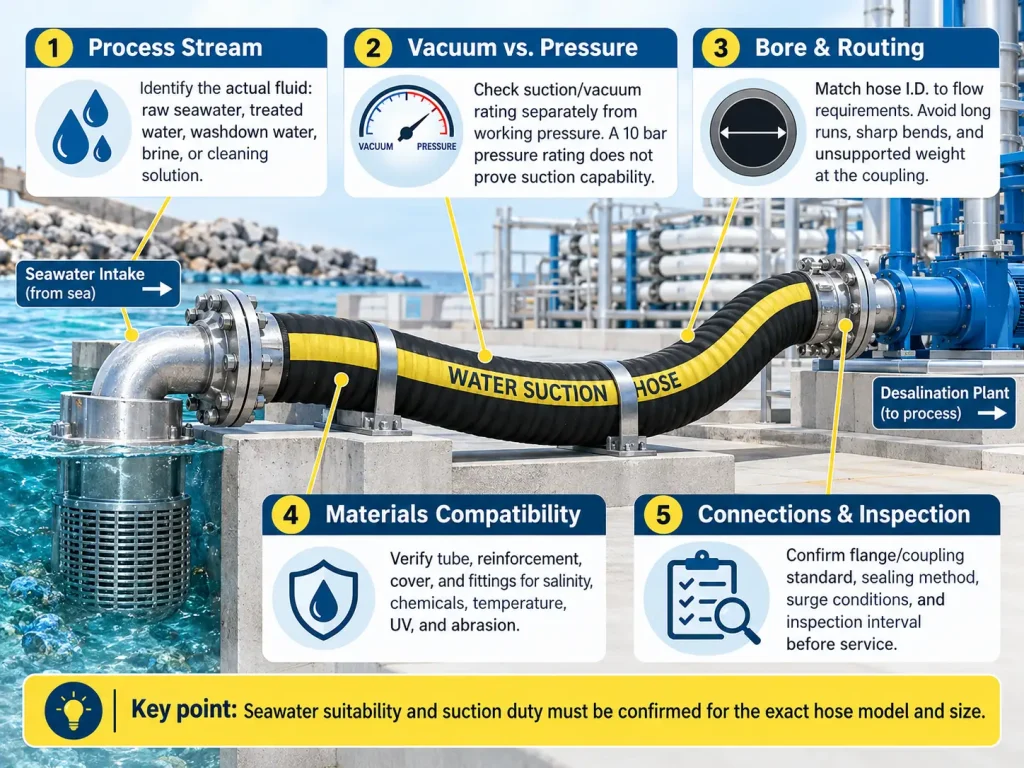
A water suction hose for a desalination plant must match the exact duty point, not simply the word “water.” Start by identifying whether the hose will handle raw seawater, treated water, washdown water, or another stream. Then verify its vacuum rating, flow requirements, fluid compatibility, temperature range, routing, and end connections against the pump and project specification. A general water suction and delivery hose may suit some low-pressure water duties, but a standard hose listing alone does not establish suitability for seawater, continuous intake service, or reverse-osmosis feed pressure.
“Desalination plant water” covers several different services. Raw seawater at an intake, screened feed water, permeate after treatment, utility water, cleaning solution, and concentrated brine do not present the same conditions. Record the fluid at the exact point where the hose would be installed. Include salinity, suspended solids, treatment additives, cleaning chemicals, and any planned flushing or disinfection. If the plant team cannot confirm the composition, treat compatibility as unresolved until the process owner supplies it.
Also establish the hose’s role. A short flexible connection at a pump skid or a temporary transfer line is a different engineering task from a permanent offshore intake line. Large desalination intakes commonly form part of a site-designed system that accounts for intake location, screening, civil works, pipe loads, and environmental constraints. Do not replace that system with a flexible hose based only on nominal bore or pressure rating. Ask the project engineer to confirm that a hose is appropriate at the proposed connection.
On a suction line, the hose experiences vacuum relative to the surrounding atmosphere. The hose must resist collapse at the maximum vacuum the pump can create in the actual installation. Check the manufacturer’s stated vacuum or suction rating for the selected diameter, length, temperature, and construction. A working-pressure figure describes positive pressure service; it does not substitute for a vacuum rating.
Ask the pump supplier or system designer for the required flow, pump curve, suction lift, inlet pressure, and allowable pressure loss. The hose bore and route affect friction losses, while a long run, small bore, sharp bends, restrictive fittings, or a clogged strainer can reduce pressure at the pump inlet. Confirm the design against the pump’s permitted inlet conditions and cavitation margin. Do not choose a smaller hose simply because its end connection fits. If the project has not set a flow rate, keep the diameter provisional and request the hydraulic designer’s flow and inlet-loss limits before finalizing it.
Record both normal and abnormal conditions. Include startup, shutdown, pump shutoff, transient pressure, intermittent operation, and any possibility of a blocked outlet or water hammer. For a suction-and-discharge hose, check the positive-pressure duty and the suction duty separately. The hose assembly, including couplings and clamps, must suit the more demanding applicable condition.
Match the inside diameter to the system design and keep the route as direct as practical. Confirm the hose length, bend radius, elevation changes, support points, and clearance from hot surfaces or moving equipment. Avoid twisting the hose during installation, forcing it into a tighter bend than its specification permits, or leaving its weight unsupported at the coupling. These conditions can strain the reinforcement and connections even when the hose’s nominal ratings appear adequate.
For suction service, ask how the hose construction maintains its shape under vacuum. A helix or other reinforcement may form part of the design, but its presence alone does not state the allowable vacuum. Request the rating for the exact product size and configuration. Confirm whether the chosen fittings preserve the bore and whether the assembly supplier approves them for the stated duty.
Confirm that the tube compound, reinforcement, cover, and end connections tolerate the actual fluid and exposure. Seawater brings chloride and salt exposure; cleaning or pretreatment chemicals can introduce additional compatibility questions. Consider both the fluid inside the hose and the external environment, including sunlight, ozone, abrasion, standing water, and washdown. Metal reinforcement and fittings may need corrosion review as well as the rubber tube.
Do not rely on a generic “water service” label to approve seawater, brine, or chemical cleaning duty. Ask for a written compatibility statement that names the medium, concentration, temperature range, exposure duration, and hose construction. If a process uses several fluids, check each one, including flushing and cleaning steps. A compatibility chart can help shortlist materials, but the final decision should use the exact compound and operating conditions.
Separate operating pressure from vacuum, surge pressure, and proof or burst values. Verify what each rating means, how it applies to the assembled hose, and whether the system can exceed normal conditions. Confirm the nominal bore and outside diameter, connection standard, sealing method, coupling material, retention method, and any project documentation required at handover. The hose and coupling ratings must agree.
Before commissioning, inspect the assembly for cuts, bulges, exposed reinforcement, a flattened section, loose fittings, or damage from transport and storage. Set an inspection interval based on the manufacturer’s instructions and plant risk assessment. Remove a hose from service when its condition or identification makes its rating uncertain. Do not use an unverified hose to test the limits of the pump or intake system.
Compare product pages only after the service requirements are clear. The Somaxflex water hose category lists several water products, including suction-and-delivery designs. Its published wrapped-surface water suction and delivery hose is described for water and non-corrosive fluids in construction and light-duty industrial applications. That description does not confirm seawater, brine, chemical cleaning, continuous desalination intake, or reverse-osmosis feed service.
The same caution applies when comparing Somaxflex’s wrapped-surface water suction and delivery hose with its corrugated-surface variant: a surface or product-name difference does not establish a different pressure, vacuum, or chemical capability. Review each model’s technical sheet and request written confirmation for the intended fluid and duty. Do not treat a water-hose listing as approval for seawater unless the manufacturer confirms that application for the exact model and size.
For an initial review, the Somaxflex water hose range shows the product types currently listed. Before placing an order, submit the process stream, bore, flow, vacuum, working and transient pressure, temperature, hose length, routing, connection details, and quantity so the proposed assembly can be checked against the application.
Choose a desalination plant suction hose from the duty point outward. Identify the fluid and hose location, confirm that flexible hose belongs in that part of the system, and verify vacuum, flow loss, positive-pressure conditions, materials, fittings, and inspection requirements. If the product documentation omits seawater or the required vacuum duty, treat the selection as unconfirmed. A written product-specific fit check is more useful than a broad water-service label.
Only when the manufacturer confirms the exact hose construction for the seawater conditions, including salinity, temperature, vacuum, pressure, and exposure. A generic water-service description does not prove saltwater compatibility.
No. Working pressure is a positive-pressure rating. Ask for the separate vacuum or suction rating for the selected size and operating conditions.
Not without an engineering review. A plant intake system may include civil, hydraulic, screening, structural, and environmental requirements beyond a hose connection.
Provide the fluid and additives, flow rate, bore, length, suction vacuum, positive and transient pressure, temperature, route, end connections, installation environment, and quantity. Include pump or system data where available.
For a product-specific review, contact Somaxflex with the duty details and request confirmation for the exact hose assembly before specification or purchase.