
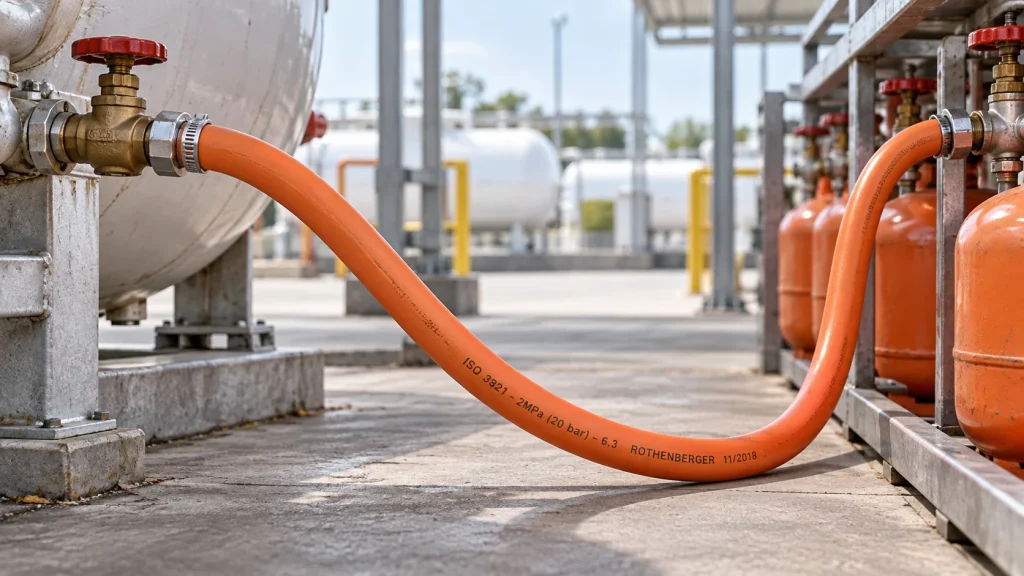
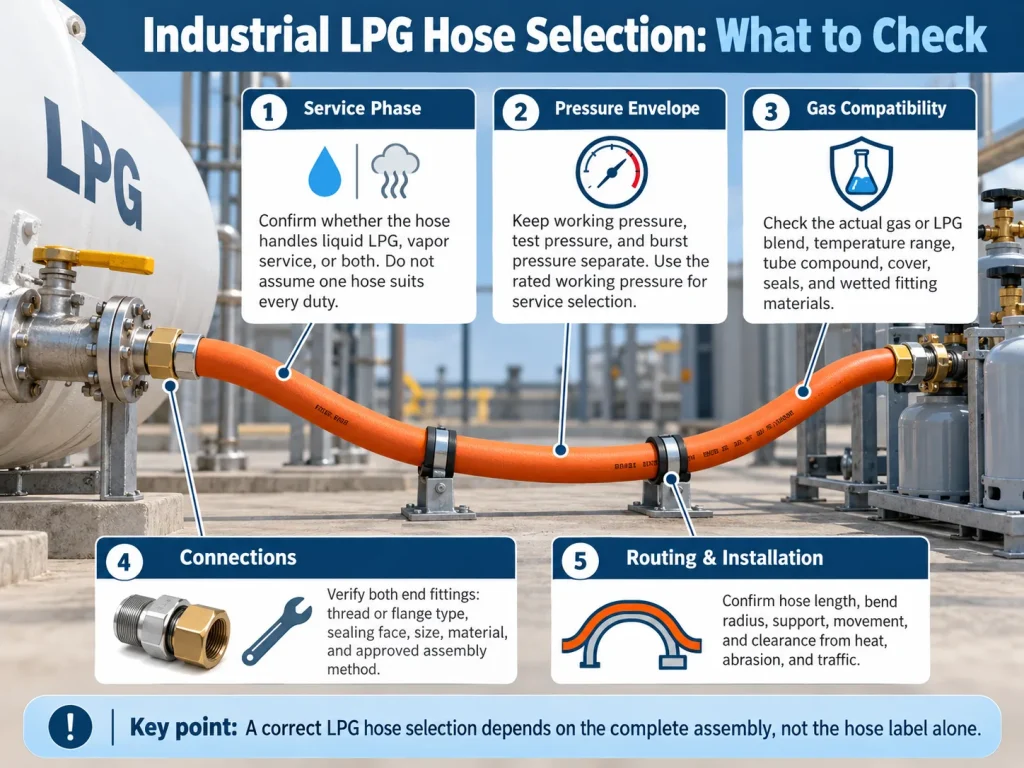
Selecting an industrial LPG hose starts with the service, not the color or a generic pressure figure. Confirm whether the line handles liquid transfer or vapor delivery, define the maximum operating conditions, verify compatibility for the actual gas and hose construction, then check the end connections as part of the complete assembly. A hose is suitable only when its documented limits match the application and the local project requirements.
Write down what the hose connects and what moves through it. Industrial LPG duties can include loading, unloading, bulk transfer, cylinder or tank connections, and vapor delivery to equipment. These duties may involve different gas phases, flow conditions, movement, and connection arrangements. A hose selected for one task should not be assumed suitable for another simply because both are described as propane or LPG service.
Start with the gas composition or commercial designation, liquid or vapor phase, source and destination, flow requirement, operating pressure, temperature range, and whether the hose is stationary or repeatedly handled. Note outdoor exposure, sunlight, abrasion, vehicle traffic, and the minimum bend space.
Somaxflex lists several LPG hose constructions in its Somaxflex LPG hose range, including a delivery hose for LPG to EN 1762 and an ISO 3821 propane hose. The pages describe different products and duties; neither label should be treated as a universal specification for every LPG installation. For a deeper discussion of the standard boundary between transfer and vapor applications, see the standards comparison guide.
Record the highest pressure the hose assembly can experience, not only the normal pressure shown during steady operation. Include startup and shutdown events, regulator or pump behavior, pressure cycling, trapped liquid, and any other credible transient stated by the system designer. Also record the gas and ambient temperature range because the permitted pressure can depend on the hose construction, size, temperature, and assembly configuration.
Compare the application requirement with the manufacturer’s published working-pressure rating for the exact hose and assembly. Check units carefully and confirm whether the value refers to gauge or absolute pressure where that distinction matters to the design. Do not infer a working limit from a burst value, a test pressure, a reinforcement description, or a rating for another diameter. Ask the supplier to identify the applicable data sheet and the exact product code behind every quoted value.
Working pressure is the declared service limit for the specified product under stated conditions. Test pressure describes a verification procedure; burst pressure describes a failure threshold under a defined test. They answer different questions and are not interchangeable. A safety factor printed beside a product does not authorize operating above its working-pressure limit, and a buyer should not calculate a new service rating from test or burst data without the manufacturer’s approval.
For example, Somaxflex publishes 2 MPa working pressure and 6 MPa burst pressure for its ISO 3821 propane hose. Those values belong to that listed product and should not be transferred to its LPG delivery hose or to a custom assembly. The published EN 1762 delivery-hose page identifies the application and construction but should be checked for the current size-specific pressure data and assembly limits before quotation or installation.
The complete assembly may be limited by more than the hose body. Couplings, inserts, clamps or crimped ends, seals, adapters, and the assembly method all need compatible pressure ratings and approval for the service. If any component has a lower limit, the assembled system must be specified around that constraint rather than the hose’s headline rating.
Compatibility is a property of the gas, phase, temperature, and complete materials set, not a broad claim that rubber is suitable for LPG. Identify the intended propane, butane, or commercial mixture and confirm whether the hose will carry liquid, vapor, or both during its duty. Ask the manufacturer to verify the tube compound, reinforcement, cover, seals, and any wetted fitting materials for that exact medium and operating range.
Material names can help identify a construction but do not replace a compatibility statement. Somaxflex lists a smooth NBR tube and a CR cover on its EN 1762 LPG delivery product. That information confirms the stated construction; it does not establish suitability for every LPG blend, phase, temperature, or fitting combination. Review the product documentation for permeation, electrical continuity, cleaning restrictions, and any exclusions relevant to the installation.
Do not substitute a natural-gas hose, fuel hose, welding hose, or general-purpose hose based on appearance or a similar connection. Nor should an LPG hose be reassigned to a different gas without written confirmation. Where local regulations or a client specification apply, confirm the required product standard, markings, conformity documents, and installation rules for the country and facility. The governing requirements can differ across markets even when the same hose family is considered.
Specify both ends of the assembly. For each connection, provide the interface type, nominal size, thread or flange details, gender, sealing face, material, orientation, and any required swivel or adapter. A photograph or dimensioned drawing can help when the mating equipment has a proprietary or uncommon interface, but it should supplement measured specifications rather than replace them.
Confirm that the fitting is designed for the selected hose size and construction, that the attachment method is approved for that hose, and that seals and wetted parts suit LPG service. Check the assembly drawing or bill of materials for the exact end configuration. Do not mix a fitting from one hose family with another, reuse a crimped fitting, or rely on a thread that merely starts to engage. Correct fit depends on the sealing geometry and assembly method, not thread diameter alone.
Plan the installed route as well as the interface. Confirm length, minimum bend radius, movement envelope, support, and clearance from heat, sharp edges, and traffic. The hose should not carry torsion, side load, or the weight of unsupported pipework at the coupling. Keep the assembly within its stated bend limits and use the specified restraint and bonding arrangements where the system design requires them.
A product image can help compare the visible hose profile with a drawing, but it cannot confirm thread form, sealing face, internal bore, pressure rating, or material compatibility. Treat those as document checks. For a fit review, send the duty description, hose size and length, required working pressure, temperature range, gas phase, and clear views or drawings of both mating connections.
A useful RFQ gives the supplier enough information to match the product and assembly without guessing. Include the gas and phase, duty, normal and maximum pressure, expected surges, temperature range, nominal bore, overall length, bend requirement, end fittings at both ends, installation country, quantity, and any required standard or project document. Attach a drawing when connection details are difficult to describe. Ask for the current data sheet, assembly specification, pressure limits, material compatibility, and product marking for the quoted configuration.
Before installation, compare the delivered hose and fittings with the approved order and drawings. Check product identification and markings, confirm there is no visible cut, kink, crush, exposed reinforcement, deformation, or damaged sealing surface, and verify that the route preserves the specified bend and support conditions. Inspection and any leak or pressure test should follow the manufacturer’s instructions and the governing site procedure; do not improvise a test method or pressure.
Retain product identification, assembly details, inspection findings, and service history to support later inspection and like-for-like replacement.
A dependable industrial LPG hose selection process checks service phase, pressure envelope, gas compatibility, and both end connections as one system. The decisive evidence is the current specification for the exact hose and assembled ends, not a generic LPG label or an isolated burst figure. Define the operating duty, verify every material and interface, and confirm country-specific requirements before release for service.
Not by assumption. The product specification must explicitly cover the phase or phases, gas composition, pressure, temperature, and duty involved.
No. Use the published working-pressure rating for the exact product and conditions. Burst pressure and test pressure describe different limits or procedures.
No. Confirm thread form, sealing face, size, materials, hose compatibility, and assembly method. Similar-looking threads may not create a suitable seal.
Provide the gas phase and composition, operating conditions, hose dimensions, required end connections, installation country, quantity, and drawings or photos of unusual interfaces.
For a project-specific fit check, contact the Somaxflex team with the duty, required pressure and temperature range, hose dimensions, connection details, installation country, and quantity.