
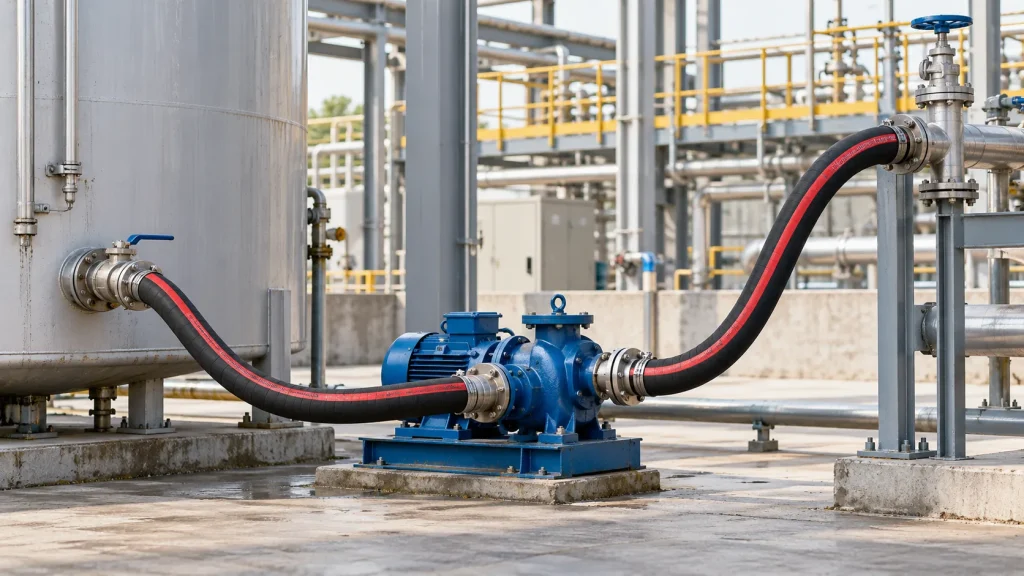
Oil suction and oil discharge hoses serve different positions in a transfer system. A suction hose sits on the pump inlet and must tolerate vacuum without collapsing; a discharge hose sits on the outlet and must contain the positive pressure created by the pump. The oil itself does not determine the difference. Pump position, pressure direction, fluid compatibility, temperature, and whether the line must handle both duties determine the right specification.
On the suction side, the pump lowers pressure inside the hose and draws oil toward the inlet. The hose wall faces external atmospheric pressure, which can flatten a construction that lacks adequate vacuum resistance. On the discharge side, the pump pushes oil through the line, so the hose must withstand the specified internal working pressure, including operating variation and any applicable surge conditions.
This distinction is about operating duty, not a universal rule that every suction hose must be rigid or every discharge hose can be lightweight. Hose construction varies by product design. A hose sold for suction and discharge service is intended to address both pressure directions, but the exact vacuum and positive-pressure ratings still need to match the system.
A suction line typically connects a tank, reservoir, or other oil source to the pump inlet. Its performance depends on more than the hose label. Lift height, line length, bends, fittings, oil viscosity, temperature, and pump speed can affect inlet conditions. Excessive restriction or a hose that deforms under vacuum can reduce flow and contribute to loss of prime or unstable pump operation.
A discharge line carries oil from the pump outlet toward a tank, machine, or process. The pump produces positive pressure on this side, so the selected hose and assembled connections must accommodate the expected working pressure. Pressure drop through a long or undersized line can also affect system performance. Determine the operating range from the equipment and system design rather than choosing by a generic suction-versus-discharge label.
A hose used at a pump inlet must resist collapse at the vacuum level the system can create. Reinforcement, wall construction, diameter, bend radius, and support all affect how the hose behaves. A visible helix or other reinforcement may be part of a particular design, but appearance alone does not confirm a vacuum rating. Confirm the rating and minimum bend requirements in the current product specification.
Oil adds a separate compatibility requirement. The tube material must suit the specific oil or petroleum product, including its additives or aromatic content where relevant. Temperature matters because it can change material behavior and fluid viscosity. A construction suitable for one fuel, lubricant, or hydraulic oil should not be assumed suitable for every oil-based medium.
For example, Somaxflex lists an SAE 100R4 hydraulic oil suction and delivery hose for hydraulic-system oil return lines and publishes product-specific construction and temperature information. That page is a starting point for checking a relevant product, not a substitute for confirming that its current vacuum, pressure, size, and compatibility details match the intended circuit.
Start with maximum working pressure, not burst pressure. The system designer or equipment documentation should establish normal pressure and any credible peaks. The hose assembly, end connections, and installation must all suit that duty. A pressure value listed for a hose does not automatically apply to every size, temperature, fluid, or assembly configuration.
Check temperature at the hose, not only the surrounding air. Oil temperature can rise during operation, while cold starts can increase viscosity and make a pump work harder. Then verify oil compatibility, hose inside diameter, total length, bend radius, movement, and the connection type. These factors interact: a technically compatible tube can still be unsuitable if its pressure rating or layout does not fit the service.
Where the system handles fuel or petroleum products, check whether the application requires an antistatic construction and what grounding or bonding measures the equipment design calls for. Do not infer static-control properties from a product name or appearance. Use the product specification and applicable site procedures to confirm the complete transfer arrangement.
It can when the product is explicitly designed and rated for both vacuum and positive pressure, and when its oil compatibility, temperature range, diameter, and connections suit the application. A label such as “S&D” or “suction and delivery” indicates the intended duty category, but it does not tell you the allowable vacuum or working pressure for every configuration.
If the hose will operate in only one direction under one known condition, a duty-specific hose may be appropriate. If the flow direction changes or a single assembly must connect to both sides of equipment, assess every operating mode. Treat a product rated for dual service as a candidate, then verify the actual limits rather than assuming it covers any combination of suction and pressure.
Before requesting a replacement or quotation, collect the operating facts that determine fit:
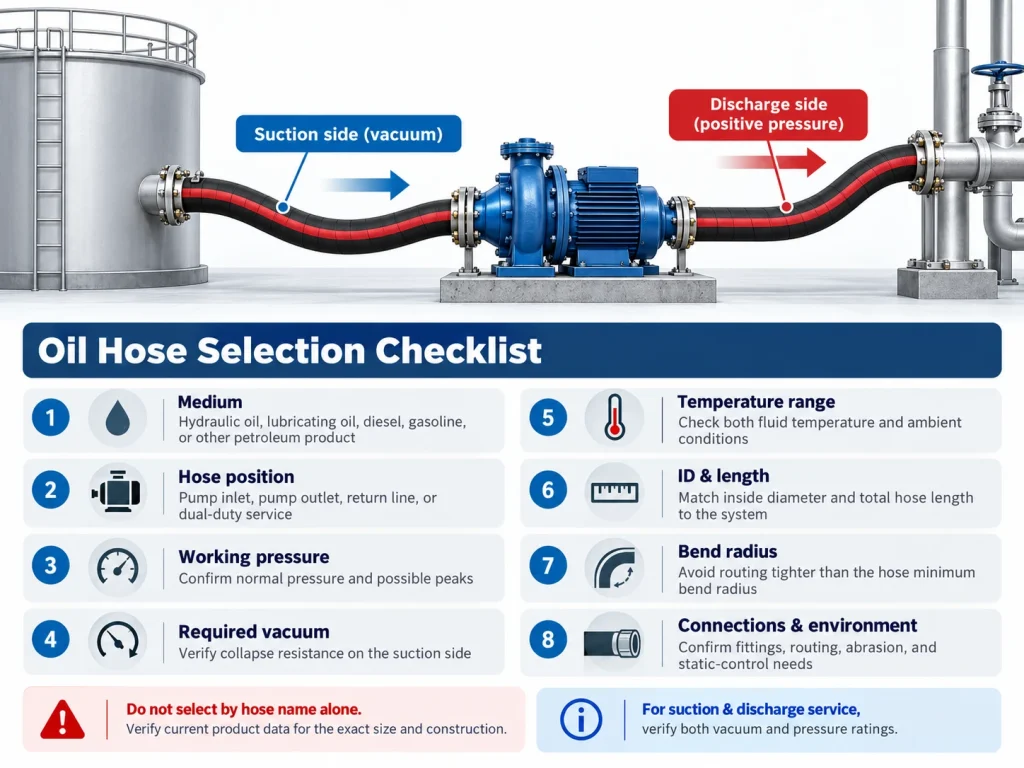
Compare the requirements with the current product data for the exact size and construction. If an existing hose is being replaced, use its markings and equipment documents as clues, not as the sole approval basis: the installed hose may have been selected for a different duty or may not match the system’s present conditions.
Somaxflex’s oil hose range includes fuel transfer, tank-truck, oil delivery, hydraulic oil, and combined suction-and-delivery offerings. The relevant choice depends on the medium and duty rather than the broad oil category alone. For instance, the listed SAE 100R4 product is described for hydraulic oil service, while a fuel oil suction-and-delivery product is listed separately. These distinctions are useful screening cues; verify the detailed product specification before selection.
When comparing options, ask for the data sheet that corresponds to the requested hose size and construction. Confirm working pressure, vacuum capability when required, fluid compatibility, temperature limits, bend requirements, and connection details in writing. For a dual-service hose, request confirmation of both pressure directions. Product category names alone are not a technical approval.
Somaxflex can be considered where the application matches a listed oil hose, but any final fit depends on the verified specification. A useful inquiry includes the exact medium, pump arrangement, pressure and vacuum requirements, temperature range, dimensions, connections, and quantity. This gives the supplier the information needed to identify a relevant product or clarify what remains unknown.
Oil suction hoses work on the pump inlet and need verified resistance to vacuum; oil discharge hoses work on the outlet and need an appropriate positive-pressure rating. Either type also requires compatibility with the actual oil, temperature, size, routing, and connections. A dual-service hose can cover both duties only when its published limits match every operating condition. Select from system requirements and current product data, not the hose name alone.
Only if the exact hose is rated for the required vacuum as well as the discharge pressure. A positive-pressure rating by itself does not establish resistance to collapse.
Not necessarily. Construction varies. Check the product specification for vacuum capability and installation requirements instead of relying on visible construction alone.
A hydraulic return line describes a circuit function, while suction describes the pressure condition at a pump inlet. Return-line pressure can vary by system, so confirm the actual operating pressure and whether vacuum occurs during any operating phase.
Provide the medium, inlet or outlet position, working pressure, required vacuum, temperature range, inside diameter, length, connections, routing, quantity, and relevant site requirements. Add a drawing or existing hose markings when available.
For a fit check or RFQ, send the oil type, application, dimensions, pressure and vacuum, temperature, connections, and quantity. Use “contact the technical team” to share the details, or review “Somaxflex’s oil hose range” and the relevant “SAE 100R4 hydraulic oil suction and delivery hose” or “fuel oil suction and delivery hose” product page.