
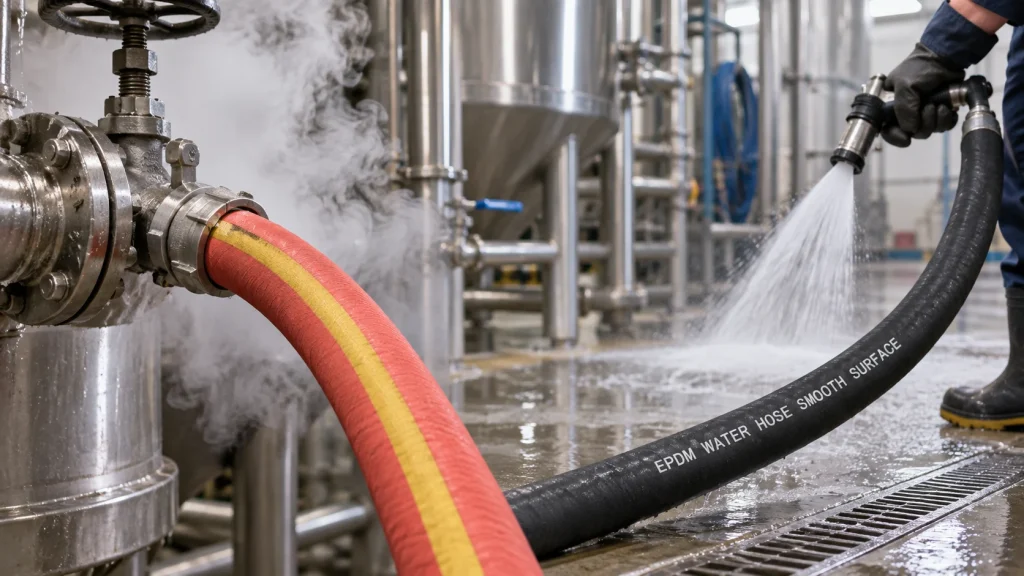
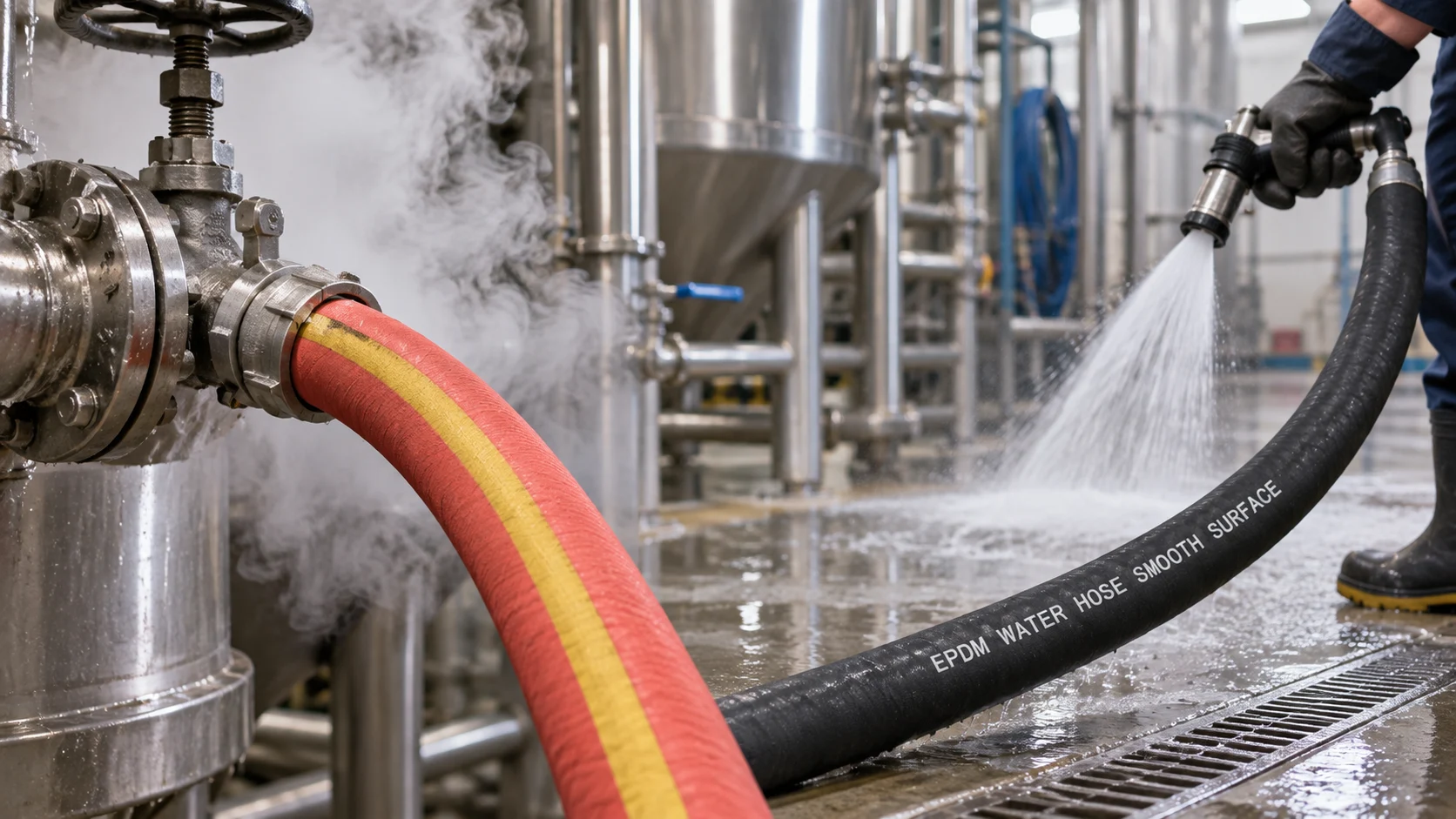
Steam hose and hot water hose can appear interchangeable because both move heated media. In an industrial system, the medium phase, temperature, pressure behavior, cleaning method, and installation layout determine whether the hose is suitable. Steam carries more thermal energy than liquid water at the same nominal temperature, and condensation can create mechanical loads that a liquid-water line does not see. The practical rule is to select for the complete operating envelope, not for temperature alone.
A steam hose is built for vapor service, where pressure cycling, heat transfer, and condensation are part of the duty. The tube, reinforcement, cover, fittings, and supports must work together under that service. Typical duties include process steam, equipment or tank cleaning, heat control, and other industrial operations where steam is intentionally delivered to the point of use.
A hot water hose is intended primarily for liquid water or a compatible hot liquid. It is commonly selected for washdown, cooling-water circulation, equipment cleaning, and transfer. A hot water rating does not automatically authorize steam service. If steam can enter the line during startup, sanitation, or a process upset, the exact hose assembly must be explicitly rated for that exposure.
| Selection factor | Steam hose | Hot water hose |
| Medium | Steam or steam condensate, subject to the model rating | Liquid water or a compatible hot liquid |
| Main design demand | Heat, pressure cycling, condensation, and dynamic loads | Liquid temperature, flow, flexibility, abrasion, and cleaning |
| Typical duties | Process steam, cleaning, heat control, industrial service | Washdown, cooling, cleaning, and hot-water transfer |
| Critical checks | Steam rating, pressure at temperature, fittings, routing | Temperature, pressure, vacuum duty, compatibility, bend radius |
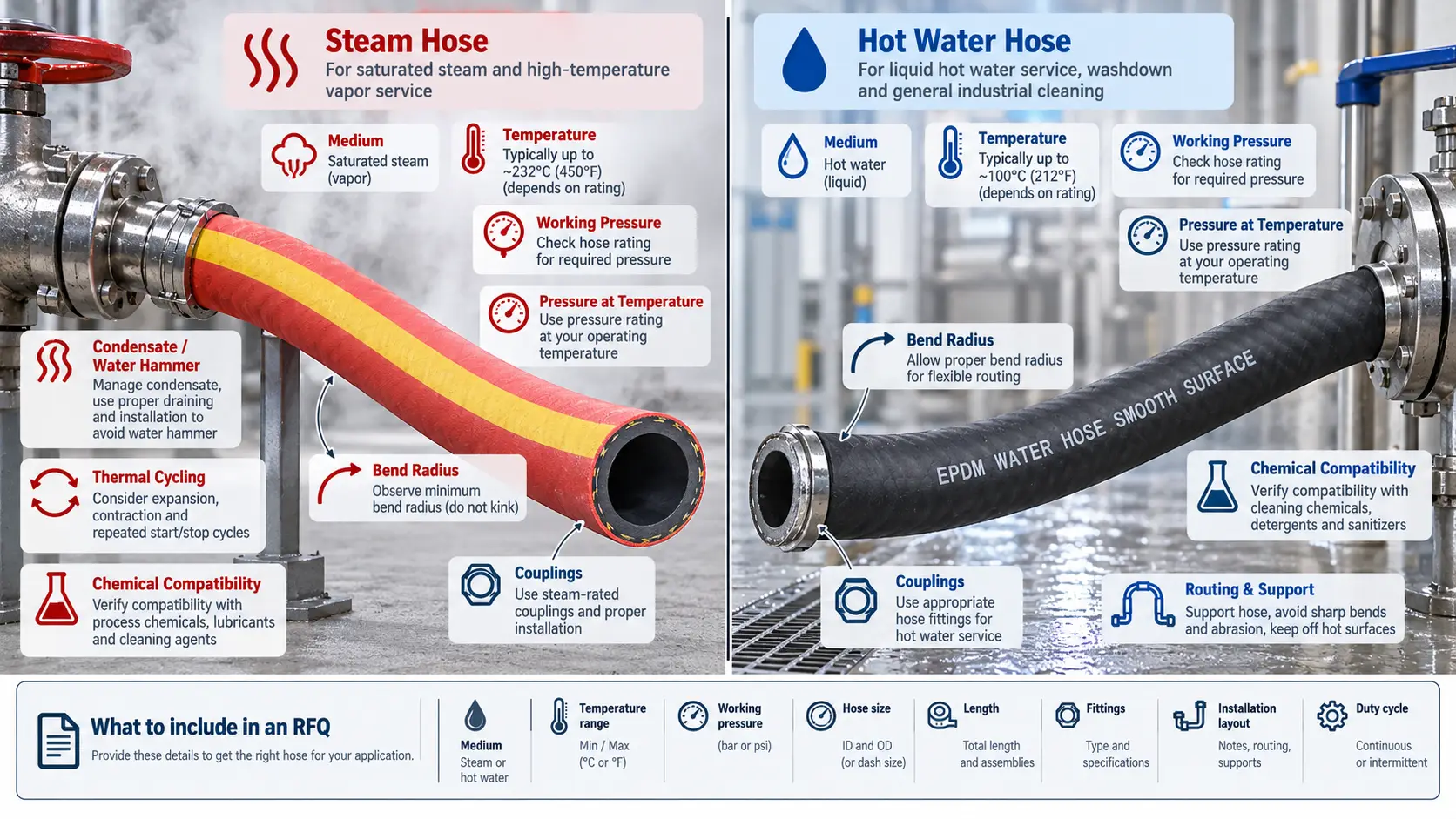
A hose rating is not one number that applies in every condition. Maximum working pressure can change with temperature, size, reinforcement, fittings, and service type. Steam systems also introduce pressure drop and condensate. When steam cools, water can collect in low points and contribute to water hammer during valve operation or rapid flow changes. The hose, couplings, clamps, and supports must be selected for those loads, not only for steady-state pressure.
SOMAXFLEX publishes a Steam Hose 7 BAR model with a 7 bar working pressure and 70 bar burst pressure across the listed 1/2 to 1 inch sizes. It also publishes a red steam hose product identified as 18 bar in the site navigation. These are model-specific references, not universal ratings. Confirm the exact size, temperature, assembly, connection, and operating cycle before purchase by reviewing the Steam Hose 7 BAR specification.
For hot water, the published EPDM Hot Water Hose table lists 20 bar working pressure and 60 bar burst pressure for the shown sizes. The separate hot-water suction and discharge model lists 10 bar working pressure and 30 bar burst pressure, with a smooth black EPDM tube, synthetic-cord reinforcement with helix wire, and a heat-, weather-, and ozone-resistant EPDM cover. Treat those values as product data for those models, not as a substitute for a system calculation.
Never use a lower-rated hot water hose simply because its temperature label appears close to the steam temperature. Steam can flash, expand, and condense inside the hose. If the application can contain steam even intermittently, specify a hose and assembly explicitly rated for that service.
In Middle Eastern plants, high ambient temperatures, outdoor routing, dust, and long transfer distances make cover durability, UV exposure, bend control, and inspection access important. In Russia and other cold-weather markets, confirm the minimum storage and operating temperature, winter flexibility, and protection from freezing condensate. European buyers may need traceable specifications and plant documentation, so the responsible engineer should confirm applicable pressure-equipment and hose-assembly requirements. In South America, mining, food processing, agriculture, and oil and gas can place very different demands on the same nominal hose type. Record the medium and duty cycle in the RFQ.
SOMAXFLEX presents steam hose products and hot water hose products as separate categories. That separation is a useful starting point for technical review. The final choice still requires a model-level check of temperature, pressure, dimensions, construction, end connections, and whether the line carries liquid, vapor, suction, discharge, or a combination.
First, confirm the actual medium at the point of use. A line called “hot water” may receive steam during startup, sanitation, or a process upset. Second, measure the route and preserve the specified minimum bend radius. Twisting a hose to align fittings can concentrate stress in the reinforcement. Third, support long vertical or horizontal runs so the hose is not carrying the weight of the fittings or a column of fluid.
Use compatible couplings and clamps, and verify that the assembly method matches the hose construction. Inspect the cover for cuts, blistering, abrasion, hardening, or heat damage. For steam, drain low points where the system design requires it and open valves gradually to reduce thermal shock. For hot water, check whether cleaning chemicals, oils, detergents, or antifreeze are present because chemical compatibility can matter more than water temperature.
A supplier can recommend a defensible construction only when the operating data is complete. Include the medium and concentration, continuous and peak temperature, working and surge pressure, vacuum conditions, inner diameter, length, bend radius, movement, routing and support, coupling type, thread or flange details, ambient temperature, outdoor exposure, cleaning chemicals, quantity, and plant or market requirements. If the hose will cross borders, ask for the technical datasheet, packing information, and documentation required by the receiving site.
For replacement work, compare the failed hose with the original specification, but do not assume the previous selection was correct. Cover abrasion suggests routing or support issues. Blistering may indicate heat or chemical attack. A damaged coupling may point to assembly or alignment problems. Record the failure date, service hours, medium, temperature, pressure, and photographs. This evidence helps distinguish a like-for-like replacement from a necessary change in material, reinforcement, or length.
Separate the hose from the assembly during procurement. A suitable tube can still fail when the coupling, clamp, gasket, or installation method is wrong. Ask for the complete assembly rating and any inspection or testing records supplied with the order. Where several sites share one purchasing specification, use the most severe confirmed duty as the baseline and list site-specific exceptions separately.
SOMAXFLEX describes more than 30 years of industrial rubber hose manufacturing experience and a portfolio covering water, hot water, steam, oil, chemical, food, marine, automotive, and material-handling service. Those capabilities can support a fit review, but the final selection should remain tied to the verified specification. Start with the hot-water suction and discharge model when the line needs both suction and delivery, then contact the technical team with the operating data for a model-level check.
Steam hose and hot water hose solve related but different transfer problems. Steam service demands explicit resistance to vapor temperature, pressure cycling, and condensate effects. Hot water service is usually selected around liquid temperature, flow, flexibility, abrasion, and cleaning requirements. When a line can see both media, specify the hose for the more severe confirmed duty or separate the services with the correct assemblies. A complete operating profile, careful routing, compatible fittings, and a documented inspection plan will do more for reliability than choosing by color or nominal temperature alone.
Only when the manufacturer explicitly rates that exact hose and assembly for steam at the required temperature, pressure, and duty cycle. A hot water rating by itself is not enough.
No. A steam hose may add unnecessary stiffness, cost, or handling burden on a liquid-water line. Select the construction that matches the medium and operating envelope.
Give the continuous temperature, peak temperature, startup and shutdown conditions, and ambient temperature. Also state whether the medium is liquid, vapor, or a mixture.
Provide medium, temperature, pressure, diameter, length, bend radius, movement, fittings, installation environment, cleaning chemicals, and quantity. A drawing or routing photo is useful when the hose moves or is supported vertically.