
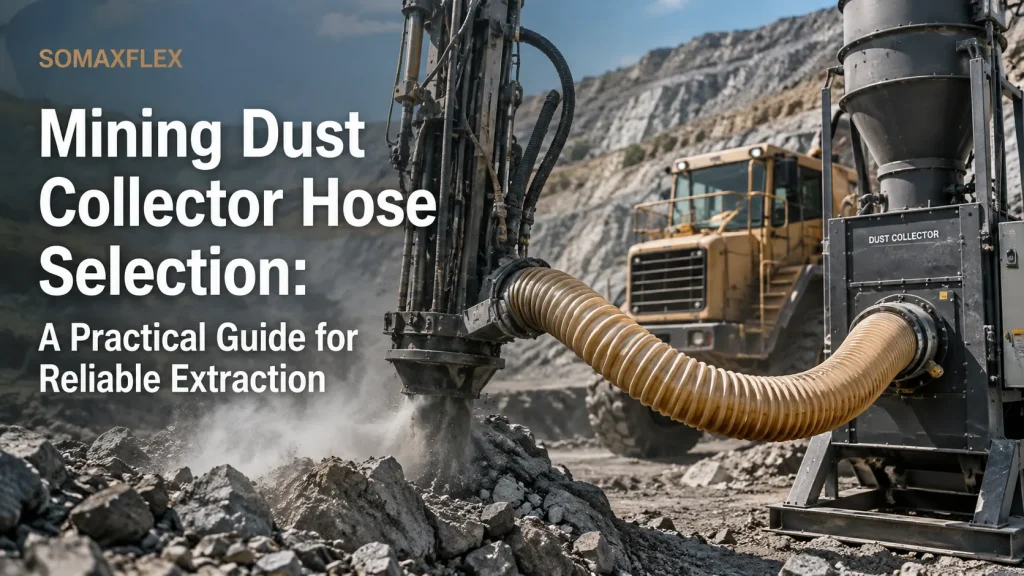
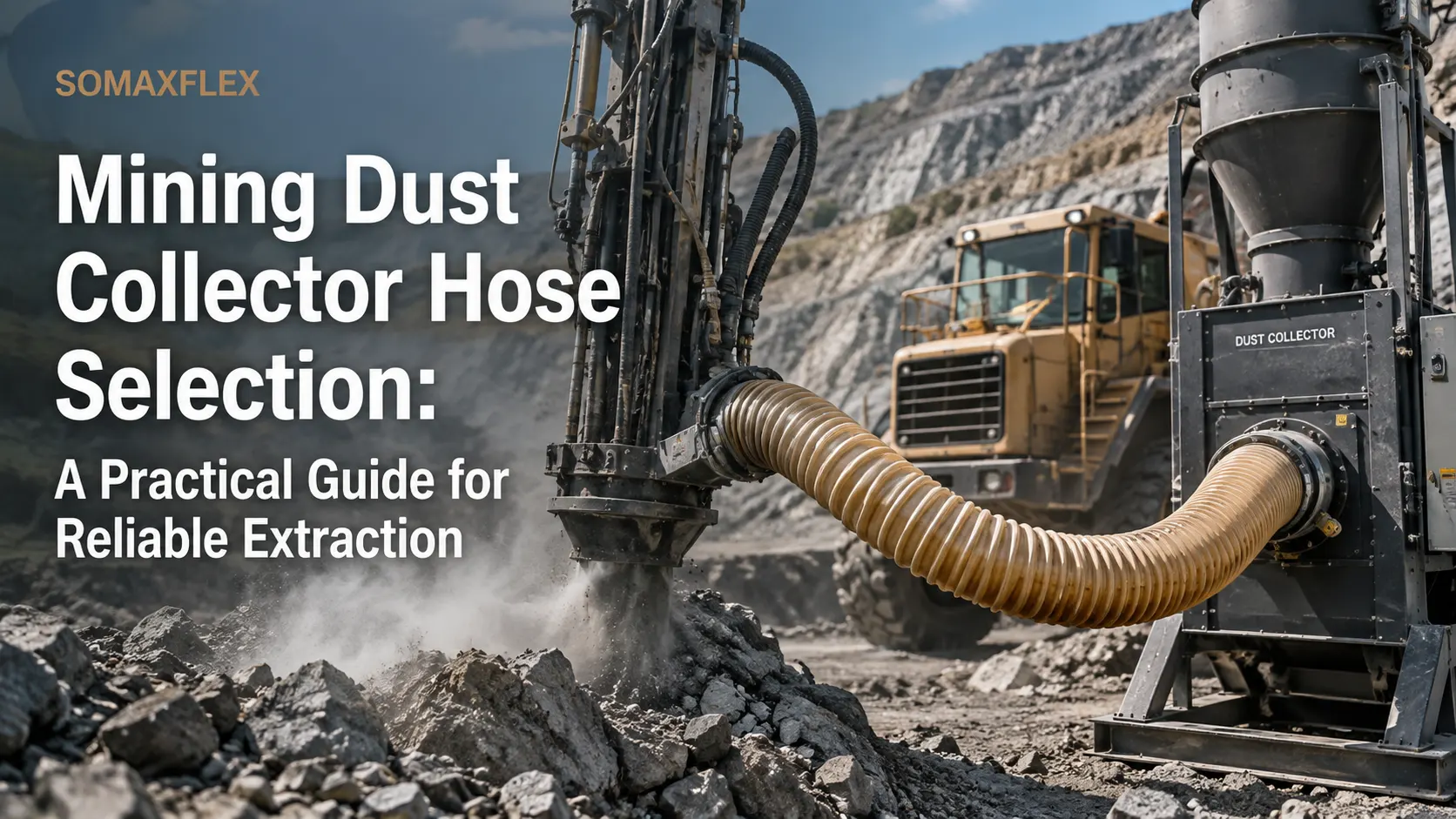
Mining dust collector hose selection is a system decision, not a simple diameter purchase. The hose must carry the expected dust without excessive wear, stay open under suction, tolerate the mine environment, and connect to the collector and tooling without leaks. Start with the dust stream and operating conditions, then verify inside diameter, routing, reinforcement, pressure or vacuum rating, temperature range, and end connections. This guide lays out a practical sequence for engineers, maintenance teams, and buyers. It also shows where Somaxflex’s verified Dust Collector Suction Hose 6 BAR can fit and which details still require an application check.
A useful starting point is the company’s Mining application guidance, which groups mining service around compressed air, water, abrasive materials, concrete, chemicals, drilling, crushers, rock dust, and tunneling. Those duties do not impose the same load on a hose, so a selection that works for light extraction may be unsuitable for abrasive transfer or high-pressure drilling.
Mining systems combine abrasive particles, negative pressure, vibration, impact, moisture, and long routing. A hose can fail by gradual wall wear, collapse, static-related concerns, crushed bends, loose couplings, or temperature damage even when its nominal size appears correct. The selection target is therefore the complete path from pickup point to collector, including elbows, reducers, blast gates, clamps, and inspection access.
Treat dust collection as a moving-material application. Fine rock dust may be less aggressive than coarse chips, while sharp mineral fragments can cut a tube quickly. Intermittent suction, frequent repositioning, and mobile drilling add flex fatigue. The right specification balances service life, flexibility, pressure loss, and handling weight instead of maximizing one property.
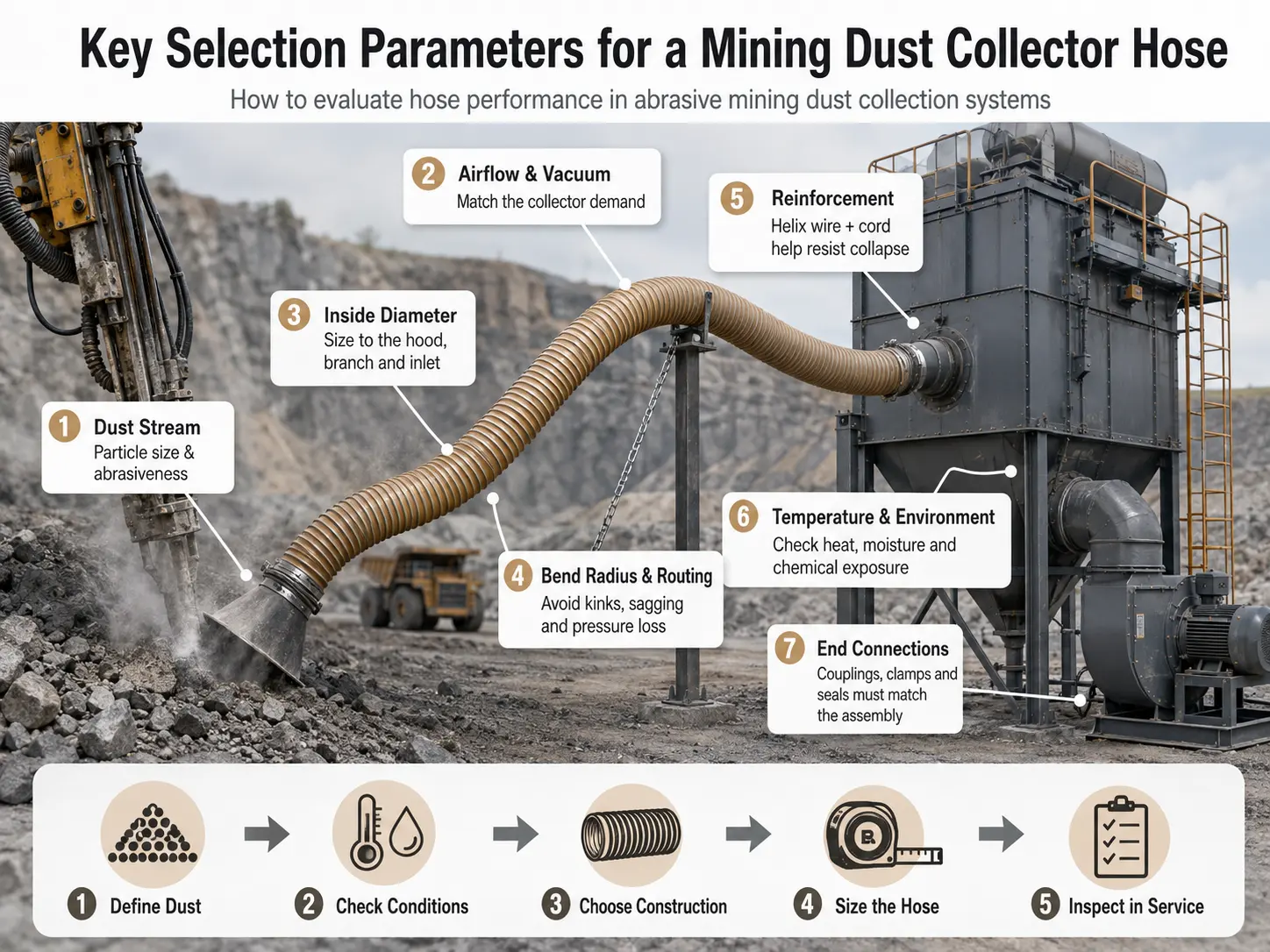
Record what the hose will convey: fine rock dust, coal dust, chips, slurry mist, fumes, or a mixed stream. Note whether particles are angular, hot, wet, or contaminated with oil or chemicals. For abrasive solids, prioritize a tube and construction intended for wear. If the stream changes by task, specify the harshest credible duty or use separate hose circuits.
A dust collector hose normally experiences vacuum, but sections near blow-off tools or pneumatic equipment may see positive pressure. Obtain the collector’s static pressure, expected airflow, and duty cycle. Ask whether the hose will hang, drag, coil, or flex at a joint. A hardwall or helix-supported construction can resist collapse, while a lighter hose may be easier to reposition; the correct choice depends on the measured duty.
Check ambient temperature, conveyed-material temperature, washdown exposure, condensation, and contact with oils, fuels, blasting residues, or process chemicals. Temperature and compatibility limits belong to the final product specification, not to a generic material label. Include seasonal extremes and heat from nearby engines, compressors, or drilling equipment.
The tube is the wear surface; reinforcement controls shape and strength. A smooth, abrasion-resistant tube can reduce snag points for particles, while synthetic cord and helix wire help a suction hose hold its form. The cover must tolerate the site: dragging, weather, impact, and contact with supports. Do not infer electrical, flame, or chemical performance unless the data sheet explicitly states it.
Corrugation can improve flexibility but may increase turbulence compared with a smooth bore. Keep bends larger than the manufacturer’s minimum radius, support long vertical runs, and prevent the hose from rubbing on sharp steel. A short, well-routed hose usually performs better than an oversized loop that sags, kinks, and collects dust.
Match the hose inside diameter to the pickup hood, branch, collector inlet, and coupling bore. A reducer may be necessary, but sudden diameter changes and long flexible runs increase pressure loss. Measure the installed route, including movement allowance, and avoid excess length. Compare the collector’s airflow requirement with the hose size rather than selecting by outside diameter or a familiar inch size alone.
Confirm whether the supplier publishes working pressure, burst pressure, and vacuum capability for the exact size. Never substitute burst pressure for a working limit. Account for startup surges, blocked filters, hose movement, and temperature derating. The coupling, clamp, and hose must be treated as one pressure boundary; the weakest component controls the assembly.
Somaxflex lists a Material Handling Hose range that includes dust collection, abrasive, bulk-material, drilling, and concrete products. This category structure is useful when a mine needs different hose duties instead of forcing one construction to serve every line.
For light dust, fumes, and light particles, the verified Tuyau d'aspiration pour dépoussiéreur 6 BAR is described as a lightweight corrugated hose. Its page specifies a tan, smooth, natural-rubber abrasion-resistant tube; high-strength synthetic cord and helix-wire reinforcement; a tan corrugated synthetic-rubber cover described as weathering resistant; and a -40°C (-40°F) to +80°C (+176°F) temperature range. Listed sizes run from 3/4 to 12 inches, with 6 bar (90 psi) working pressure and 18 bar (270 psi) burst pressure shown across the table. Verify that the exact size, vacuum duty, dust severity, and end assembly suit the mine before ordering.
For coarse or highly abrasive solids, compare the application with the full-rubber or polyurethane-lined abrasion-resistant products in the same range. Those alternatives may be more appropriate for material transfer, but the final choice depends on particle profile, pressure, temperature, and required flexibility. Treat the product names as starting points for a fit check, not as a substitute for a project specification.
Inspect the first meter near each pickup and collector inlet, where turbulence and movement are greatest. Look for thinning, exposed reinforcement, collapsed corrugations, cracked covers, loose clamps, and dust leakage at couplings. Keep the hose supported without flattening it, isolate it from hot surfaces, and remove sharp edges from contact points. After filter changes or line modifications, recheck airflow and static pressure; a new restriction can make an otherwise sound hose collapse.
Document the installed size, length, product specification, date, and duty location. A simple record helps maintenance teams replace like-for-like assemblies and identify recurring failure points. If the dust changes, the collector is upgraded, or the route is extended, repeat the selection review rather than assuming the original hose remains suitable.
Reliable mining dust collection starts with a clear description of the stream and the operating envelope. Select tube, reinforcement, cover, diameter, length, and connections as one assembly, then verify airflow, vacuum, pressure, temperature, and wear limits for the exact size. Somaxflex’s mining and material-handling range provides relevant starting points, including a documented 6 BAR dust collector suction hose, while application-specific confirmation remains essential. For an RFQ, send the model or drawing, dimensions, material handled, operating conditions, quantity, and end-connection details to contact the technical team.
Only after checking abrasion, vacuum, temperature, routing, and connection requirements. Consumer or light-duty hose may not tolerate angular mineral particles, vibration, or continuous service.
No. Diameter must match the collector airflow, pickup geometry, and system pressure. An oversized or unnecessarily long hose can reduce conveying velocity and add handling problems.
Provide inside diameter, length, dust description, airflow or vacuum, temperature, movement, connection details, quantity, and any required electrical or chemical properties that must be verified.
Replace it when wear, leaks, collapse, damaged reinforcement, or end deterioration can no longer be controlled. Use inspection records and measured performance to set a site-specific interval.