
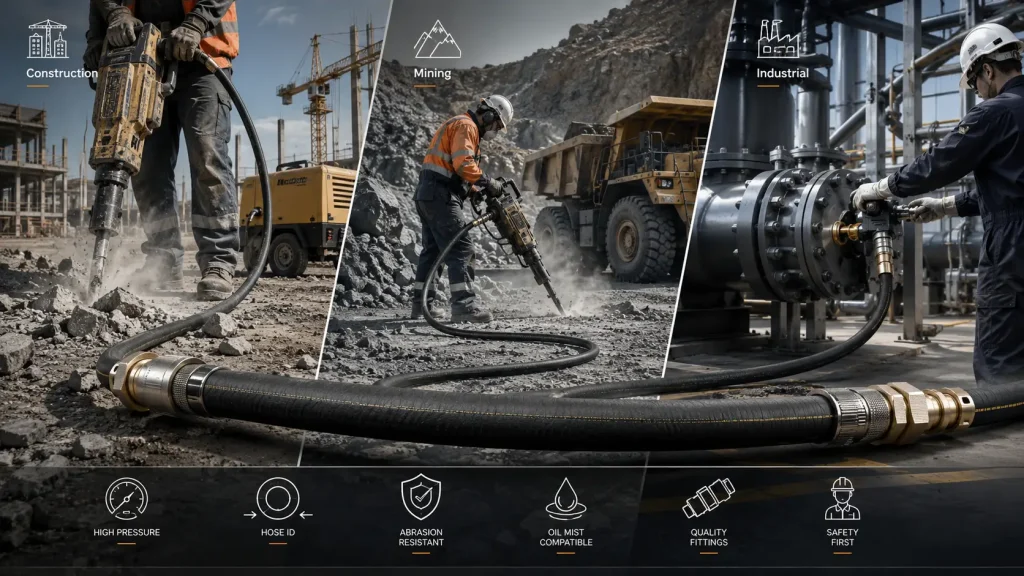
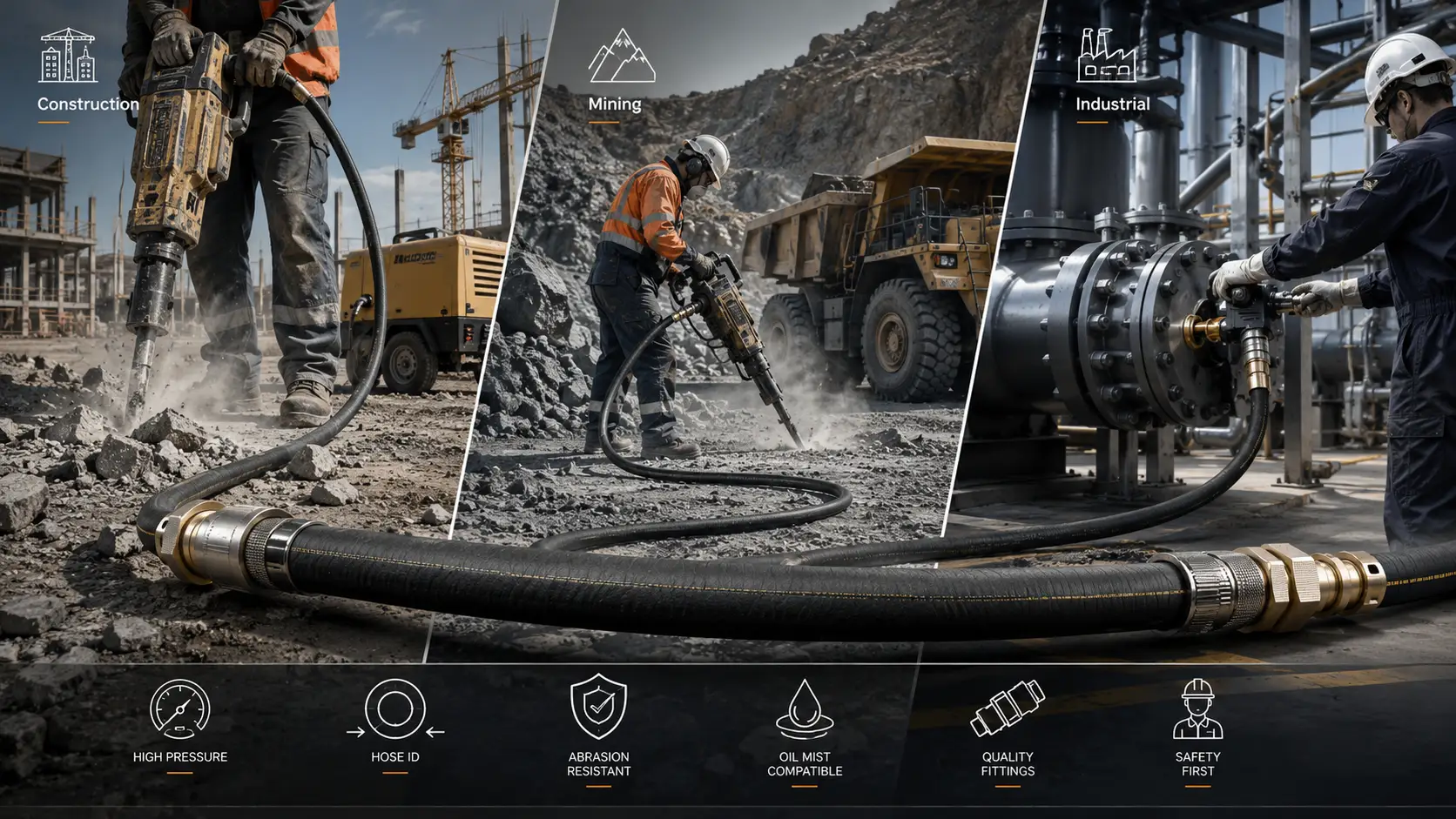
Choosing an air hose for construction sites, mines, or heavy-duty industrial work requires more than checking pressure or selecting a product labeled “heavy duty.” A suitable hose must deliver enough air to the tool, tolerate oil mist and outdoor exposure, withstand repeated dragging, and remain compatible with its fittings and restraints.
The correct specification depends on the tool’s air demand, hose length, working pressure, reinforcement, tube compound, cover, connection method, and jobsite risks. A higher pressure rating does not automatically mean better airflow, abrasion resistance, or suitability for every application.
| Application | Main operating risks | Specifications to confirm first |
|---|---|---|
| Construction and demolition | Dragging, sharp edges, weather, frequent movement | ID, length, pressure, cover, fittings |
| Quarry and rock drilling | Oil mist, rock abrasion, continuous high airflow | Tube compound, ID, reinforcement, coupling bore |
| Open-pit mining | Long runs, outdoor exposure, moving equipment | Cover, pressure, restraints, protective routing |
| Underground mining | Fire, static electricity, restricted space, local rules | Application-specific safety data and compliance |
| Factory maintenance | Oil mist, reels, fixed routing, regular inspection | ID, bend radius, tube, cover |
| Equipment rental | Mixed tools, misuse, repeated handling | Clear markings, flexible specification, inspection plan |
After defining the jobsite and operating risks, buyers can compare suitable constructions in the SOMAXFLEX industrial air hose range. The product category includes smooth and wrapped 20 bar options, multipurpose hose, and steel-wire-reinforced air hose for different industrial requirements.
Construction air hoses may supply breakers, jackhammers, air drills, chipping tools, and other equipment that consumes more air than small workshop tools. A hose can physically connect to the equipment and still restrict performance if its internal diameter or fittings are too small.
The outer cover must also tolerate dragging over concrete, contact with scaffolding, sharp edges, weather, and repeated movement. Before purchasing, confirm the tool’s air consumption, expected hose distance, normal pressure, possible pressure peaks, and whether the hose will be moved continuously or installed along a defined route.
A textile-reinforced hose may be appropriate for many general construction applications when its pressure and airflow capacity match the equipment. It should not be selected solely because the cover looks rugged or the product name contains “contractor” or “construction.”
Rock drills and continuous pneumatic equipment require stable airflow over extended operating periods. Long hose runs, restrictive couplings, or insufficient ID can cause pressure loss at the tool, even when the compressor gauge appears normal.
Lubricated compressors may introduce light oil mist into the air stream. In that case, the inner tube should be verified for the actual compressed-air condition. External requirements are different: rock, dirt, repeated dragging, and vehicle movement affect the cover rather than the tube.
The SOMAXFLEX 20 bar wrapped air hose for construction and mining is listed for compressed air containing light traces of oil mist. Its published applications include road construction, quarries, mines, air drills, and pneumatic tools. The product uses an SBR tube, synthetic-cord reinforcement, and a wrapped EPDM cover described as resistant to weather and ozone.
Suitability still depends on hose ID, length, tool demand, temperature, fittings, and the complete assembly rating.
An ordinary mining air hose is not automatically appropriate for underground or potentially hazardous locations. Some applications may require documented fire resistance, antistatic behavior, conductivity, or other properties established by the site and applicable local rules.
The purchasing team should separate underground mining from quarry and open-pit applications during the RFQ process. Ask for product-level documentation rather than relying on color, appearance, or a broad “mining hose” description.
When a project has special fire or electrical requirements, provide the mine type, transported medium, pressure, hose dimensions, installation method, and applicable standard or site specification. A supplier should confirm whether a dedicated product is required instead of treating a general construction hose as an acceptable substitute.
Textile reinforcement can provide a practical combination of flexibility, weight, and pressure support for many construction tools and industrial compressed-air applications. A 20 bar hose may offer sufficient pressure capacity when the system’s normal and peak conditions remain within the published product rating.
However, the compressor outlet reading is not the only value to check. Pressure loss along a long hose, restrictive fittings, temperature, and tool demand can all influence performance at the point of use.
Buyers should verify working pressure rather than relying only on burst pressure. They should also confirm that the tube, cover, fittings, clamps, and restraints suit the operating environment. A 20 bar label does not indicate the hose ID, flow capacity, oil compatibility, or abrasion performance.
Steel-wire reinforcement may be appropriate when the verified system pressure exceeds the range of a textile-reinforced product or when the application requires a construction specifically designed for higher pressure.
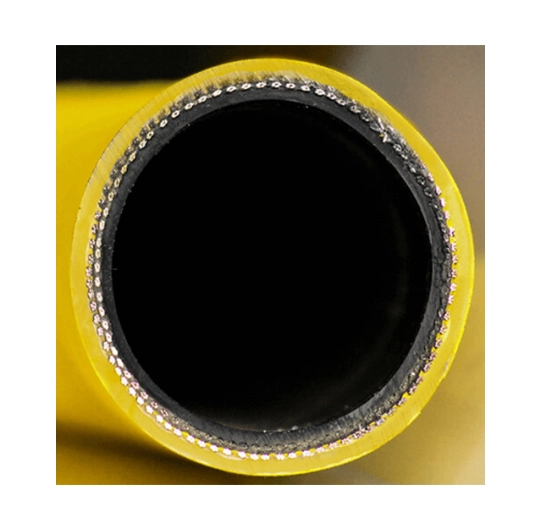
SOMAXFLEX lists a 40 bar steel wire reinforced air hose with an NBR tube, high-tensile steel-wire reinforcement, and an EPDM cover described as resistant to weather and ozone. The published pressure varies by hose size, so the selected diameter must be checked against the individual specification.
Steel wire also changes weight, flexibility, bending behavior, and assembly requirements. It should not be selected simply because the jobsite is abrasive. Higher pressure capability does not automatically improve airflow or protect the cover from sharp rocks.
An air hose does not operate independently. Fittings, clamps, valves, filters, couplers, restraints, and the tool inlet form one compressed-air assembly.
OSHA’s construction standard states that manufacturers’ safe operating pressures for hoses, pipes, valves, filters, and other fittings must not be exceeded. It also requires pneumatic power tools to be positively secured to the hose or whip to prevent accidental separation.
For procurement purposes, confirm:
A higher-rated hose cannot compensate for an unsuitable fitting or improvised clamp.
Hose ID and length determine how easily air can reach the tool. High-consumption tools, long runs, and continuous operation are more sensitive to restrictions than small intermittent tools.
Use the tool manufacturer’s stated air consumption and required inlet pressure as the starting point. Then calculate the practical distance from the supply to the tool, including reels, whip hoses, and extension sections. The smallest internal passage—often a fitting or coupler—can limit the entire system.
If a tool feels weak, test it with a shorter serviceable hose or a larger ID assembly before increasing compressor pressure. Outside diameter and thread size do not reliably indicate airflow capacity.
A dedicated size guide should handle detailed 1/4-, 3/8-, and 1/2-inch comparisons. This application guide should instead help buyers recognize when distance and tool demand require a separate airflow review.
Oil mist affects the inside of the hose, so the inner tube—not the cover—must be compatible. Symptoms of an unsuitable tube may include softening, swelling, cracking, or premature deterioration.
“Rubber air hose” is not a complete compatibility statement because different rubber compounds respond differently to oil, heat, weather, and other exposure. Ask the supplier to identify the tube material and confirm that the product is intended for compressed air containing the expected level of lubricant carryover.
When replacing a failed hose, provide a sample or photographs, compressor type, operating temperature, time in service, and information about visible internal or external damage. This helps distinguish oil incompatibility from overheating, excessive pressure, or mechanical wear.
The outer cover protects the reinforcement from environmental and mechanical damage. On construction and mining sites, abrasion can come from continuous ground dragging, one sharp edge, vehicle contact, or repeated movement against equipment.
The damage pattern should guide the solution. A single worn area often indicates poor routing, while broad wear along one side may indicate unsuitable dragging conditions. Protective sleeves, guides, supports, or a changed route can sometimes prevent failure more effectively than changing the hose alone.
Outdoor use also requires verification of temperature, ozone, and weather resistance. High-visibility colors can help workers identify air lines and avoid vehicle contact, but color is not a performance rating.
A large hose connected through a small-bore coupling can still restrict airflow. Confirm the coupling profile, internal bore, thread standard, pressure rating, and compatibility with the tool.
Construction vibration and hose movement also increase the consequences of accidental disconnection. OSHA requires positive means to prevent pneumatic tools from separating from the hose. For hoses exceeding 1/2-inch ID that supply pneumatic tools, the construction standard also requires a safety device at the source or branch line to reduce pressure if the hose fails.
Requirements vary by country and site, so the assembly should also be checked against local regulations, contractor rules, and the tool manufacturer’s instructions.
Inspect hoses before use and remove visibly unsafe products from service. OSHA expressly requires pre-use inspection of compressed-air hose in covered shipyard operations, reflecting a sound maintenance principle for other industrial settings as well.
Replacement should be considered when the hose shows:
Before installing the replacement, correct sharp edges, tight bends, pulling loads, unsuitable clamps, or excessive movement. Otherwise, the new hose may fail in the same location.
A useful RFQ should state:
Le SOMAXFLEX industrial hose website organizes air hose separately from hydraulic, material-handling, chemical, and other hose types, helping buyers avoid selecting a similar-looking product intended for a different medium.
A supplier should ask about the application before recommending a pressure rating. Product information should clearly identify the tube, reinforcement, cover, dimensions, working pressure, temperature range, and intended service.
SOMAXFLEX presents multiple air hose constructions rather than positioning one product as suitable for every jobsite. For bulk or custom inquiries, compare the supplier’s ability to review operating data, discuss dimensions and markings, match fittings, and document product limitations.
A technically useful quotation should reflect the submitted operating conditions. It should not be based only on color, price, or a generic “heavy-duty” description.
Construction, mining, and heavy-industrial air hoses should be selected as complete assemblies. Start with tool airflow, working pressure, length, oil mist, abrasion, weather, fittings, and safety requirements. Use steel-wire reinforcement only when the verified pressure and application justify it, and treat underground mining as a separate technical review.
For a specification assessment, submit the tool type, CFM, pressure, hose dimensions, length, environment, connection details, quantity, and failure photographs through request an air hose specification review.
Q1: What type of air hose is used on construction sites?
A: Construction sites commonly use reinforced rubber air hoses selected for the tool’s airflow, pressure, hose length, oil-mist exposure, abrasion, weather, and fitting requirements. “Construction hose” alone is not a complete specification.
Q2: What air hose is suitable for mining and rock drills?
A: Rock-drill and mining applications often require adequate ID for continuous airflow, an oil-mist-compatible tube, a cover suited to dragging, and correctly rated couplings. Underground applications may require additional safety properties.
Q3: Is a 20 bar air hose enough for a jackhammer?
A: It may be, provided the hose working pressure, ID, length, couplings, and airflow capacity match the tool and system. The tool manual and product specification should be checked before selection.
Q4: When should a steel-wire-reinforced air hose be used?
A: Evaluate steel-wire reinforcement when verified operating or peak pressure exceeds the suitable range of a textile-reinforced hose, or when the specified application requires that construction. Consider the added weight and reduced handling flexibility.
Q5: Do construction air hoses need safety restraints?
A: The requirement depends on applicable regulations and the assembly. OSHA requires positive means to prevent pneumatic tools from accidentally disconnecting and specifies additional protection for certain larger-ID hoses supplying pneumatic tools.