
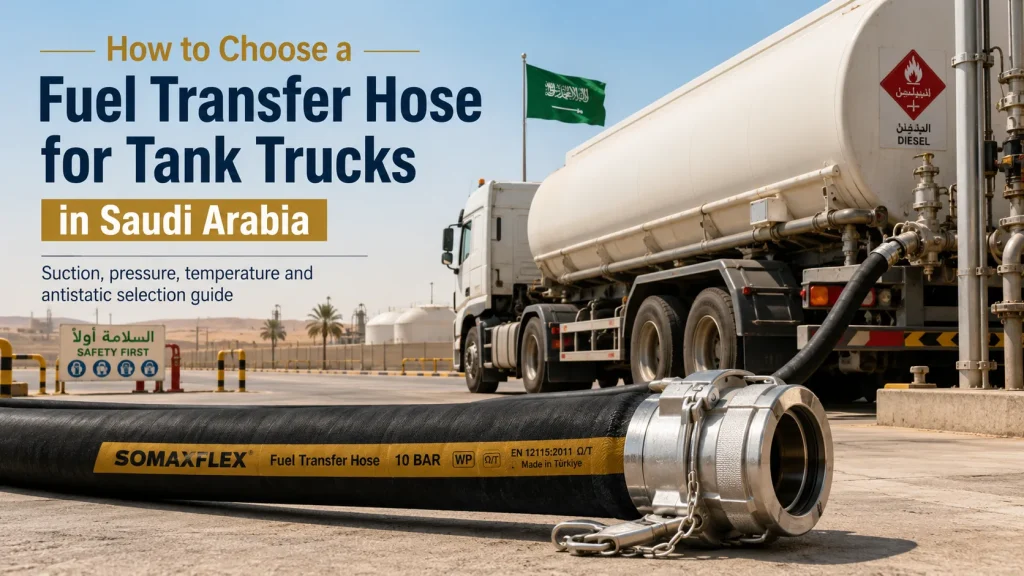
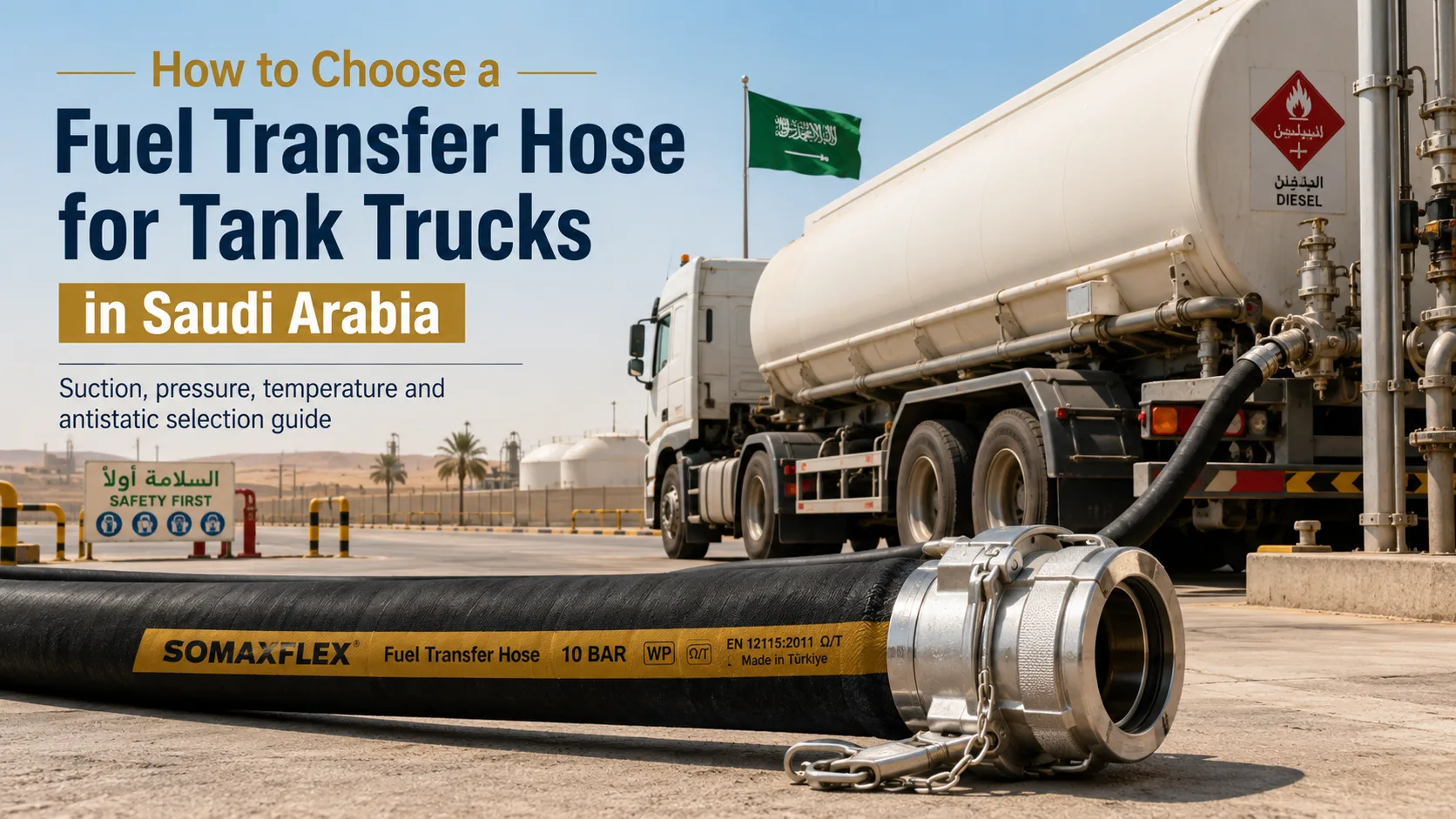
For a tank-truck operator in Saudi Arabia, the right fuel transfer hose is a duty-specific safety component, not a generic length of rubber. The correct choice must match the fuel, suction or discharge mode, working pressure, vacuum demand, connection size, temperature range, antistatic strategy and daily handling pattern. This guide explains how to turn those operating facts into a hose specification and where SOMAXFLEX tank-truck products may fit.
Begin with a flow map: where does the product come from, where does it go, and when does the hose see suction? Loading from a bottom outlet, unloading to a storage tank and transferring between compartments can impose different bending, vacuum and coupling loads. A hose used only for gravity discharge may not need the same construction as one that must remain stable under pump suction. Record whether the line is used for loading, unloading, recirculation, draining or emergency transfer, and whether the truck operates on paved depots, remote oil-field roads or mixed routes across the Gulf.
Fuel compatibility starts with the product list, not the word diesel on a purchase order. Gasoline, diesel, kerosene, lubricating oil, blended fuels and products containing aromatic compounds can affect the tube compound differently. Ask the terminal or fuel supplier for the product family, aromatic content, additives and cleaning fluids that may contact the hose. Also confirm whether the hose will carry water or glycol during maintenance; cross-service use can change the material decision and cleaning procedure.
SOMAXFLEX’s tank-truck hose information identifies NBR as the tube material and describes service for petroleum fuels with aromatic content up to 50 percent. That is a useful starting point for a fuel-transfer specification, but the exact product, temperature, concentration and assembly should still be checked against the selected product document. For a broader comparison, review the company’s Oil Hose product category and keep fuel service separate from general-purpose oil or hydraulic service.
Working pressure is only half of the hydraulic question. Tank-truck lines can experience positive pressure during pump-assisted delivery and negative pressure during suction, blocked vents or a collapsing flow path. Specify maximum working pressure, pump pressure, surge conditions and the required vacuum rating as separate fields. Do not assume a pressure-only delivery hose can tolerate full suction.
SOMAXFLEX lists a Tank Truck Hose 10 BAR construction for heavy-duty suction and discharge service, with antistatic features, helix wire and a stated 3:1 safety factor. Its published size table includes 2 to 6 inch nominal bores and 10 bar working pressure. The Tank Truck Hose 10 BAR specification can help an engineer shortlist dimensions, but the final selection must reflect the truck’s actual pump and vacuum conditions.
Select bore size from the required flow rate and allowable pressure loss, then verify that the hose can physically route without a sharp bend. A larger bore may reduce velocity and loading time, but it can add weight and make manual handling harder. Measure the truck outlet, reel, swivel and manifold dimensions; identify whether the connection is threaded, flanged, cam-and-groove or a custom adapter. Record the required cut length and minimum bend radius, including extra length for suspension movement and thermal expansion.
Saudi fleets often combine high ambient heat, intense solar exposure, dust, long road distances and frequent coupling cycles. Temperature at the hose surface can exceed the air temperature when a parked truck is exposed to direct sun, while night-time desert routes can be much cooler. Specify the expected fluid temperature and storage conditions, then verify the product temperature range. Protect the cover from abrasion against chassis rails, and prevent dragging over sharp aggregate or contaminated loading bays.
When routes include refrigerated products, winter export movements or cold-room service, a low-temperature tank-truck construction may be more appropriate than a standard fuel hose. SOMAXFLEX lists a Manguera para camión cisterna de baja temperatura 10 BAR option; treat the stated temperature range as a selection input to verify, not as permission to exceed the product specification.
A practical shortlist should show what changes between constructions and why. Use the table below as a procurement discussion tool, then request the current drawing and specification for the selected model.
| Construcción | Typical duty | What to verify | SOMAXFLEX reference |
| 10 BAR hardwall | Routine petroleum suction and discharge | Bore, vacuum, pressure, antistatic path | Manguera para camión cisterna de 10 BAR |
| 20 BAR hardwall | Higher-pressure loading or oil-field transfer | Pump surge, coupling rating, bend radius | Manguera para camión cisterna 20 BAR |
| Low-temperature 10 BAR | Cold-route or refrigerated service | Minimum temperature and flexibility | Manguera para camión cisterna de baja temperatura 10 BAR |
| Corrugated antistatic | Paraffinic fuel and tight routing | Aromatic content, small bend radius, bonding | Antistatic-Corrugated Fuel Oil S&D 10BAR |
Fuel transfer creates a static-electricity question that must be addressed in the hose, couplings and truck bonding procedure. Confirm whether the design uses an antistatic wire, conductive tube, conductive cover or another documented path, and define how continuity will be checked after assembly. SOMAXFLEX product information identifies antistatic wire or antistatic construction on its fuel hose options. That confirms the feature exists in the range; it does not replace a site-specific continuity test or the terminal’s own safety procedure.
The cover must also tolerate the real handling environment. Look for resistance to oil, weather, ozone and abrasion when those properties are confirmed for the model. A corrugated cover can improve flexibility and kink resistance, while a smooth cover may be easier to clean. Select based on routing, dragging risk, cleaning method and inspection access rather than appearance alone.
Inspect the hose before each shift and after any event that could damage the assembly. Check for cover cuts, exposed reinforcement, blistering, permanent kinks, flattened sections, coupling movement, damaged gaskets and unreadable identification. During scheduled maintenance, check continuity where required and inspect the bore for swelling or soft spots. Remove a hose from service when damage, chemical attack or uncertainty exceeds site criteria.
Keep an asset record with the hose model, size, coupling details, service limits, inspection dates and replacement reason. This turns recurring failures into evidence for improving routing or specification.
A useful RFQ gives the supplier enough information to make a fit check without guessing. Include the fuel names and aromatic content, temperature range, working and surge pressure, suction or vacuum requirement, bore and length, minimum bend radius, connection drawings, antistatic requirement, cover environment, quantity, delivery location and any terminal or fleet acceptance criteria. Ask for a dimensional drawing, material description, test or inspection records that are available for the selected model, and clear identification of what remains conditional on final assembly.
SOMAXFLEX manufactures and exports industrial rubber hoses and lists tank-truck, oil and antistatic fuel options across its product range. For a model-specific fit check, use the Tank Truck Hose 20BAR product page when the application requires the higher-pressure construction, and contact the technical team with the operating data rather than requesting a generic fuel hose.
Choosing a fuel transfer hose for tank trucks in Saudi Arabia is a matter of matching the complete duty envelope: fluid chemistry, suction and discharge mode, pressure, vacuum, bore, bend radius, temperature, static control and outdoor handling. A documented RFQ and an asset-level inspection record reduce compatibility errors and make replacement decisions repeatable. Start with the operating facts, compare only constructions that meet them, and verify the final assembly against the current product specification.
It may be suitable when the complete system stays within the hose’s working pressure and vacuum limits. Confirm pump pressure, surge, suction and coupling ratings before approval.
Common nominal bores vary by truck, pump and loading system. Measure the existing connection and calculate flow requirements instead of assuming a standard size.
Aromatic compounds can affect elastomer swelling and service life. Confirm the fuel composition and select a tube compound whose documented compatibility covers that service.
No. Hose construction, coupling continuity and the truck or terminal bonding procedure work together. Follow the site’s documented safety checks.