
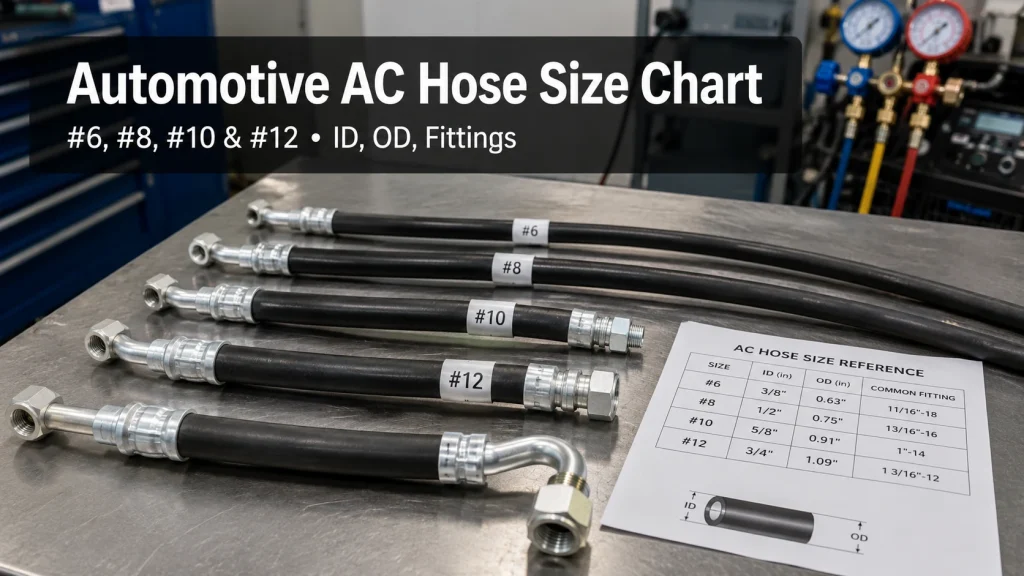
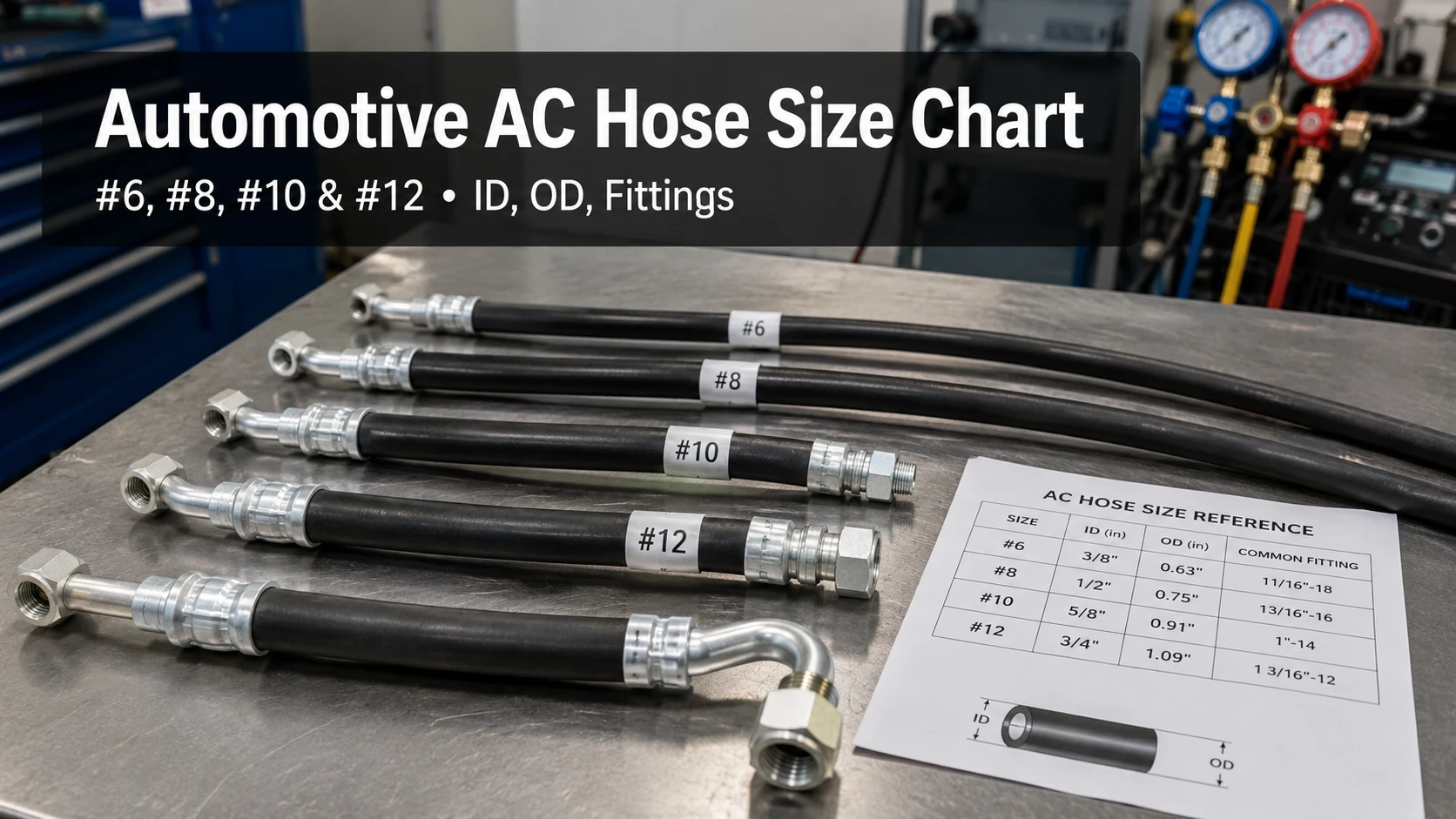
An automotive AC hose size chart is useful only when it separates nominal hose size, actual inside diameter, outside diameter, and fitting compatibility. A #8 hose is commonly associated with a 13/32-inch ID, but that does not mean every #8 hose uses the same OD, ferrule, fitting stem, or coupling procedure. For B2B buyers, the correct replacement must also match the refrigerant, hose construction, operating conditions, and applicable SAE requirements.
Automotive refrigerant hose is commonly identified by #6, #8, #10, and #12 designations. These are industry size references associated with the hose bore, not direct inch measurements.
| Nominal Hose Size | Diámetro interior común de la manguera | Approximate Metric ID | Additional Checks |
|---|---|---|---|
| #6 | 5/16 in. | 8 mm | Hose series, OD, and fitting |
| #8 | 13/32 in. | 10 mm | Barrier construction and ferrule |
| #10 | 1/2 in. | 13 mm | OD, bend radius, and fitting family |
| #12 | 5/8 in. | 16 mm | Installation space and connection system |
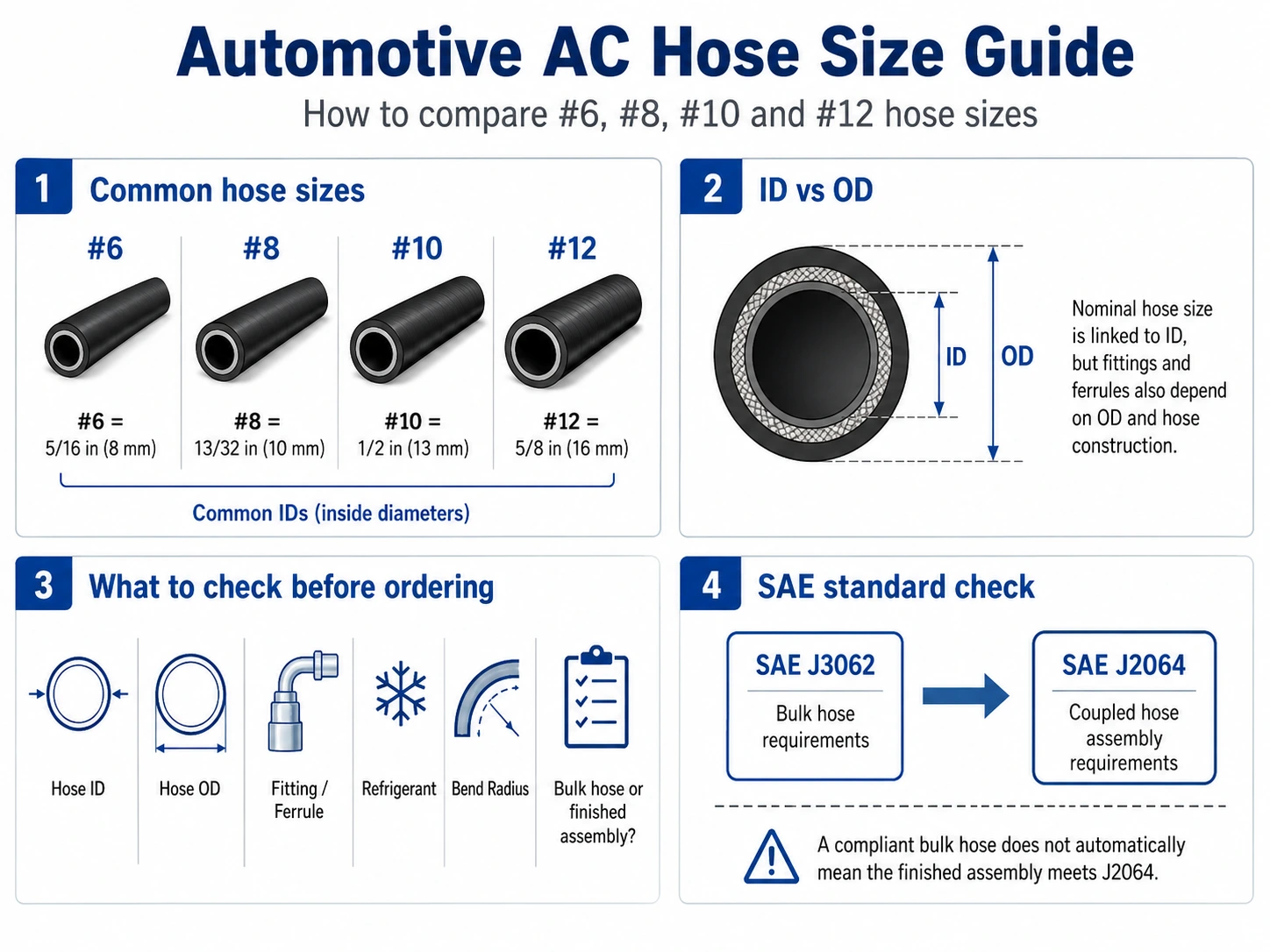
Industry dimensional guidance identifies #6, #8, #10, and #12 automotive AC hose with 5/16-, 13/32-, 1/2-, and 5/8-inch IDs respectively. It also warns that hose outside diameter can vary significantly and should not be used alone to identify nominal hose size.
Inside diameter describes the primary refrigerant passage, while outside diameter reflects the tube, barrier, reinforcement, cover, and total wall thickness. Two hoses may therefore share the same nominal ID but require different ferrules, fittings, or routing space.
The SOMAXFLEX Type E automotive air conditioning hose specifications illustrate this issue. The published table includes two 13 mm ID versions with listed ODs of 23.0 mm and 25.4 mm, together with wall thickness, working pressure, burst pressure, bend-radius, and permeability data. Buyers should identify the exact product specification rather than order only by “#10” or “1/2-inch AC hose.”
A smaller OD may be useful in tight vehicle routing, but it is not automatically interchangeable with a thicker hose. The stem geometry, ferrule, coupling process, pressure requirement, and product validation must all match the selected construction.
Replacing a hose becomes more difficult when the layline has worn away, the hose has become oval near a clamp, or the assembly contains both rigid metal tube and flexible hose.
Flexible automotive refrigerant hose is generally identified by nominal size and ID, while rigid tube sections are commonly identified by OD. Fitting threads and hose stems are separate measurements. A 1/2-inch hose ID does not imply a 1/2-inch fitting thread or metal tube.
Begin by recording every visible size, standard, refrigerant reference, and product code on the layline. Measure the hose OD at an undeformed section. If a removed sample can be inspected safely, confirm its ID. Record the metal tube OD, fitting configuration, sealing method, and assembly orientation separately.
When markings are missing, submit photographs with a caliper in view, the overall assembly length, fitting angles, and metal tube measurements. Do not identify the hose only from whether it appears on the high or low side of the system. Line position is useful context, but it is not a dimensional specification.
Correct ID is only the first requirement. The connection must also match the hose OD, wall structure, barrier design, reinforcement, and approved coupling procedure.
A nominal #8 designation confirms a common bore category, not a universal fitting system. Industry fitting guidance notes that beadlock-style fittings may be intended for a particular hose construction and must be paired with compatible hose dimensions.
A stem designed for one #8 hose may have the wrong interference fit in another. A ferrule sized for a larger OD may not retain a reduced-OD hose correctly, while a smaller ferrule can over-compress or damage a thicker construction. These mismatches can contribute to leakage, pull-off risk, restricted flow, or premature hose failure.
Before purchasing bulk hose or replacement components, provide the exact hose series, measured ID and OD, fitting part number or drawing, ferrule type, and intended assembly method. A nominal number alone is insufficient.
Inspect the fitting stem, sealing surfaces, O-ring groove, threads, tube section, and any area previously compressed by a ferrule. Corrosion, scratches, deformation, damaged sealing grooves, or unidentified components make reuse difficult to justify.
Reuse also requires confirmation that the fitting belongs to the new hose family and assembly procedure. A fitting that worked with standard barrier hose may not be appropriate for reduced barrier hose of the same nominal size. When validated coupling information is unavailable, replacing the connection with a documented compatible component is the more controlled decision.
Buyers frequently use SAE J2064 and SAE J3062 as though they describe the same product. Their scopes are different.
SAE J3062 covers automotive refrigerant air-conditioning hose. Its current scope includes hose intended for R-134a, R-152a, and R-1234yf systems, and it separates bulk-hose requirements from the coupled-assembly requirements covered by SAE J2064.
SAE J2064 covers factory- and field-coupled automotive refrigerant hose assemblies. SAE states that a hose meeting J3062 does not by itself mean that the completed assembly meets J2064. The assembly manufacturer is responsible for confirming that the coupled assembly satisfies the applicable acceptance criteria.
An inquiry for “SAE J2064 hose” should therefore clarify whether the buyer requires bulk hose, a completed coupled assembly, or both. Bulk-hose documentation cannot automatically serve as assembly-level evidence.
Correct size does not prove compatibility with the refrigerant, compressor lubricant, temperature, permeation requirement, or vehicle specification.
The SOMAXFLEX Type E product page publicly lists R134a, R12, and R404a, a temperature range of -40°C to +135°C, and construction that may include EPDM, CSM, or IIR tube materials, a PA or nylon barrier, braided reinforcement, and an EPDM or cloth cover. It also references SAE J2064, SAE J3062, and QC/T664.
These published facts should not be expanded into a universal refrigerant claim. A standard’s scope is not proof that every product referencing the standard has been tested for every refrigerant named in it. Buyers requiring R1234yf or another refrigerant not explicitly listed on the product page should request written product-specific confirmation.
A complete specification should identify the refrigerant, compressor lubricant, operating temperature, required permeation performance, and any regional or customer standard. A correctly sized #6 or #8 hose can still be unsuitable if its material system does not match the application.
Type C and Type E should be compared through published construction and performance data rather than assumptions about pressure side or vehicle type.
Review:
A project drawing, existing sample, or customer specification should take priority over a generic Type C versus Type E rule. The supplier should state which published configuration is being quoted and which application details still require validation.
The first common mistake is confusing hose ID with metal tube OD or fitting thread size. Each measurement should occupy a separate field on drawings, inspection reports, and purchase orders.
Another mistake is selecting hose only from its high-side or low-side location. System position may provide a useful clue, but it does not replace measurements, refrigerant identification, fitting details, and the original product specification.
A third risk is mixing hose, ferrule, and fitting components from unrelated systems. Matching nominal numbers do not establish a validated assembly. The complete connection should be reviewed as one system before repair or production.
A complete RFQ enables the supplier to determine whether an existing product is suitable and which technical points remain unresolved.
Provide:
“#8 automotive AC hose” alone does not provide enough information to confirm a technically compatible product.
A supplier should clearly state the proposed hose construction, ID, OD, pressure and temperature limits, bend radius, refrigerant scope, applicable standard, and whether the quotation covers bulk hose only or additional components.
SOMAXFLEX publishes Type C and Type E products within its automotive hose product range. Its industrial rubber hose manufacturer website also provides company and product-demand fields for technical and commercial inquiries.
Requirements involving fittings, ferrules, crimping, vehicle-specific assemblies, or assembly-level testing should be confirmed in writing rather than inferred from a bulk-hose product page.
Automotive AC hose selection starts by converting #6, #8, #10, or #12 into the correct ID. The buyer must then confirm actual OD, hose construction, fitting system, refrigerant compatibility, and the applicable hose or assembly standard.
For a specification review, contact SOMAXFLEX with the hose marking, measured dimensions, refrigerant, fitting drawing, old sample or photographs, required quantity, and confirmation of whether the inquiry concerns bulk hose or a finished assembly.
A #6 automotive AC hose is commonly associated with a 5/16-inch, or approximately 8 mm, ID. Confirm the exact hose series and OD before selecting fittings or ferrules.
Nominal automotive AC hose size is generally associated with ID. OD can vary between hose constructions, so it must also be checked when selecting ferrules, fittings, and routing space.
No. A #8 designation does not confirm the hose OD, barrier construction, fitting stem, ferrule, or coupling procedure. Use components documented as compatible with the exact hose family.
SAE J3062 addresses automotive refrigerant hose, while SAE J2064 addresses coupled hose assemblies. A J3062-compliant hose does not automatically make the finished assembly compliant with J2064.
Not based on hose size or an R134a label alone. Verify that the exact hose product and completed assembly are documented for R1234yf, the compressor lubricant, and the intended coupling system.